Incident Response Plans for PHI Exposure in Automated Workflows
Automated workflows require incident plans that span all systems an agent touches, not just one.
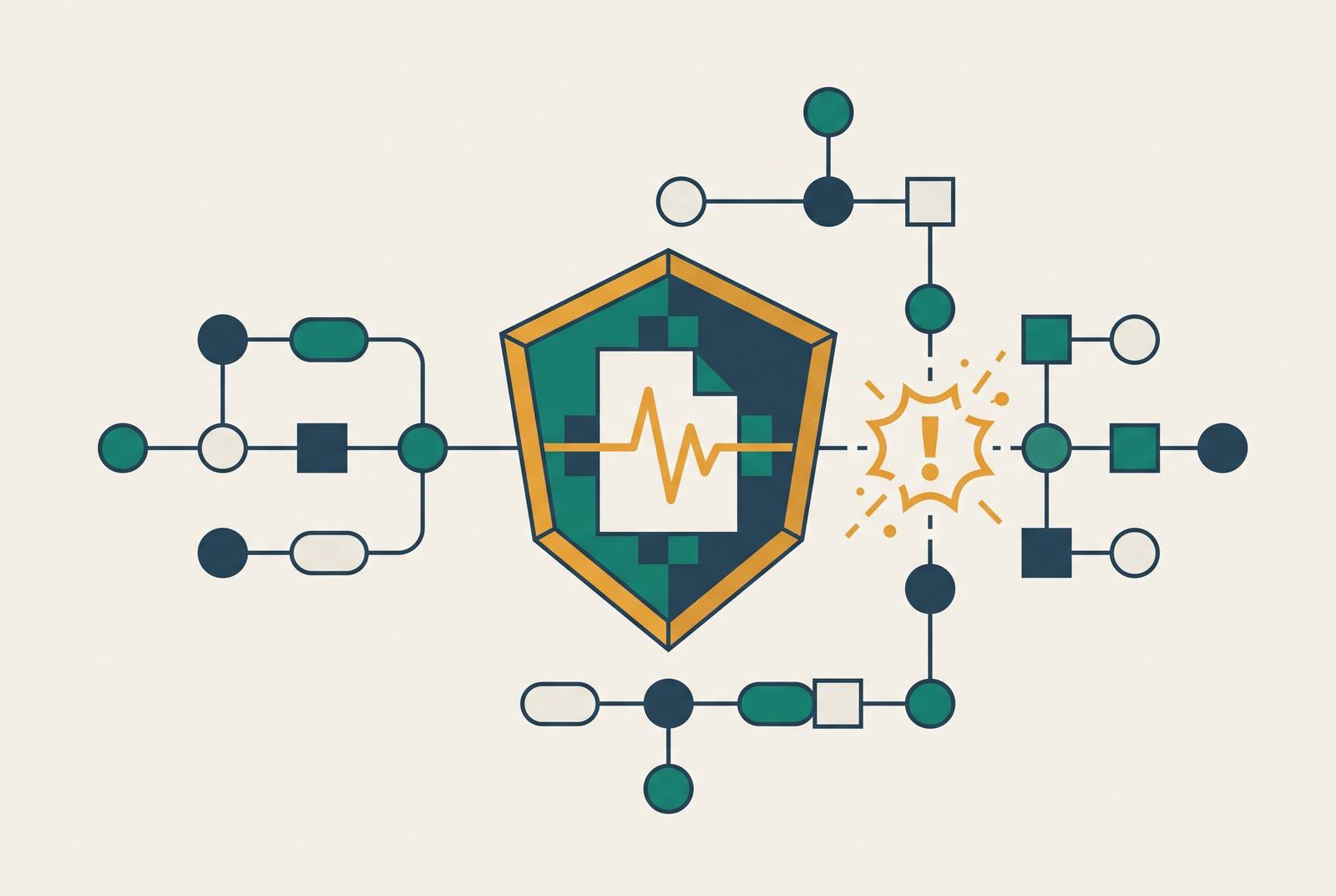
Incident response plans for PHI exposure in automated workflows must cover the full path of the agent, including the application where an anomaly appears. When an agent moves through EHRs, payer portals, and scheduling systems, detection, containment, notification, and recovery become cross-system responsibilities. The plan must therefore be a condition of deployment, built around documented access, data flows, vendor obligations, and session records.
Why automated PHI workflows create a different kind of exposure problem
A computer-using agent moves between applications as it works on a single administrative task. It reads screens, navigates between systems, and writes output to different destinations, leaving no single application with a complete account of its work. Traditional incident response plans tend to start from a discrete location, such as a compromised server, a misconfigured database, or a stolen laptop. For an agent session, investigators must look at the whole workflow. Isolating one application does not account for PHI already handled elsewhere.
Prior authorization shows how wide that investigation can become. The workflow can traverse eligibility checks, clinical documentation pulls, submission, status polling, denial appeal, decision update, and patient communications. Its PHI trail may span EHR access logs, payer portal sessions, scheduling records, intermediate storage, prompt logs, and screenshots. Each is a separate PHI-handling event that needs an audit, even though all belong to the same administrative task. Existing HIPAA Security Rule requirements already cover ePHI systems, but that legal floor does not supply the operational instructions for reconstructing an agent’s work across them.
How the agent's access model multiplies the PHI surface before any incident occurs
The agent’s service account largely determines the potential reach of an exposure before work begins. Broad permissions let the agent access more records than it needs for the assigned task. Unlike a human employee, whose attention and shift hours limit activity, an agent can operate continuously and at scale. With a misconfigured account, even a narrow administrative task can expose records across the organization. Across multiple locations, that same configuration can extend the problem to every site the account touches.
The access review must link permissions to a clear PHI data-flow map. That map needs to show where PHI enters, what the agent can access, where intermediate state resides, which vendors receive data, how long records remain, and where output goes. Prompts, model requests and responses, logs, traces, and screenshots belong within that boundary. Least-privilege access, scoped permissions, and just-in-time elevation with approvals reduce the records available to a future incident. Role- and attribute-based access controls, session timeouts, and tamper-evident audit logs support those limits and make them accountable.
If a vendor lacks a properly scoped Business Associate Agreement, PHI sent to its infrastructure is itself a potential breach. The agreement must cover the PHI uses the agent actually performs. The incident response plan must consequently account for subprocessors as well as the agent’s direct actions.
What the proposed HIPAA Security Rule changes require IR plans to address now
HHS OCR’s proposed HIPAA Security Rule updates give organizations a concrete reason to review plans written before mid-2025. The proposals would make encryption at rest and in transit and multi-factor authentication mandatory for ePHI systems. Under the current rule, encryption is addressable and multi-factor authentication remains unnamed, with mandatory requirements for both still at the proposal stage. Their planning significance is nevertheless immediate because they concern the systems and credentials on which automated workflows depend.
The proposed rule would require a written inventory of technology assets that create, receive, maintain, or transmit ePHI, including AI software. For an agent deployment, that inventory must account for the agent and the systems and intermediate stores in its data path, with vendor subprocessors documented as well. The proposal also calls for written procedures to restore certain relevant electronic information systems and data within 72 hours of loss. That contingency and recovery requirement leaves containment in place until an audit is complete.
CMS-0057-F adds a separate path for data that plans on the provider side must name. The rule requires payers that fall under it to put in place a FHIR-based Prior Authorization API that follows the HL7 Da Vinci PAS Implementation Guide, with a key compliance date of January 1, 2027. For agents that use this API, the response plan must cover PHI transmitted through that channel. Waiting for proposed Security Rule changes to become final does not resolve these existing documentation and response needs.
Detection: identifying a PHI exposure event when the agent touched a dozen systems
Detection starts with setting out what normal activity looks like for each workflow, agent identity, and connected system. Warning signs used for humans, including unusual hours or large volumes of access, tell less when the agent is expected to work continuously and at high volume. The meaningful deviation may instead be access to records outside the task’s scope or a system absent from the task map. Monitoring needs the deployment-time data-flow map to show what access to expect.
The audit trail must cover application logins, data access, prompts, model outputs, and administrative actions. Session-level records must capture which screens the agent read, which fields it wrote, and which external systems it queried. Immutable logs make that evidence available for reconstruction, while anomaly detection identifies volume spikes and out-of-scope access. Automated data-loss-prevention rules must also flag what looks like PHI in free text outputs, logs, and intermediate files.
Prompt injection makes it especially important to monitor output because malicious input can cause the agent to disclose data or act outside the authorized task. With Shadow AI, activity goes unlogged when staff use consumer AI tools to draft patient emails or summarize insurance questions without an agent-level log. The plan must cover that human entry point as well as approved automation.
Containment: stopping an agent workflow mid-run without leaving PHI stranded across systems
At the moment of intervention, an agent may have written partial information to a payer portal, pulled a record into an intermediate buffer, and queued a scheduling action. Halting the agent prevents further work but leaves each of those states to be audited and resolved. Containment must both halt the workflow and record which actions are finished and which are unfinished. A shutdown alone is not a containment record.
The plan needs a defined kill switch that does not depend on manually entering every downstream system. When the agent is halted, a session-state snapshot must record every system it accessed, every record it touched, and every output it wrote. That snapshot gives responders a concrete boundary for the suspect session. The agent’s credentials must then be revoked across all connected systems, including the primary EHR. Downstream systems that received data during the session must be put on hold until an audit is complete, along with the submissions, confirmations, and queue entries involved.
Restoration order must reflect those unresolved states as well as application availability. Restoring the EHR before auditing data written to a payer portal could propagate corrupted or exposed records. Vendor notification triggers and timelines must also be part of containment because stopping the agent does not stop exposure at a subprocessor. Requiring human approval before high-impact downstream writes gives the workflow a point at which to pause, so that pre-deployment control is part of the containment design.
Notification: mapping which patients, payers, and systems a cross-workflow breach must cover
HIPAA’s Breach Notification Rule requires covered entities to notify the people affected, HHS, and in some cases media outlets within set timeframes. In an agent incident, the difficult part is establishing who belongs within that scope. A single prior authorization session may touch eligibility records, supporting documentation, payer accounts, and scheduling entries for many patients. The apparent location of the anomaly therefore says little about the full affected population. Notification depends on reconstructing the exposure window across the workflow.
Investigators must cross-reference session logs with the deployment-time data-flow map. The map shows the record sets available at each step, while the logs establish what the suspect session actually touched. EHR access records alone leave out PHI that may be in screenshots, intermediate buffers, and prompt logs. Those artifacts must be included in the scoping process. Otherwise, a notification exercise confined to the EHR can undercount affected individuals.
If a vendor received PHI, its BAA governs when and how it must notify the covered entity, and the response plan must incorporate that timeline into its own notification process. PHI transmitted through the Prior Authorization API may also make the receiving payer a party requiring notification or a co-responsible entity, depending on the agreement’s terms. Those relationships must be documented before discovery.
Recovery: restoring agent workflows without reintroducing the conditions that caused the exposure
Recovery must restore the workflow’s technical components and authorize the workflow again. A backup cannot correct an over-broad service account or supply missing BAA coverage. Root cause review must distinguish among misconfigured access, prompt injection, vendor PHI handling failures, shadow AI activity, and credential compromise. That finding determines what must change before the agent resumes. System integrity is necessary, but it is not sufficient evidence that the workflow is safe to reactivate.
Before account reactivation, permissions must be revalidated against the defined task set, with unnecessary access removed. Any newly discovered systems or record sets must be added to the data-flow map and reviewed for further exposure. Missing or inadequate BAA coverage must be corrected before the workflow resumes. The tamper-evident logs covering the exposure window must also remain preserved and accessible for post-incident review and any regulatory inquiry.
The response plan should name the person authorized to reactivate the agent. That person should not be the individual who configures the workflow, and approval should require documented sign-off that the root cause has been addressed. If several sites use the same configuration, the incident may call for putting that workflow on hold at the other sites until the root cause is known. Recovery then becomes a governance decision about the configuration’s use, rather than a local declaration that an application is available. The post-incident review should also turn the actual failure pattern into an updated tabletop scenario.
Building the IR plan before the first agent workflow goes live
Deployment must be approved only when the materials needed for response are in place. Those materials are the PHI data-flow map, least-privilege account configuration, vendor BAA inventory, session logging architecture, and a tested workflow-halt procedure with a session-state snapshot. Their value lies in how they connect, since the access scope defines what is permitted and the logs show what occurred. The inventory also needs someone who is responsible for keeping it up to date. A plan detached from changes to the agent’s systems, permissions, or vendors cannot reliably govern an incident.
Computer-using agents can support this preparation because they operate through existing EHRs, payer portals, and scheduling tools without requiring API integrations or workflow overhauls. Their task scope can be defined before go-live without waiting for custom integrations. The same workflow configuration used to deploy the agent can produce the data-flow map needed for response planning.
Small and independent practices may have few resources for compliance, but they need the data-flow map and BAA inventory as a minimum, just as enterprises do. A vendor deploying an agent into a practice should be able to provide both during deployment. Practice administrators should then test the plan against the actual workflow configuration. The tabletop exercise should include an agent that has run for hours before detection, requiring the team to halt work, reconstruct the session, and account for PHI across every system under time pressure.