SOC 2 Type II and HIPAA Dual-Certified Vendors Serving Clinical Workflow Automation
Dual certification alone won't protect PHI without the right architecture and contracts.
Clinical workflow automation requires more than a vendor’s assurance that patient data is secure. SOC 2 Type II and HIPAA dual-certified vendors must be evaluated through the controls, contracts, and audit scope behind that claim. Those protections must cover the actual production workflow involving protected health information.
Why dual certification is the vendor evaluation bar that matters in healthcare workflow automation
Vendors describe compliance as a product attribute, but healthcare operators need evidence that a particular deployment can lawfully handle protected health information, or PHI. Encryption and access restrictions answer only part of that question. A Business Associate Agreement, or BAA, establishes the legal relationship required for a vendor handling PHI on a covered entity’s behalf. Without that agreement, technical safeguards do not remove the covered entity’s HIPAA exposure.
The next distinction is between an assertion and an audit. SOC 2 Type II evaluates controls over an extended period. Third-party assessment of HIPAA controls provides evidence beyond self-attestation, although HIPAA has no official certification. In this context, dual certification is shorthand for SOC 2 Type II assurance and independently assessed HIPAA compliance. A platform described as HIPAA-configurable still requires scrutiny because its suitability depends on which protections the product enforces and which responsibilities remain with the operator.
What SOC 2 Type II and HIPAA each require, and why their overlap is not redundant
SOC 2 Type II and HIPAA examine different dimensions of the same operating environment. SOC 2’s five Trust Services Criteria are security, availability, processing integrity, confidentiality, and privacy. A Type II audit examines the controls within its scope over the audit period, making the report evidence of both design and operating performance. HIPAA adds obligations specific to electronic PHI, or ePHI. Its Security Rule addresses Administrative, Physical, and Technical safeguards, while its Privacy Rule governs how PHI may be used and shared.
Those obligations extend beyond preventing unauthorized access. HHS’s Breach Notification Rule requires a business associate to tell the covered entity of a breach without unreasonable delay after finding it. Inside an automation product, that obligation must coexist with controls that protect data and records that support an investigation. SOC 2 assurance about operational security does not replace this PHI-specific legal responsibility. A BAA alone cannot show that controls worked as they should throughout an audit period.
Procurement requirements should make clear which protections the rules require and which are choices about how to build the system. Encryption at rest, such as AES-256, is an addressable HIPAA safeguard. For data in transit, the brief’s cited NIST SP 800-52 guidance specifies TLS 1.2 or higher, with TLS 1.3 preferred. Audit logging must support examination of ePHI activity, with tamper protection providing the stronger evidentiary record expected in enforcement. For AI workflows, the evaluation must also establish that customer data is not used for model training, where PHI resides during processing, and how autonomous agents authenticate across systems.
Where the architecture breaks down in practice and what compliant vendors often get wrong
The central failure pattern is a gap between the agreement a vendor signs and the protections its product applies. A platform may offer a BAA but leave model restrictions, access controls, and audit logging for teams to set up by hand. That arrangement places consequential decisions with the covered entity’s engineering and compliance teams. A mistake in that configuration can expose PHI even when the vendor says it meets compliance requirements. Evaluation must establish whether a control exists and who must activate and maintain it.
An enterprise-only BAA can make a nominally eligible product unavailable within an operator’s budget. Self-hosted platforms such as n8n and Flowise are usable with PHI only on BAA-covered infrastructure, placing the hosting obligation with the operator. Neither condition makes the software unsuitable in every setting. Both mean that a general compliance claim cannot establish eligibility for the deployment under consideration.
An agent crossing payer portals must authenticate securely, and its audit record must capture individual actions as well as inputs and outputs. Consumer AI that staff use without IT oversight adds a separate risk because those workflows run outside the approved architecture. Likewise, a session record cannot substitute for evidence of what an agent actually did. A vendor’s SOC 2 Type II report does not automatically extend protection to these activities, and it does not substitute for the BAA.
What a purpose-built compliance architecture looks like when it is working correctly
A purpose-built architecture makes the protected path the default. For HIPAA workloads, it automatically restricts AI processing to BAA-covered models. It also limits agent tools that expose PHI to external services, including HTTP requests and email integrations. These restrictions matter because the operator does not have to remember to apply them separately to each workflow. Annual third-party assessment and available attestation reports then provide evidence about the controls behind those defaults.
The controls must also keep working as the product changes. Heidi Health describes year-round practices in its SOC 2 Type 2 certification account, including regular access reviews, mandatory MFA, timely vulnerability patching, and comprehensive network monitoring. Internal readiness checks catch control drift during the operating period, which gives them a different role from the final audit. When incidents or deviations occur, the record must include their resolution and corrective action. Compliance maintained only around an audit window is not the operating model that Type II assurance is intended to examine.
For agents, the positive model extends to authentication, action records, and data residency. Browser-native architectures can handle MFA and CAPTCHA without storing credentials in a retrievable form. Complete, tamper-evident action trails make autonomous behavior examinable, while PHI residency controls establish where data lives during multi-step processing. The covered entity also needs its own auditable management layer, including HIPAA-to-SOC 2 control mapping, six-year log availability, BAA tracking and renewal, and role-based PHI access reviews.
How to evaluate vendors in practice and what certified platforms look like in this market
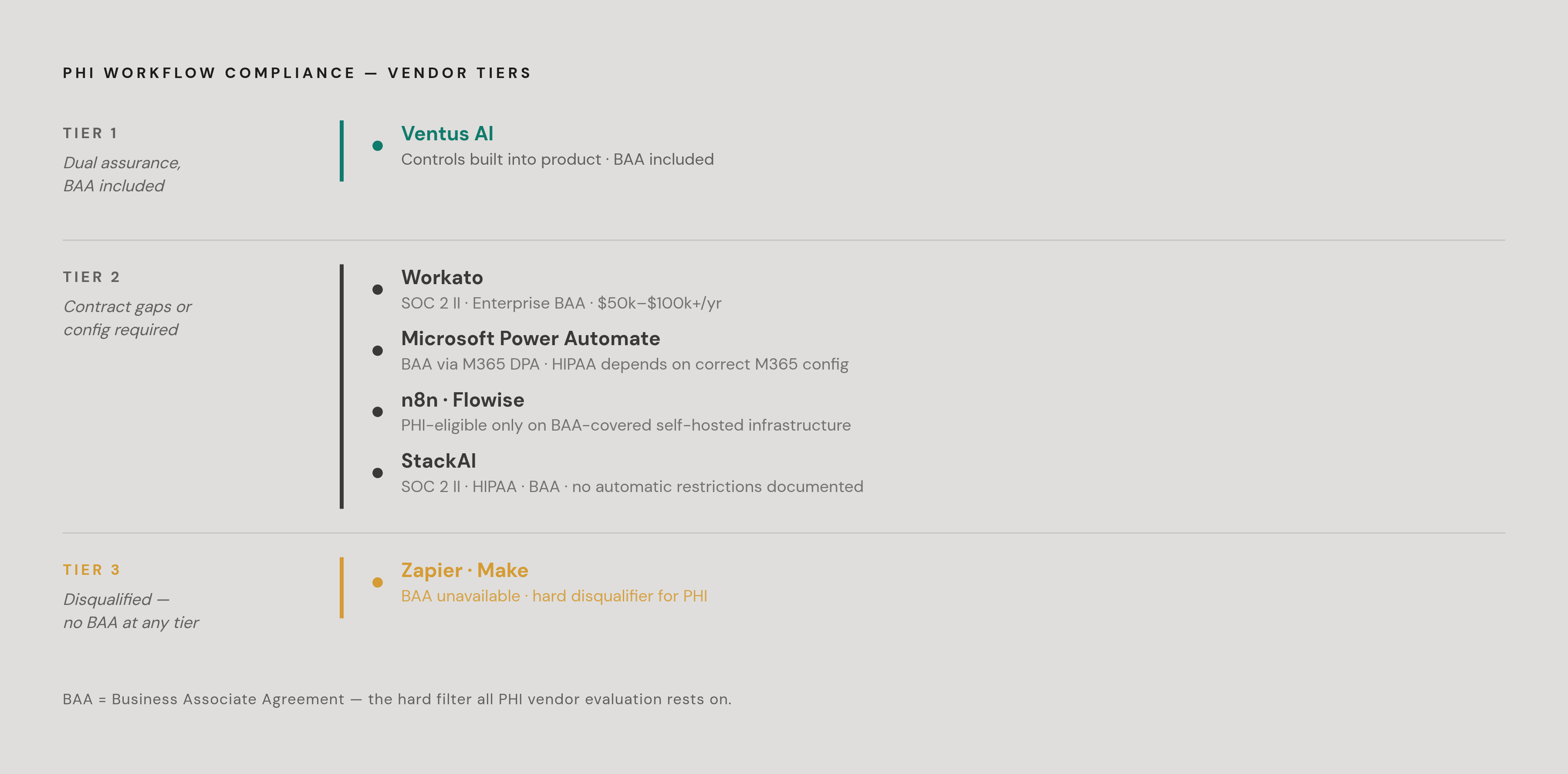
The market falls into three tiers based on the contracts vendors offer and who is in charge of the controls. The first tier has dual assurance, a BAA, and compliance controls built into the product. Its documented California healthcare deployment includes five production workflows, namely prior authorization automation, billing code extraction, disability documentation, state regulatory medical forms, and medical clearance and fitness evaluations.
Ventus AI occupies this tier through its stated SOC 2 Type II assurance, full HIPAA compliance with a BAA, and browser-native architecture for enterprise payer portal and claims automation. Its relevance is architectural rather than a reason to rank it above other platforms. Computer-use agents belong in this category when their controls cover screen-based operation as well as the vendor’s underlying infrastructure. This distinction matters for payer portals with MFA gates, non-standardized interfaces, and no direct API.
The second tier calls for a closer look at contract terms or what the operator must do. Workato offers SOC 2 Type II assurance and an enterprise BAA, with custom pricing in the five to six figures annually. Microsoft Power Automate offers SOC 2 Type II assurance and BAA coverage through the Microsoft Online Services Data Protection Addendum, with pricing from $15/user/month, but HIPAA compliance depends on correct M365 configuration. These options suit different setups, especially large organizations that have enterprise contracts or operators that already use Microsoft. For n8n and Flowise, BAA-covered self-hosting is the condition that determines PHI eligibility.
StackAI is also an option for operators looking for an AI-native agent builder. StackAI states that it is SOC 2 Type II and HIPAA-Compliant and offers BAA signing. Those credentials establish a basis for evaluation, but do not by themselves demonstrate the automatic restrictions documented for a product-enforced architecture. The third tier is simpler to resolve for PHI scope. Zapier and Make offer no BAA at any tier and therefore do not qualify for workflows involving PHI, regardless of their usefulness for other automation.
Compliance management software is a separate purchase from software that executes clinical workflows. Drata supports combined HIPAA and SOC 2 programs with 300+ integrations, while Vanta offers 400+ integrations but no BAA for direct PHI handling. Thoropass offers software and an in-house audit team in one package for organizations that want a bundled path to Type II. Censinet RiskOps places SOC 2 within healthcare third-party risk management, including PHI-scoped access reviews and BAA lifecycle tracking. Sprinto addresses early-stage digital health companies at a lower price point.
What computer-use agents add to the compliance architecture that API-based tools cannot address
The distinction between API automation and computer use becomes decisive when the workflow reaches a system without an API. Prior authorization, claim status checks, and payer portal submissions often require interaction with browser interfaces. A direct API integration cannot complete a portal step for which the payer provides no API access. Browser-automation intermediaries can expose those workflows as API-callable endpoints, but the underlying work still occurs through the interface. Computer-use agents can work across this access boundary, which a comparison of API-only tools leaves out.
That boundary also changes what the compliance architecture must cover. An agent working across an EHR, a payer portal, and third-party software reads screens and enters information through the UI layer. Its protections must cover both those actions and data stored in the vendor’s infrastructure. Ventus AI’s browser-native approach is relevant here because it applies the agent model to payer portal and claims work. For the operator, the value is the ability to work through existing systems without requiring a direct integration agreement with each payer or replacing the EHR.
When automation covers only part of the workflow, staff have to take over the steps it leaves out. Those handoffs can leave inconsistent or unaudited activity unless the workflow’s controls account for them. Prior authorization, claim-denial appeals, eligibility verification, and referral scheduling all expose this problem because they cross systems not designed to interoperate. Concerns about interface changes remain legitimate, but they do not remove the need for the same BAA, access controls, and audit trails required elsewhere. Purpose-built healthcare agents are built to handle UI variability, but records of their work must still show that they run reliably.
How healthcare operators should structure their vendor evaluation given what dual certification actually requires
The evaluation should check the contract and architecture before a feature demonstration. Establish whether the vendor will sign a BAA at the pricing tier being considered. Request the SOC 2 Type II report and evidence of annual third-party HIPAA assessment. Determine which HIPAA controls the product enforces and which require operator configuration. Finally, establish whether customer data is used for AI model training, because an affirmative answer disqualifies the vendor for the PHI workflows described here.
An agent evaluation then needs to follow the work across every system it touches. Examine how the agent authenticates, where credentials are stored, what its action trail captures, and how long those records remain available. Check whether the agent does the steps in systems without an API or hands those steps back to staff. Deployment timing belongs in this discussion, together with any required changes to existing systems or staff workflows.
For multi-location groups, PE-managed portfolios, and enterprise health systems, that boundary must remain controlled at scale. The evaluation should check whether dozens of locations and hundreds of thousands of monthly claims leave gaps in controls at individual locations. It should also examine whether audit scope covers the agent’s interactions across systems as well as the vendor’s infrastructure. HIPAA-to-SOC 2 control mapping should reduce duplicated compliance work. Passing the initial credential check does not establish that the proposed workflow falls within the audited scope.
ROI and KPI agreements should establish whether the agent performs the complete workflow as reliably as a trained staff member, across every system it touches, at any hour. A compliant workflow that underperforms is still a failed deployment. Compliance architecture and operational performance are therefore not competing priorities. A vendor that treats them that way is either under-investing in security or over-promising on automation.