HIPAA Breach Notification Rules for Medical Office Administrators
Discover when to notify affected patients and regulators after a HIPAA breach.

HIPAA breach notification rules give medical office administrators a sequence to manage when protected health information is exposed. A defensible response depends on establishing discovery, documenting whether notification is required, and meeting each applicable notice obligation. The central requirement is not simply to respond to an incident, but to produce a record that supports both the decision and its timing.
What the HIPAA Breach Notification Rule actually requires of a medical office
A breach is an impermissible use or disclosure of unsecured protected health information, or PHI, unless the covered entity demonstrates a low probability that the information was compromised. The HIPAA Breach Notification Rule applies to paper records as well as electronic information. HHS OCR enforces the rule, and its scope is not limited to cyberattacks.
The operative term is unsecured PHI, meaning information that has not been rendered unusable, unreadable, or indecipherable through technology or destruction methods specified by HHS. Who must receive notice depends on the circumstances and can include affected individuals, the HHS Secretary, and prominent media outlets. Business associates have a separate duty to notify the covered entity. Administrators manage the office’s response within this framework, but the covered entity carries the burden of demonstrating that notices were provided or that the disclosure did not constitute a breach.
When the clock starts — and why internal escalation delays are a hidden deadline trap
Discovery starts the notification clock before an investigation necessarily establishes the full scope of the incident. The rule treats a breach as discovered when it is known, or reasonably should have been known, to a workforce member or agent other than the person committing it. Discovery does not wait for IT, legal counsel, or office leadership to declare a breach. A front-desk employee who notices a misdirected fax containing PHI can therefore start the clock for the organization. A delay in reporting the fax upward does not move that starting point.
The outside limit, including investigation time, is 60 calendar days. State law or the terms of a business associate agreement may require the office to act sooner. Administrators should escalate using the best current estimate of affected individuals. That estimate can change as evidence develops without postponing the initial response. Logs and communications should also be saved right away because routine retention schedules or changes to systems can destroy evidence before the investigation ends.
The practical first-hour action is an intake log that anchors the response to a documented discovery event. Record the date and time of discovery, who discovered the event, and the systems and records involved. The same record should identify containment actions already taken and the person responsible for the decision. Together, those details establish what the office knew at intake and who owns the next step.
The encryption safe harbor — the one check that can end the analysis early
Before starting the four-factor assessment, check whether the PHI was secured under HHS guidance. An encrypted laptop that is stolen generally does not trigger notification if its encryption meets HHS guidance and the encryption key was not compromised. The safe harbor depends on both conditions, so administrators must establish the encryption status and separately assess whether the key was exposed. When the conditions are satisfied, document the conclusion and end the breach notification analysis.
By contrast, password protection alone does not qualify, and encryption that was disabled at the time of the incident provides no safe harbor. Paper records must be shredded or destroyed so that they cannot be reconstructed. A locked filing cabinet does not meet that standard. When the safe harbor fails, the office must either conduct the four-factor assessment to support a decision not to notify or proceed with notification without completing the full assessment.
The four-factor risk assessment — what to document for each of the required elements
A conclusion of low probability that PHI was compromised requires supporting facts in the four-factor assessment. Its purpose is not to complete a generic checklist, but to connect an incident-specific conclusion to evidence. If the office relies on that conclusion to avoid notification, its documentation must withstand scrutiny. This is a separate task from the annual security risk analysis, which examines organization-wide vulnerabilities to electronic PHI rather than the consequences of a particular disclosure.
The first factor is the nature and extent of the PHI involved. Document the identifiers and information categories present, including names, Social Security numbers, financial information, diagnosis codes, and treatment details. State how likely reidentification is and flag sensitive information such as behavioral health, substance use disorder, HIV status, or reproductive health records. A misdirected fax with limited, partially redacted information poses a different risk from a spreadsheet with full demographic and financial data. The assessment should use the records involved to explain how those risks differ.
The second factor is the unauthorized person who received or used the information. Record whether the recipient was another HIPAA-covered entity or business associate that already had a duty to protect PHI. That circumstance presents lower risk than disclosure to an employer, an unknown party, or the public. Evidence that the information was returned unopened, immediately destroyed, or never accessed can lower the risk finding. The record should state which of those circumstances is supported rather than assume protection from the recipient’s identity alone.
The third factor asks whether the PHI was actually acquired or viewed. Distinguish an opportunity to access information from evidence that someone accessed it. An email that bounced back undelivered presents less risk than one confirmed opened. Relevant evidence includes system logs, access records, security alerts, and written statements from the recipient. Document what each source showed, because an absence of evidence of access is not evidence of non-access.
The fourth factor is the degree to which risk has been mitigated. Record actions such as retrieving records, obtaining a deletion attestation, resetting credentials, or containing affected systems. The documentation should establish when the action occurred and what information was recovered. Mitigation after disclosure can reduce risk, but it does not erase the exposure. The final assessment must weigh the evidence for all four factors, even when one fact points to a lower risk.
Notification deadlines by breach size — individual, media, and OCR obligations on one timeline
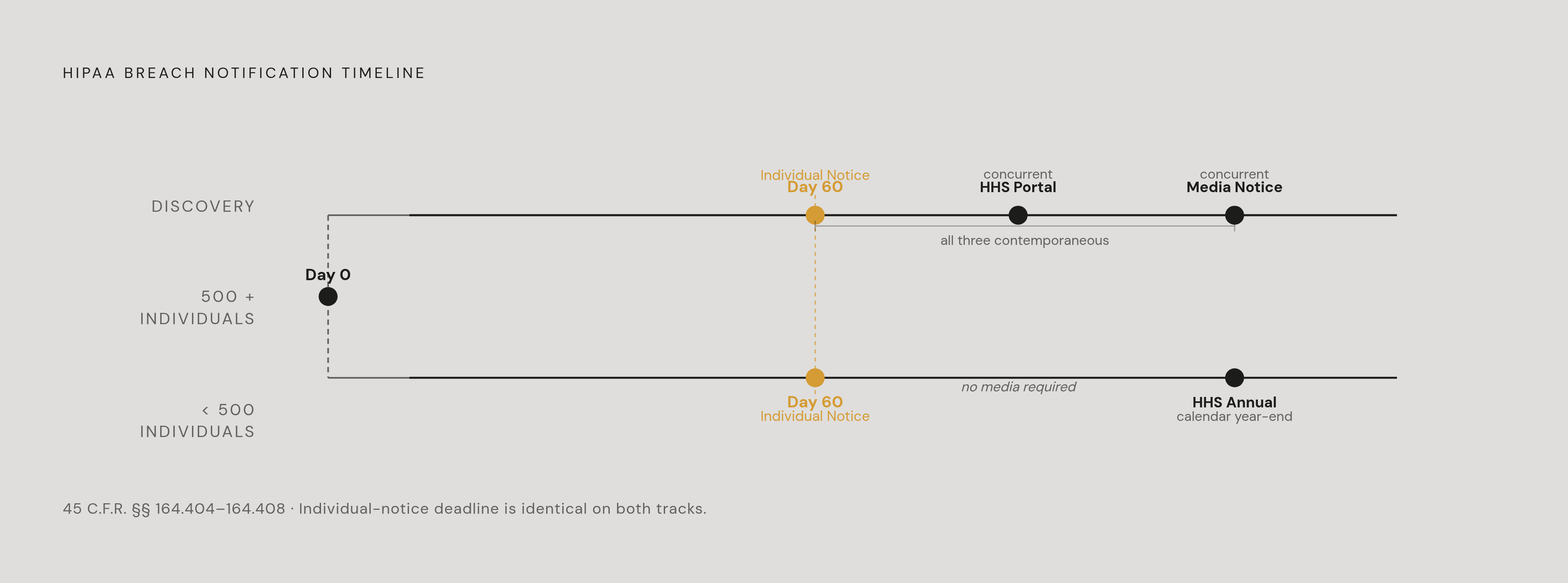
Once notification is required, begin with the obligation that applies regardless of breach size. Individuals who are affected must receive notice without unreasonable delay and no later than 60 calendar days after discovery. Investigation supports the content of the notice, but it does not create a new discovery date. Administrators should notify as soon as the investigation supports doing so.
Next, determine the applicable HHS and media obligations from the affected-person count and geography. For breaches affecting 500 or more individuals in a single state or jurisdiction, HHS must be notified contemporaneously with individual notices and no later than 60 days after discovery. Prominent media outlets that serve the affected state or jurisdiction must also receive notice within that time. HHS OCR requires submissions to the Secretary through its online breach portal.
For breaches affecting fewer than 500 individuals, annual OCR reporting is a separate obligation from prompt individual notification. The annual reporting track does not defer the individual notices or turn the incident into an internal matter only. Administrators need to distinguish that annual OCR deadline from the discovery-based deadline for individuals. A smaller affected population changes the reporting track while leaving the need to document the response unchanged.
The business associate must notify the covered entity within 60 days of its own discovery, and many business associate agreements shorten that period. The covered entity’s clock runs from when it knows or should have known of the breach. That point can precede the business associate’s formal notice if the covered entity had reason to know earlier. Contractual reporting terms give the office time to investigate, but they do not replace its own discovery analysis.
What a legally compliant notification letter must contain
Timely delivery is only part of compliance because HIPAA also specifies the notice’s content. The letter must briefly describe the breach and include the breach date and discovery date if known. It must identify the types of PHI involved by specifying the categories of “health information. Depending on the incident, those categories may include a name, Social Security number, diagnosis, or financial account number.
The letter must also explain what individuals should do to protect themselves. The notes give credit monitoring, fraud alerts, and password changes as examples, and which steps to take depends on what was exposed. The notice must describe what the covered entity is doing to investigate the breach and mitigate harm. It must also provide contact procedures for questions, such as a dedicated phone number, email address, or mailing address. These elements give individuals both an account of the event and a way to respond.
Individual notice is delivered by first-class mail to the last known address, or by email when the individual has previously agreed to electronic notification. If contact information is incomplete or out of date, substitute notice may be required. Those requirements may call for a post on a website or a media notice. Administrators should confirm the applicable threshold and method with legal counsel rather than assume that an undeliverable letter completes the obligation.
Where enforcement actually lands — the breach notification failures OCR has penalized
Breach notification failures provide a standalone basis for enforcement, separate from the underlying disclosure. Presence Health paid a financial settlement specifically for notifying patients more than a month beyond the 60-day deadline. HHS OCR described the matter as “the first HIPAA settlement based on the untimely reporting of a breach.”
The enforcement pattern also directs attention to whether an assessment addresses the specific incident and whether the covered entity can defend its discovery date. Administrators can check their response plans against those same questions. A plan should support timely notice, preserve the evidence behind any low-probability conclusion, and establish when the organization first knew or should have known. Good intentions do not substitute for that record.
Regulatory changes administrators should be tracking now — without changing their current obligations
The requirements of the HIPAA Breach Notification Rule now apply to Part 2 substance use disorder records. That extension belongs in current compliance work. It also reinforces the importance of identifying the precise records involved when assessing an incident.
The proposed Security Rule update remains a proposal and does not shorten the existing 60-calendar-day breach notification clock. Administrators should track its progress through OCR’s official channels without restructuring current response procedures around requirements that have not been finalized. The Health Care Cybersecurity and Resiliency Act is a separate bill awaiting action by Congress. Its proposed measures include encryption, multifactor authentication, monitoring that includes penetration testing, and standards aligned with a cybersecurity framework.
Administrators must establish discovery, record the notification decision, and send the notices required under the rules now in force. Monitoring the regulatory pipeline is part of keeping that process current, but it does not displace today’s work. Document current compliance now and track what comes next through the official channels.