Computer-Use AI Agents vs Scripted Automation in Healthcare Operations
Computer-use agents adapt to healthcare's messy workflows where scripted bots fail.

Healthcare's administrative workload is not linear, and that single property determines which automation architecture can survive contact with it. A prior authorization request routinely crosses an EHR, a payer portal, and at least one third-party system before it resolves, and the order those systems get touched in changes based on payer rules, documentation quality, and specialty. Scripted automation assumes a fixed path through that sequence. Healthcare rarely offers one.
Why healthcare's operational environment breaks scripted automation
The variability starts with the payer side. Payer requirements change on schedules no practice controls, and when a payer redesigns its interface or adds a new documentation requirement, a script built to match today's portal layout or field structure stops working. Nothing about the clinical or financial logic has changed. A script that depends on screen structure to function cannot tell whether a change to the screen is cosmetic or substantive.
Documentation adds a second layer of variability that has nothing to do with software. The quality and format of clinical notes shift by provider, by specialty, and sometimes by week, depending on who is charting and how busy the week was. A script cannot read around a missing field or interpret a note written in shorthand it has not seen before. A well-designed healthcare AI agent is built for this condition specifically: it is meant to carry a workflow through to completion by adapting to whatever state it finds, rather than stepping through a sequence written in advance.
System fragmentation compounds both problems. Patient and claims data has historically lived in incompatible formats across separate systems that were never designed to talk to each other, so any automation that cannot reason across those boundaries tends to fail exactly at the seam between two systems, not in the middle of either one. That seam, repeated across every prior authorization, every denial, and every claims appeal a practice processes, is where the operational and financial cost of rigid automation accumulates.
What scripted RPA was actually built for and where that leaves healthcare
Scripted robotic process automation remains genuinely useful in healthcare, and dismissing it outright would misstate what it does well. RPA performs reliably on tasks that are structured, high-volume, and deterministic: eligibility checks, claims status inquiries, payment posting. These are jobs with predictable inputs and predictable outputs, run at a scale where a fixed script pays for itself many times over. In that territory, RPA is not the problem.
The problem lies in what that territory excludes. The workflows that actually determine a practice's financial performance, prior authorization, denial adjudication, and claims appeals, are document-intensive and exception-heavy by nature, and they require reasoning across system boundaries that a script cannot cross. These workflows sit outside RPA's structured, rule-bound comfort zone, and they are where the money is.
A scripted bot has no way to recover when a form changes layout, when a payer updates its interface, or when a claim shows a mixed signal, such as documentation that exists but was filed under the wrong patient ID. Faced with any of those conditions, the bot stops, or it completes the task incorrectly and leaves a human to find the error later. Either outcome carries a compliance cost beyond the immediate operational one. A fixed script cannot audit its own decision path or account for an unexpected state, so it creates real HIPAA exposure, because every exception handled through a manual workaround is a gap in the audit trail that a regulator or an auditor will eventually ask about.
How computer-use agents are architecturally different from scripted bots
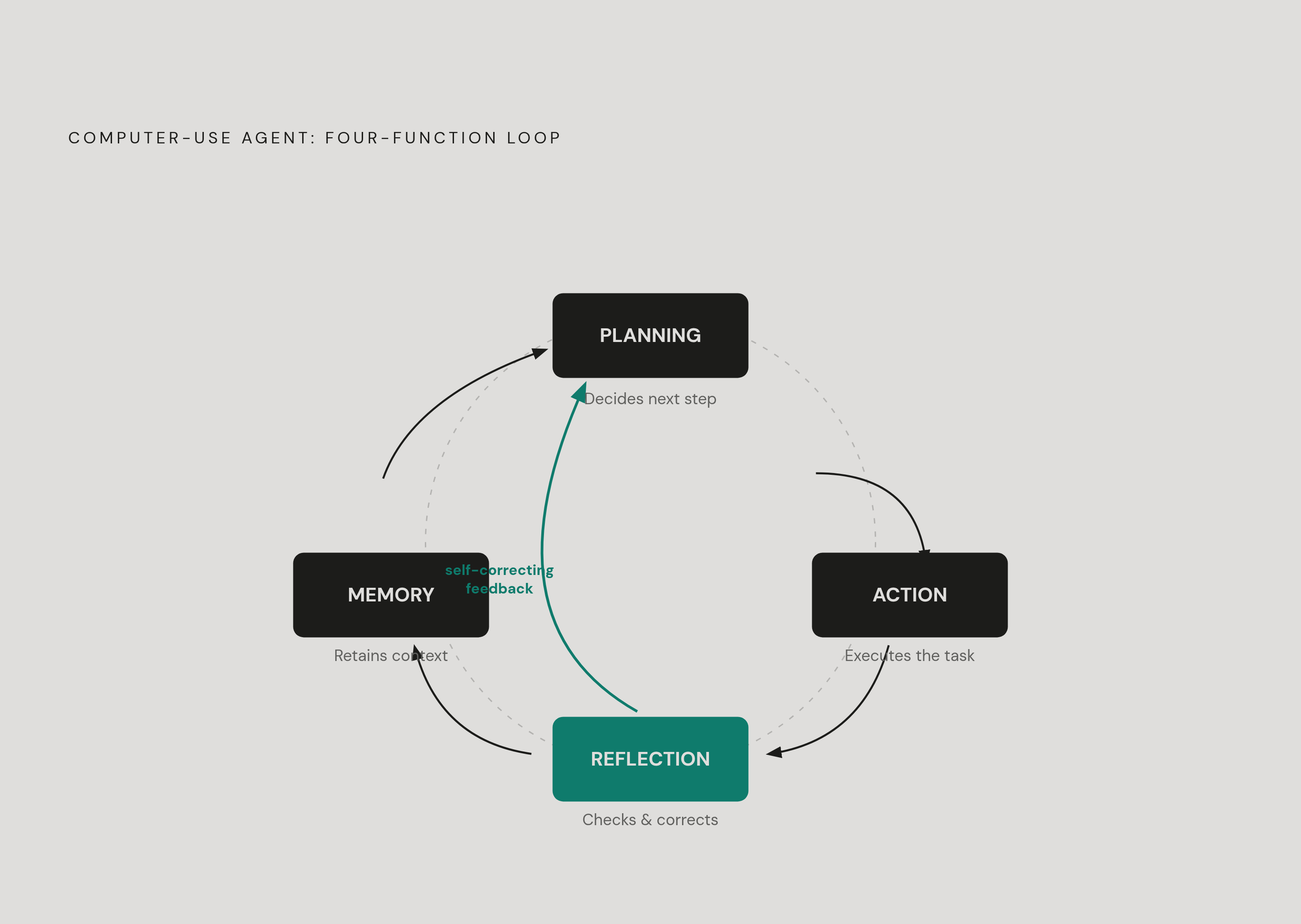
Computer-use agents are built around a different execution model, one suited to the non-linear conditions described above. The architecture rests on four functions: planning, where the agent decides its next step based on the current state of the workflow rather than a fixed order of operations; action, where it executes a task through whatever system interface is in front of it; reflection, where it checks whether the action actually achieved the goal and corrects course if it did not; and memory, where it retains context across a multi-step, multi-system task so it does not lose track of where it is partway through a prior authorization that spans three different pieces of software.
Computer-use agents interact with software the way a human staff member does: reading the screen, clicking, typing, navigating, rather than depending on a pre-built API connection or a portal-specific plug-in. That is what lets them work across the kind of fragmented system landscape most healthcare organizations actually run, where EHRs, payer portals, and third-party tools were never built to exchange data cleanly with each other. Platforms built around this pattern, Novoflow among them, deploy agents across the full arc of a workflow, from the initial documentation step through portal submission and back into the EHR, without needing a separate integration built for each system the task happens to touch.
The distinction from RPA follows directly from that design. A scripted bot breaks the moment a screen element moves or a new field appears, because it was never reading the screen in any meaningful sense, it was following coordinates. A computer-use agent reads the current state of the interface and decides its next move from what it actually sees there, which makes it goal-oriented. That difference is what lets it survive the kind of payer interface change or documentation quirk that stops a scripted process cold.
The scope of what these agents do matters as much as how they do it. Healthcare AI agents operating today handle the operational layer that surrounds care, patient inquiries, prior authorizations, claims, scheduling, credentialing, not clinical decisions themselves, and that boundary is a large part of what makes them deployable in a regulated setting right now. Human-in-the-loop design follows from the same logic. Agents handle routine execution on their own, and they bring in a human, with full context attached, only when a case genuinely needs a human judgment call. That pattern is what makes agentic automation auditable and safe enough for a HIPAA environment.
Results in Revenue Cycle and Prior Authorization
Prior authorization sits at the center of this argument because it carries every property that defeats a scripted process: it spans multiple systems, varies by payer, depends on documentation that is never perfectly consistent, and runs against a clock. An agent working a prior authorization case gathers the clinical data a payer requires, prepares the submission, navigates the payer's portal, and routes the resulting approval back into the workflow, without a human needing to hand the case off between each of those steps.
Denial management shows a similar pattern on the claims side. The hardest fraction of claims volume to work through is the document-intensive case carrying a mixed signal, like a claim with the right documentation filed under the wrong identifier, and that is exactly the category where a human paired with an agent outperforms either a pure RPA process or a pure human workflow working alone. An agent in this role reads the claim, checks the coding, flags the denial, and prepares a corrected appeal, carrying the task forward and only escalating to a human when the case genuinely calls for a judgment a human needs to make. Prior authorization, denial adjudication, and claims appeals share the same underlying shape: document-heavy, full of exceptions, and dependent on reasoning across system boundaries that scripted logic was never built to cross. That shape is where agent-based automation starts to separate itself from scripted automation, because it reasons across those systems instead of running through a longer list of pre-written decision branches.
Payer portal navigation is its own quiet drain on staff time. A large share of payer interactions still runs through phone trees, IVR systems, and portal interfaces with no API behind them at all, and someone has to sit through that navigation regardless. A computer-use agent can take on that work the same way a trained billing specialist would, minus the time spent waiting on hold, freeing staff from a task that contributes nothing to their actual judgment or training.
Scheduling and patient access round out the picture. An agent connected to live EHR data can book, reschedule, and confirm appointments as those events happen, with no manual handoff back to a staff member at any point. A voice bot that takes the call but still routes the actual scheduling work back to a person produces a meaningfully different outcome, one that raises template utilization and front-desk workload for any group managing a high volume of patient contact. Credentialing and onboarding work the same lever in a lower-urgency setting: agents chase down the documents a credentialing file requires and verify them against primary sources, a process that is high-volume and rules-heavy enough that the manual version costs a meaningful amount of staff time for predictable, repeatable work.
What Novoflow's Computer-Use Agent Approach Adds
It takes more than a capable underlying model to get a computer-use agent to work inside an actual practice. It takes an implementation built to survive the fragmented system landscape described earlier without asking the practice to change how it already operates. Novoflow's agents interact with a practice's existing EHR, payer portals, and third-party software the same way a staff member would, reading screens, clicking, typing, navigating. There are no new API integrations to build, no workflow overhaul, and no EHR replacement as a precondition for going live.
The deployment process reflects that design philosophy directly. Novoflow's AI forward-deployed engineers, referred to internally as the AI FDE, map a practice's existing SOPs and workflow, then configure and refine the agent before it ever goes live, turning what would otherwise be months of manual development into a matter of days. The starting point for a practice is a single login, an admin account created the same way any new staff member's would be.
The workflows Novoflow automates end to end, inbound scheduling, cancellation recovery, new-patient referral scheduling, and prior authorization, map directly onto the revenue-sensitive, exception-heavy work described throughout this piece, the same work scripted RPA structurally cannot finish on its own. Deployment scales from a templated setup for an independent practice up to the highly customized, protocol-heavy automations a multi-location group or an enterprise health system would need, so it can coordinate dozens of agents across a much larger footprint of systems and locations.
Compliance is treated as a floor, not a selling point. Novoflow operates under SOC 2 Type II and HIPAA compliance as baseline conditions, and every agent it deploys runs inside a governed, auditable framework that meets the obligations that apply to any system touching PHI, not just the ones built specifically for healthcare. The standard an agent gets measured against is whether it performs like a trained staff member available at any hour, and Novoflow's deployment model holds to that standard directly: agents follow a practice's existing SOPs, escalate exceptions to a human with full context attached, and never require staff to learn a new tool or abandon a process that already works. Return on investment gets measured against workflow-specific goals set at the start of a deployment, because a prior authorization bottleneck at a three-location orthopedic group and a denial-rate problem inside an enterprise health system carry different cost structures and different definitions of what success looks like.
The real latency problem: where current computer-use agents still need improvement
The strongest honest objection to computer-use agents is speed, and it deserves a direct answer. Research behind the OSWorld-Human benchmark, published in 2025, found that even the best computer-use agents available take several times more steps than a human would need to complete the same task, and that most of the total end-to-end delay comes from the large model calls involved in planning, reflecting on outcomes, and judging whether a step succeeded. The same research found that as a task stretches across more steps, each added step tends to take about three times longer than the steps the agent started with, so the complex, multi-step healthcare workflows where agents matter most are also the ones where this latency compounds hardest.
That finding carries real weight for any task that requires a live, real-time human interaction on the other end, a patient holding on the phone, a payer representative waiting on the line. In those settings, current agent latency is a genuine constraint on where an agent belongs today.
It matters much less for the asynchronous, high-volume administrative work that makes up the largest share of what agents are actually being deployed to do in healthcare operations: prior authorization submissions, denial appeal assembly, credentialing verification. None of that work depends on a human waiting in real time for the agent to finish. An agent that takes longer than a staff member would on any single case still changes the underlying math once it is running continuously, at scale, without adding headcount. The gap is one that researchers are actively working to narrow, not a permanent property of the technology. The deployment pattern that holds up today routes around the constraint rather than ignoring it: agents take on the asynchronous, high-volume back-office work, humans stay on the interactions where a real-time response genuinely cannot wait, and exceptions get escalated with full context attached so the human review that follows takes as little time as possible.
HIPAA compliance and PHI governance requirements that apply to any agent deployment
HIPAA applies to a computer-use agent with the same force it applies to any staff member, and any practice administrator weighing this kind of deployment needs to treat that as a starting condition. The law covers any system that accesses, uses, or discloses protected health information, and software is held to that same standard.
Agentic deployment introduces a few obligations that need to be designed in from the start. Minimum necessary access stands out as the clearest example: an agent has to be scoped to only the PHI its specific task actually requires, and a scope that is broader than the task calls for is a technical design flaw, not only a policy oversight to flag in a compliance review. Getting that scoping right, along with the audit trail and business associate agreement obligations that follow from it, is what separates an agent deployment built to satisfy HIPAA from one that merely assumes it does.