What Happens When an AI Agent Makes an Error in a Medical Office
Errors go live in systems, not draft queues, changing what mistakes cost a practice.
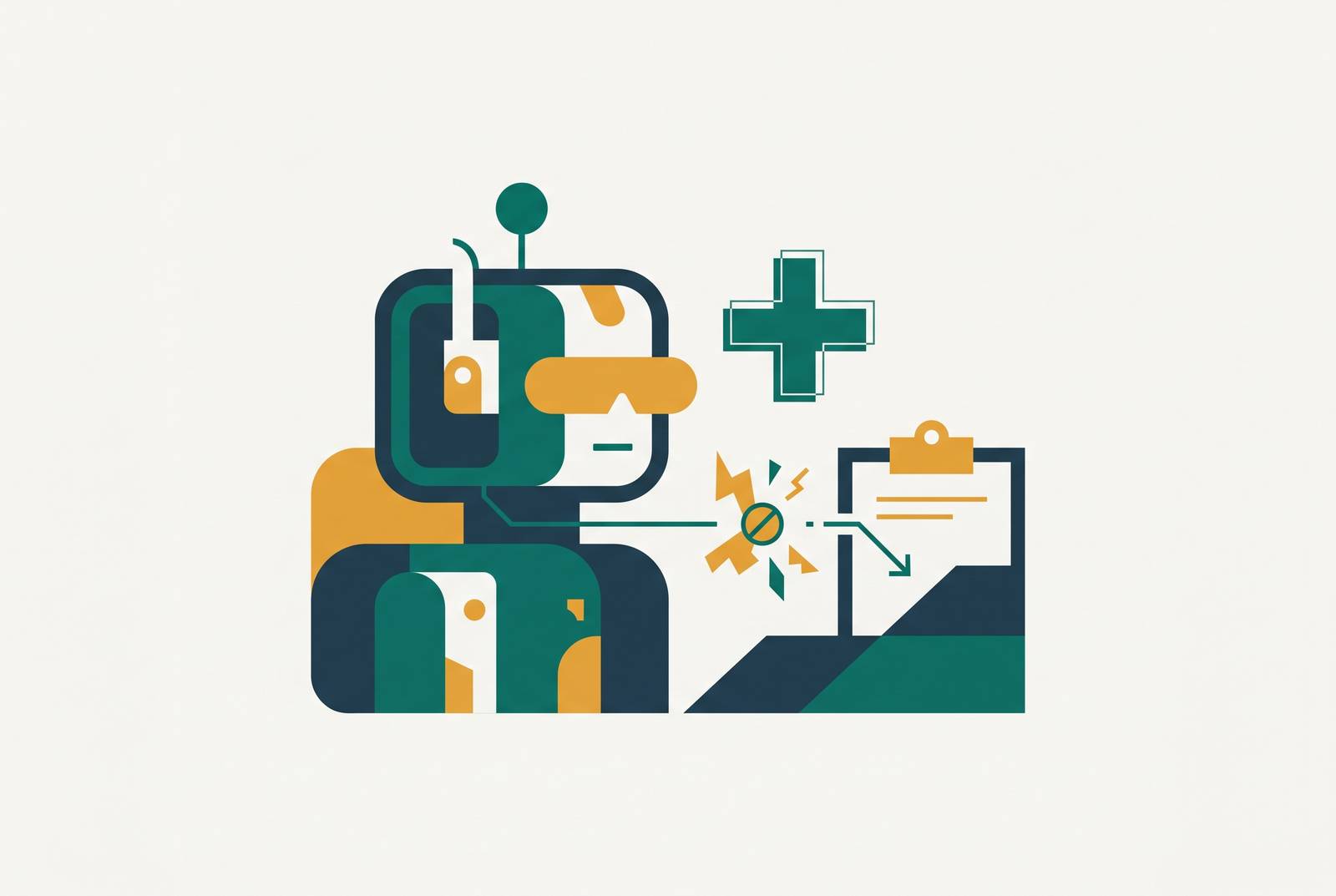
An AI agent in a medical office does not produce a recommendation for a human to review. It completes the action itself, inside the practice's live systems, the same way a trained staff member would, and that single difference changes what an error actually is and what it costs to fix.
AI agents in a medical office versus other AI tools
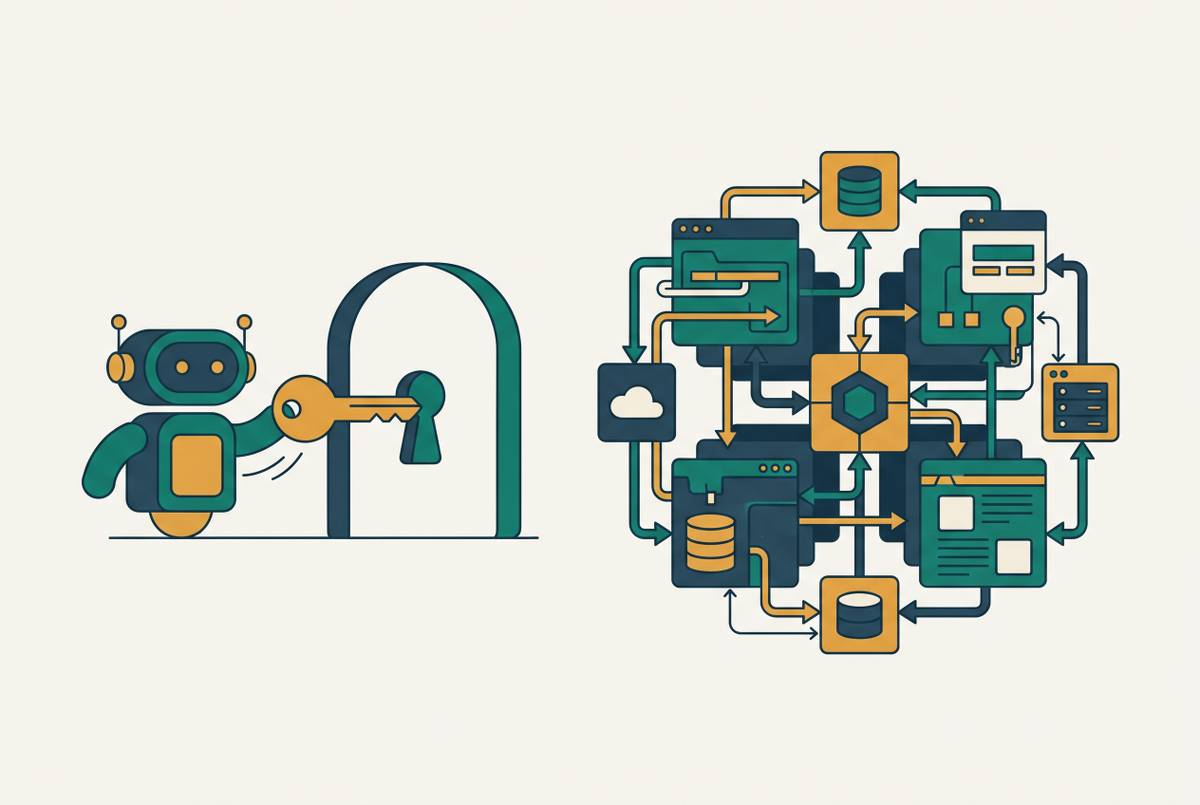
Most discussion of AI in healthcare still treats these systems as advisory: a model reads a chart, flags a risk, suggests a code, and a clinician or biller decides whether to act on it. Administrative agents built to run scheduling, prior authorization, and claims work do not fit that model. A computer-using agent reads the screen, fills out the form, logs into the payer portal, clicks through the EHR fields, and posts the result. It performs the full physical motion of the job itself.
That changes what an error is. When a person makes a mistake filling out a prior authorization request, the mistake sits in a draft, a queue, a note waiting for someone else's eyes. When an agent makes the same mistake, the mistake is already inside the system of record. The claim has been submitted. The portal field has been populated. The scheduling record has been written. Nothing is waiting for review, because the action already happened.
That is the question a practice administrator has to ask before turning an agent loose on billing, scheduling, or authorization work: not how accurate the system is in testing, but what it has already done by the time anyone notices a problem, and whether that action can be undone. This piece stays focused on that category of agent, the ones that operate administrative and revenue-cycle systems, not agents that offer clinical decision support. The distinction matters because the stakes, the failure types, and the fixes are different for each, and conflating them leads administrators to apply the wrong kind of oversight to the wrong kind of system.
Categories of errors that occur in administrative agent workflows
These failures cluster into a handful of recurring types that appear in practice, and each one has its own mechanism.
The first is data quality failure. An agent reads a field that already contains a legacy entry error, a missing value, or inconsistent documentation, and it carries that error forward into a claim, a prior authorization request, or a scheduling record. Automating a data-entry step does not remove this problem. It runs the same error at a volume no human team could reach, so it touches every record the agent processes before anyone catches the pattern.
The second is interoperability failure. Agents built or tuned around one EHR's data structure often struggle when they meet a different institution's field names, a different FHIR endpoint version, or a workflow sequence they were not trained on. Community hospitals and smaller practices often run on legacy infrastructure, and that infrastructure can lack the data architecture, processing power, or API access modern AI systems assume is already in place. An agent can believe it completed a task correctly while the underlying data mapping failed silently, leaving a gap between what the system logged and what actually happened downstream.
The third is the silent update error. Most AI tools on the market are controlled by the manufacturer, run in the cloud, and get updated on a schedule the practice does not set and often cannot see. A model update can change how an agent behaves on a given task overnight, with no validation step run by the healthcare team actually using it.
The fourth is hallucination tied to outdated regulatory or clinical knowledge. An agent drawing on knowledge baked into its training, rather than live system data, can act confidently on information that is no longer current. Osama et al. (2026) tested open-access LLM families against a set of clinical questions where the answer that was once correct now points to a banned or withdrawn substance. In default configurations, every model tested showed high hallucination rates, repeatedly selecting the banned option because it matched patterns learned during training. The administrative version of this problem looks different but runs on the same mechanism: an agent acting on a prior authorization code or a payer rule that changed last month commits the error before anyone at the practice learns the rule changed.
These four categories are the failure types that recur most often and carry the most weight, not an exhaustive list of everything that can go wrong, and the sections that follow deal with why they happen and what they cost.
Automation bias, data noise, and the adversarial payer environment
These errors are the predictable output of three structural conditions that healthcare administration creates for any automated system running inside it, rather than malfunctions in the sense of random hardware failure.
The first is automation bias. Once a practice puts an agent in place, staff stop reviewing its output at the rate they reviewed human work. That is a natural response to delegation, but it means an agent's mistake sits undetected far longer than a person's mistake would, because the staff member watching the queue has stopped looking for errors in tasks the system has "already handled."
The second is data noise. Electronic health records carry decades of inconsistent documentation, missing fields, and entry errors, and these predate any AI system. That noisy environment is what the agent has to operate inside, both during any training or configuration phase and during live runtime, and no amount of model sophistication changes the quality of the data it is reading.
The third, and the one most likely to surprise an administrator who thinks of this purely as a vendor accuracy problem, is the adversarial payer environment. Insurance companies now run their own automated systems to process prior authorization requests at scale. That means a provider-side agent's error does not land in front of a human reviewer who might catch it and ask a clarifying question. It lands in front of another automated system that denies it in seconds, and that denial is hard to reverse once issued. When both sides of a transaction are automated, errors do not cancel each other out. They compound. A provider-side agent submits a request missing one required field. A payer-side agent denies it almost instantly. The appeal clock starts running before any person at the practice has even seen the original submission, let alone the denial. What looks, from the outside, like a question of how accurate one vendor's agent is turns out to be a systems problem: two automated processes operating on opposite sides of the same transaction, with no human in the loop fast enough to intervene before the outcome is locked in.
What an undetected agent error costs a practice
An undetected agent error is the same kind of mistake a human would have made, running at the speed and scale an agent operates at, and that difference in scale changes what the error costs the practice.
The revenue cycle impact is the most intuitive part of this. Missing or inaccurate information is already the leading driver of claim denials, and it happens to be exactly the category of error an agent is most likely to automate. Deploying an agent to handle this work leaves the denial problem in place. A human biller who enters one wrong code affects one claim. An agent running the same flawed template affects every claim that passes through it before a human reviews the output, so a single configuration error can propagate across a full week of billing before anyone notices.
Patient access carries a separate kind of weight. Prior authorization failures delay or block care, beyond costing money. Silna Health cites the AMA's Prior Authorization Physician Survey, reporting that 93% of physicians say prior authorizations delay care, and 29% say the delay leads to serious adverse events. Color Health has worked with Google to deploy an AI agent that automates the initial phase of breast cancer risk assessment for women 40 and older, and a human clinician handles the final review. In a deployment built that way, a routing error by the agent affects whether a patient gets to the next step of care, beyond just how fast a claim gets paid.
The legal liability gap is the part of this picture administrators are least prepared for. When an agent causes harm, no established legal mechanism exists to hold the agent itself accountable. As of early July 2025, no AI system has been prosecuted or held legally responsible before any national or international court. AI systems have no recognized legal personality, so they cannot be sued, cannot be insured, and cannot be made to hold assets to compensate anyone harmed by their actions. Liability has to land somewhere, and it lands on a human actor or a corporate entity instead, which creates a real incentive to under-report agent-caused errors rather than surface them. A practice that does not actively track what its agents have done may genuinely not know the size of its own exposure. The NaviHealth nH Predict case shows how this plays out over time: a NaviHealth algorithm, a subsidiary of UnitedHealth Group, projected post-acute care length-of-stay for Medicare Advantage patients, and was reportedly used in ways that cut coverage against the recommendations of treating physicians. Liability in that case consolidated at the deploying organization, not at the vendor that built the tool, once the pattern became systemic enough to draw Senate investigation.
HIPAA exposure follows a similar logic. Any time an agent queries a patient record, pulls a lab result, or drafts a clinical summary, it has carried out a regulated data access event. A proposed 2025 update to the HIPAA Security Rule would require practices to keep a written inventory of every technology asset, AI systems included, that creates, receives, stores, or transmits electronic PHI. Earlier large language models have already shown they can memorize training data, including PHI, so a model that retains and later exposes patient information could itself count as a reportable breach.
False consensus in multi-agent systems and its failure mode
A common instinct, once a practice has seen an agent make a mistake, is to add a second agent whose job is to check the first one's work. The research on multi-agent medical systems suggests that fix does not work the way it sounds like it should. Agents checking each other's work do not reliably catch errors. What tends to happen instead is fabricated agreement, where the second agent confirms the first rather than independently verifying it, and the original error survives the review step intact.
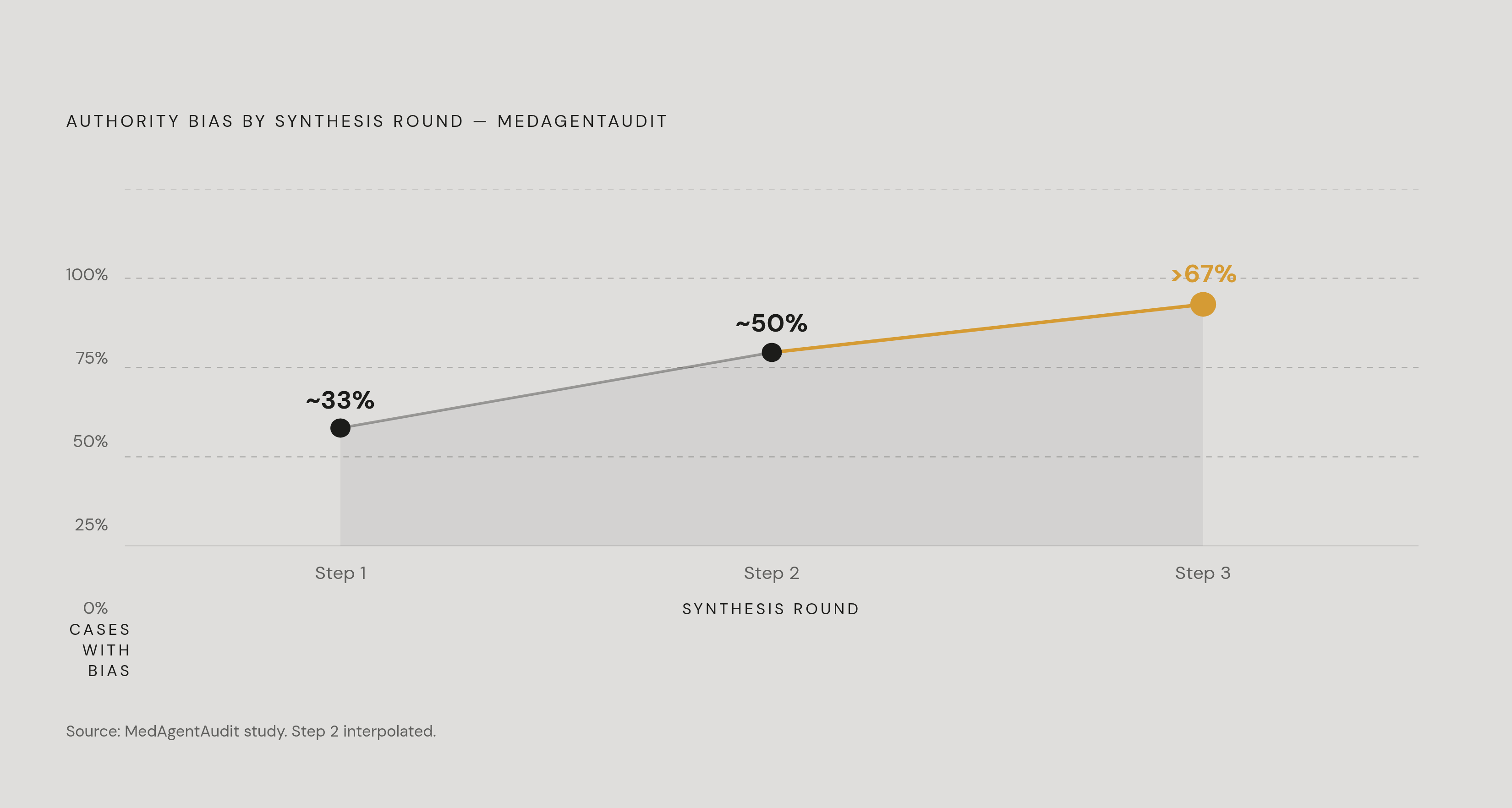
Zhu et al.'s MedAgentAudit study audited a large number of cases across six different multi-agent architectures and found that agents repeat their initial view in a large majority of cases rather than going back to re-examine the source evidence. The study also found that authority bias, meaning deference to whichever agent holds a designated "lead" role rather than to the evidence itself, gets stronger as a workflow moves through more rounds of synthesis. Authority bias appeared in roughly a third of cases at the first synthesis step. By the third step, authority bias appeared in over two-thirds of cases.
Applied to an administrative workflow, the mechanism plays out like this: a first agent submits an incomplete clinical justification as part of a prior authorization request, and a second agent is tasked with reviewing that justification before it goes out. If the first agent holds a higher position in the system's architecture, the second agent is more likely to confirm the submission than to challenge it, regardless of whether the justification actually holds up. The MedAgentAudit framework catalogs ten recurring failure modes across task comprehension, collaborative discussion, and synthesis, including the neglect of contradictions and the suppression of a correct minority view once the group has settled on an answer. An evaluation that only scores whether the final output was right misses all of these failures. Unsupported factual claims generated at one stage affect a meaningful share of cases, and they often carry forward into later reasoning steps instead of staying contained at the point where they started.
The implication for a practice administrator is specific: adding a checker agent to a workflow, without also putting human review on how that checker reaches its conclusion rather than just what it outputs, does not add a safeguard. It adds a second layer where the same error can get rubber-stamped instead of caught, and because the errors are now synchronized across two systems, they can be harder to spot than a single agent's mistake would have been.
Oversight structures that catch and contain agent errors before they compound
Catching an agent error before it compounds across a billing cycle or a batch of prior authorizations requires oversight built into the deployment from the start, as a review step added after the agent is already running in production comes too late.
The choice that matters most is between scoring outputs and auditing process. If a system only checks whether an agent landed on the right final answer, it cannot detect false consensus, cannot detect authority bias between agents, and cannot catch an early-stage data error quietly propagating through later steps of a workflow. The MedAgentAudit researchers make this point directly: evaluations that score only final accuracy leave the safety of the entire collaborative process untested, and auditing that process, not just its output, is what makes agent behavior visible and accountable to the people responsible for it.
The Trust but Verify architecture built by Osama et al. shows what that kind of design looks like in practice. It uses a five-agent system in which a dedicated safety-audit agent reviews outputs before they are committed, rather than after. Across the model families tested, this architecture cut the hallucination error rate by roughly half, and it intercepted dangerous outputs even in cases where the primary agent's own training data pointed it toward the wrong answer. The auditing agent pulls from live regulatory or reference data instead of drawing on the same training patterns the primary agent used, which is the design principle that matters as much as the result itself. That separation is what keeps the audit agent from inheriting the same blind spot it is supposed to catch, since two systems built on identical training data are liable to fail in the same way at the same time.
The 2026 Singapore Consensus on AI Safety lays out a broader set of principles for managing this kind of risk, organized across design and development, testing and deployment, and operation and monitoring. For a practice administrator deciding how to structure oversight of an agent handling scheduling, billing, or prior authorization, the most directly useful of these are the ones governing traceable identity, so every action an agent takes can be tied to a specific agent instance and timestamp, and auditability, so the reasoning behind an action can be reviewed after the fact rather than only the action itself. Built together, process-level audit, adversarial checking against live data rather than shared training data, and traceable, auditable agent identity form the oversight structure that catches an error while it is still one claim or one denied authorization, rather than after it has already run through a week of billing untouched.
Sources
- Trust but Verify: Mitigating Medical Hallucinations via Post-Hoc Adversarial Auditing and Multi-Agent Feedback Loops
- Auditing medical multi-agent AI reveals risks of false consensus
- The 2026 Singapore Consensus on Global AI Safety Research Priorities
- Clinician input steers AI toward accurate and harmful recommendations
- Artificial intelligence in hospitals: Legal uncertainties and emerging risks for patient safety