Reducing Patient No-Shows With Structured Confirmation Workflows
Structured confirmation workflows cut no-shows better than reminder texts alone.
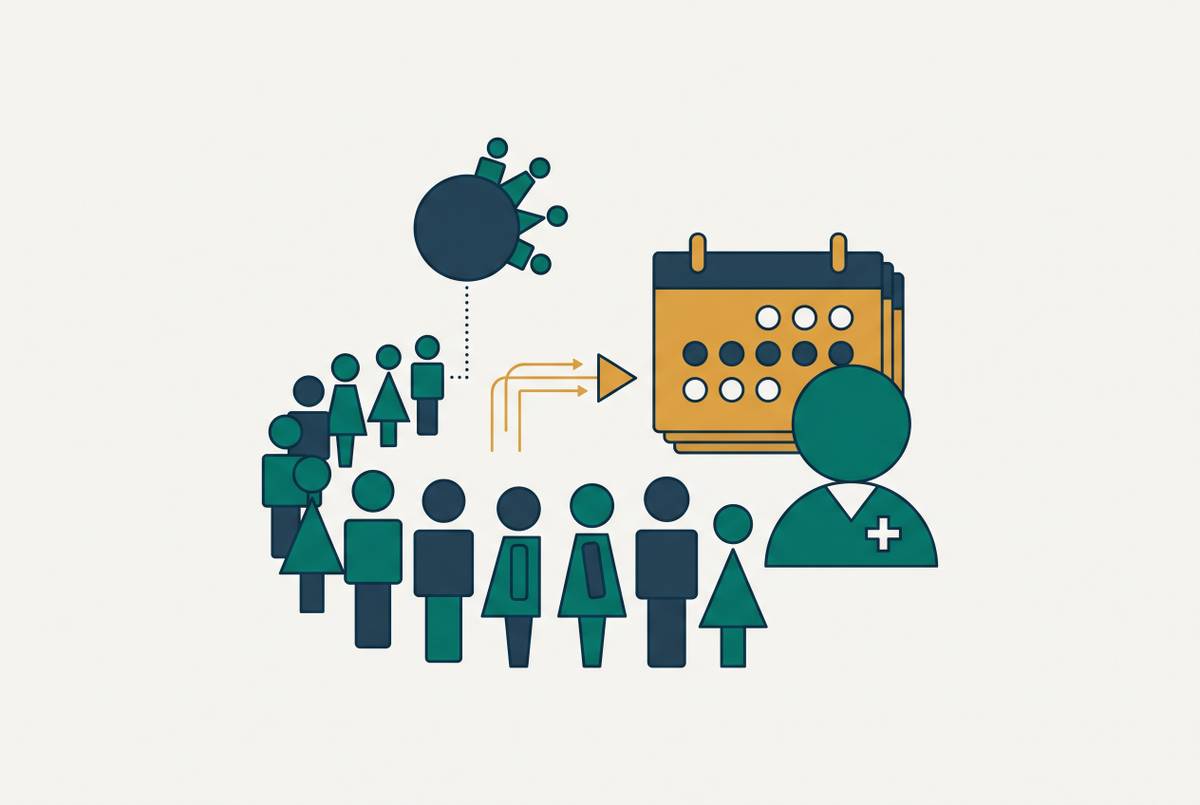
No-show rates in healthcare range from 5.5% to 50%, with a global average around 23.5%, a wide spread. That spread is the tell. Reminder texts alone haven't closed the gap, and they never will, because a missed appointment is rarely caused by forgetting alone. It's caused by a scheduling mismatch, a coverage lapse, a phone number that changed six months ago and never got updated. Texting harder at a broken process just produces a faster broken process.
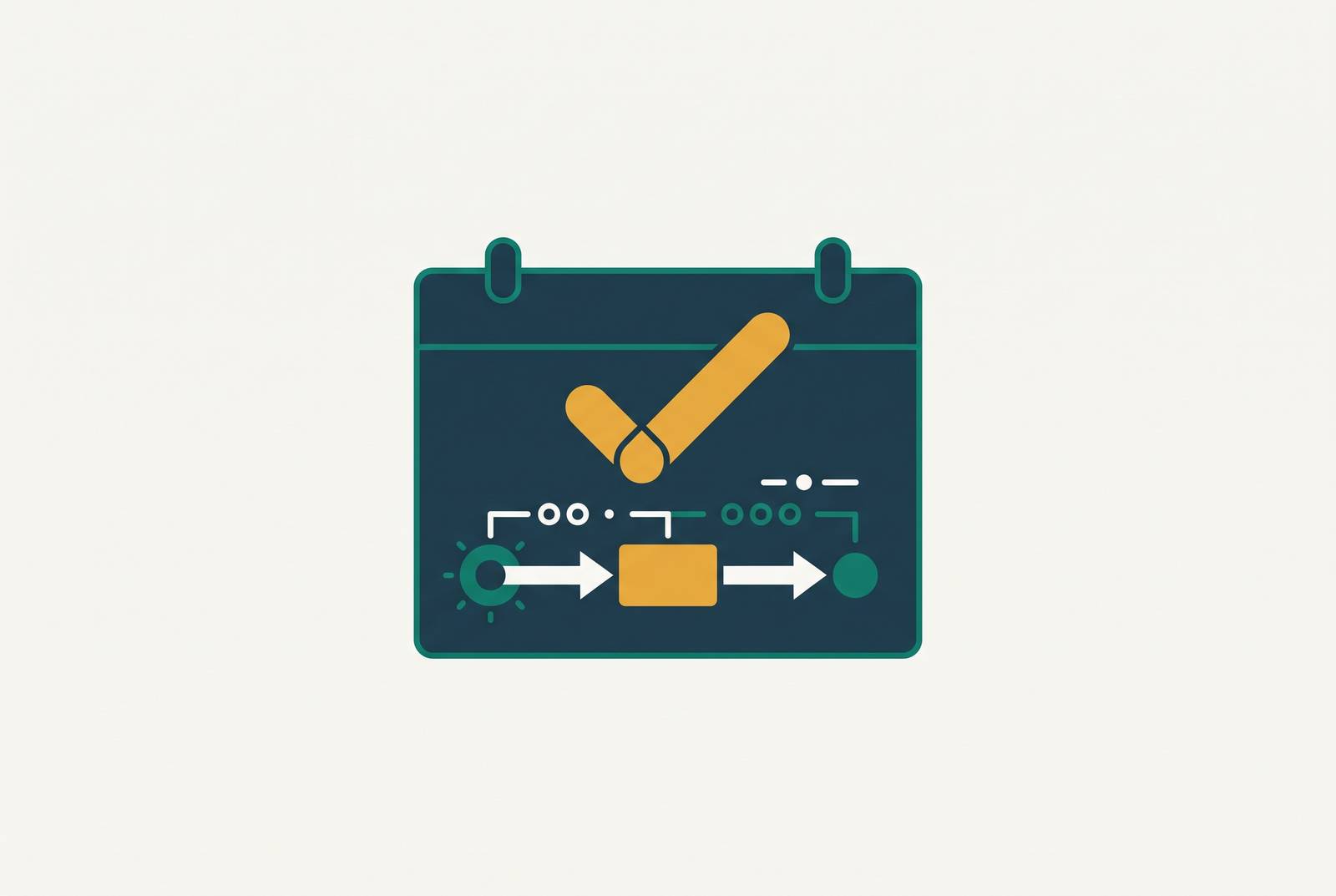
The most effective strategies for reducing patient no-show rates center on structured confirmation workflows rather than standalone reminder texts. A working workflow runs a 3-1-0 confirmation cadence (touches at three days out, one day out, and the day of), expects a patient response at each stage, and routes confirmed, cancelled, and unconfirmed patients to distinct next steps rather than treating silence as a soft yes. Clean contact and coverage data captured at intake, risk stratification that directs heavier outreach toward higher-risk appointments, and waitlist automation that backfills cancelled slots immediately are each load-bearing parts of the system. Post-no-show recovery outreach within 24 to 72 hours closes the loop, since patients who miss one visit are 70% less likely to return within 18 months without active re-engagement.
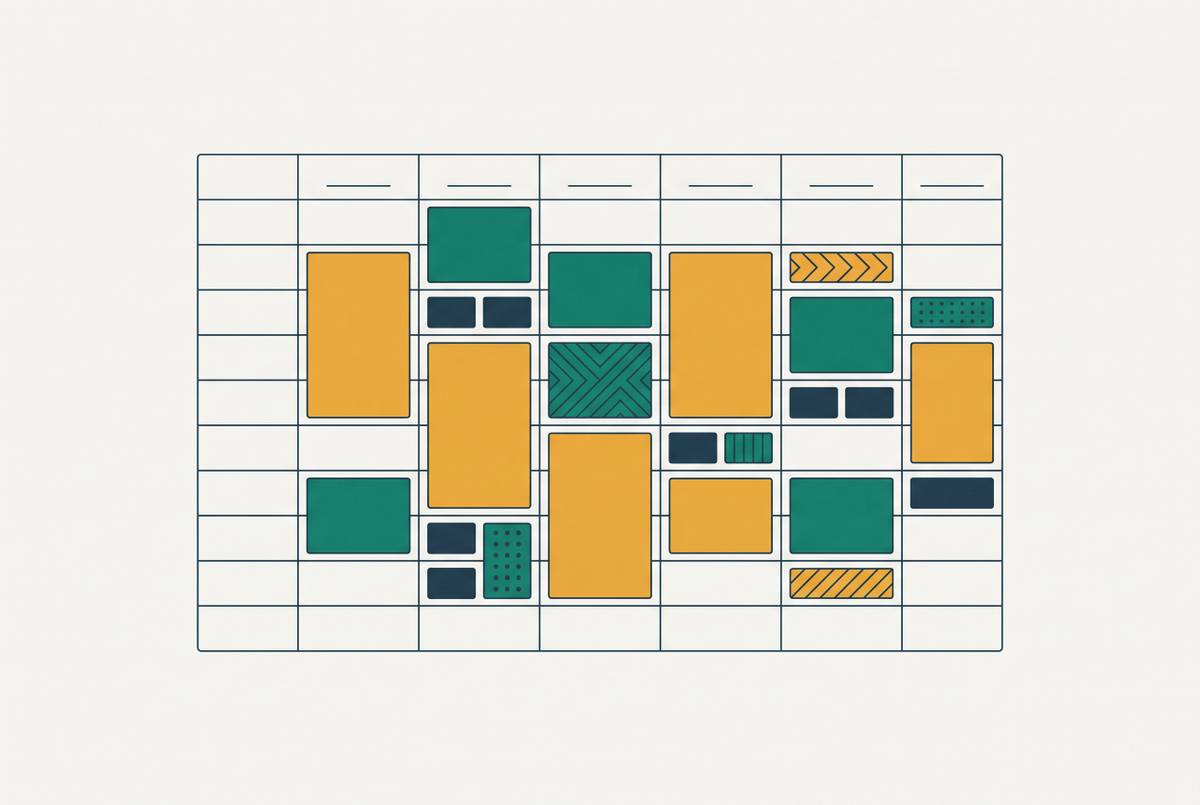
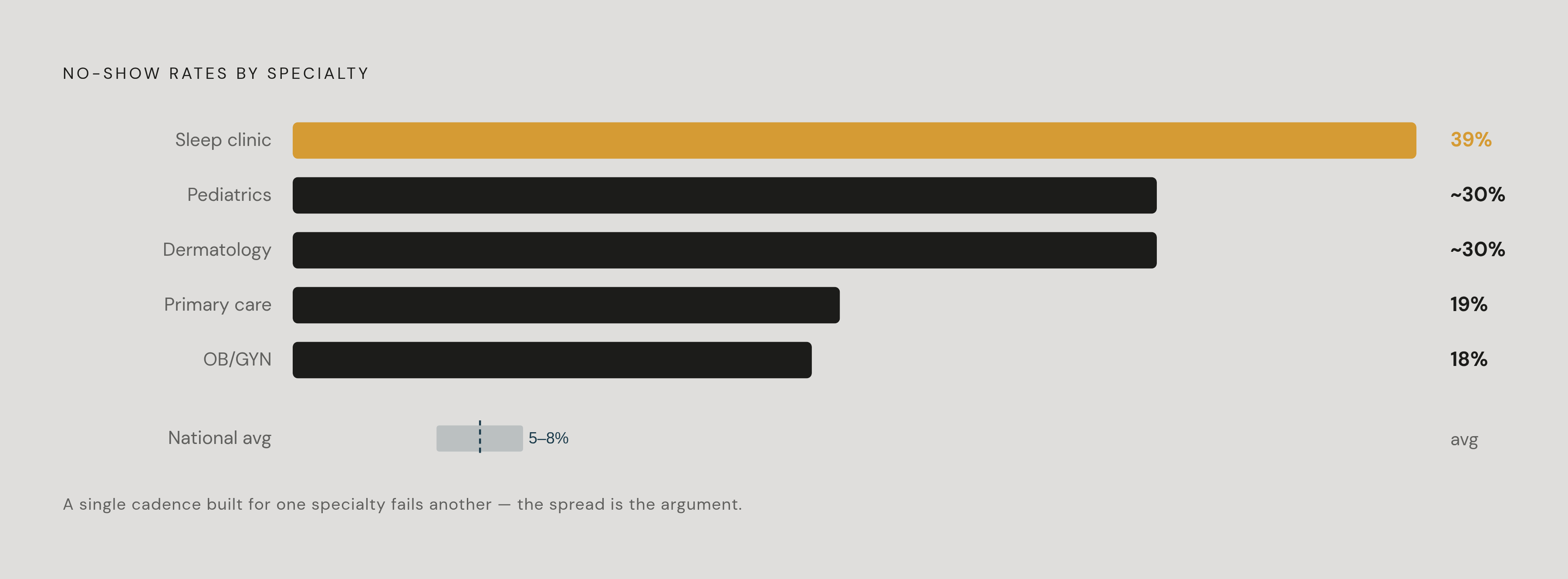
The national average across specialties runs about 5% to 8%, but that number hides real variation. Sleep clinics run as high as 39%. Pediatrics and dermatology are near 30%. Primary care runs about 19%, OB/GYN close behind at 18%. A cadence built for primary care will not work on a sleep clinic's patient population, and most practices make their first mistake right here: treating the whole schedule as one problem with one fix.
The money at stake isn't trivial. No-shows cost the system an estimated $150 billion a year, with a single missed visit running $200 to $375 in lost revenue. Three missed 20-minute slots in a single shift knock provider productivity down by 12.5%. Three missed 20-minute slots in a single shift knock provider productivity down by 12.5% of the day. That's a chunk of the day gone.
What's stranger is the plateau. Roughly 73% of practices report no-show rates holding steady or improving, but 60% report no real change despite ongoing effort, and 27% actually saw rates climb. Stability here just means the reminders are enough to keep the problem from getting worse, not enough to fix it. Practices are running to stay in place, and mistaking that treadmill for progress is the second mistake.
What are the best strategies for reducing patient no-show rates in a medical practice?
A reminder is a one-way broadcast. It goes out, it lands or it doesn't, and nothing downstream depends on what the patient does with it. A confirmation workflow expects a response, handles the absence of one, and routes whatever outcome results to a specific next action. Calling both of these things "reminders" produces most underperforming programs, because a confirmation workflow expects a response, handles the absence of one, and routes whatever outcome results to a specific next action, while a plain reminder does none of that.
The data on plain reminders shows that, sent alone, without any follow-up behind them, they produce less than a one percentage point reduction in no-show rates. The message itself does almost nothing. What happens after it's sent is what keeps the appointment kept, and most practices still pour their effort into wording the text instead of building the machinery that acts on the response.
Three things separate a workflow from a reminder, and skipping any one of them collapses the whole thing back into a broadcast. Sequencing means touches land at deliberate intervals, each one building on what the last established. Response handling means a confirmed patient, a cancelled one, an unconfirmed one, and an unreachable one each trigger a different next step. Closed-loop follow-through means the process doesn't end when the message delivers. It ends when the slot is filled or the patient's status is fully resolved.
A confirmation workflow, run this way, looks less like a communications tactic and more like infrastructure. It runs the same way for every patient, every time, without depending on a front-desk staffer remembering to make a callback at the right hour on a busy Tuesday.
Step one: capturing clean data before a single reminder goes out
A large share of missed appointments trace back to problems that have nothing to do with the reminder, such as a wrong phone number, a mismatched provider or visit type, or a scheduling rule nobody updated after a provider changed their hours. A perfectly timed text sent to a disconnected number accomplishes nothing, and no amount of cadence tuning fixes that.
Intake is the moment to catch this, because it's the one point where the data is cheapest to get right and most expensive to fix later. Patient self-scheduling tends to produce cleaner contact data, simply because the patient types it in. Staff-entered data needs verification at the point of scheduling, not the assumption that it carried over correctly from a prior visit. That assumption breaks more often than most practices want to admit.
Channel choice is where a lot of practices guess wrong. Text messages get read fast, with 95% opened within three minutes, which makes SMS the highest-reach format available. That doesn't mean every patient wants texts. Preference still varies, and the workflow needs to confirm the preferred channel rather than defaulting to whatever's cheapest to send at scale.
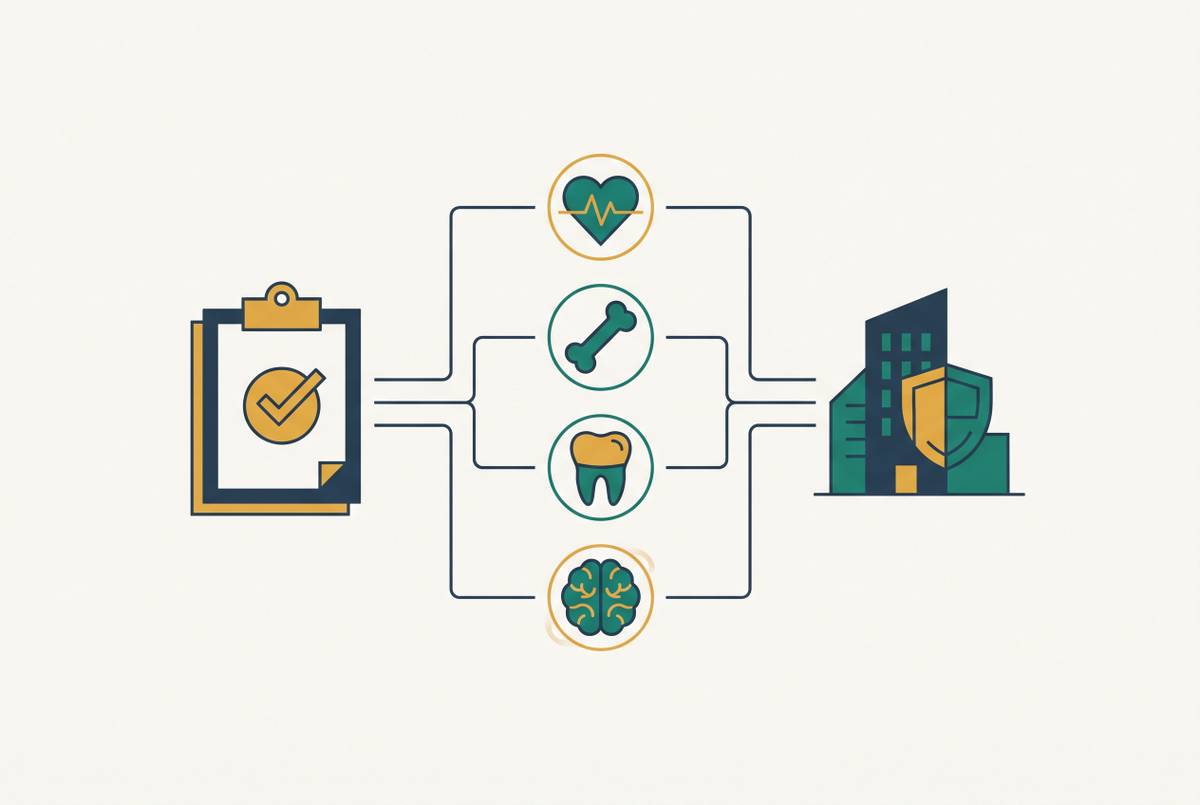
Visit-type matching deserves its own attention, separate from contact data. Routing a patient to the wrong provider or wrong appointment type is a no-show risk in disguise: the patient shows up, can't actually be seen for what they came in for, and rarely bothers to reschedule after that kind of friction. Coverage verification belongs in this same intake stage, seven days out. Checking benefits at that point, and messaging patients proactively if coverage has lapsed, removes one of the more common last-minute cancellation triggers before it turns into a same-day scramble.
The confirmation cadence: timing, channel, and the purpose of each touch
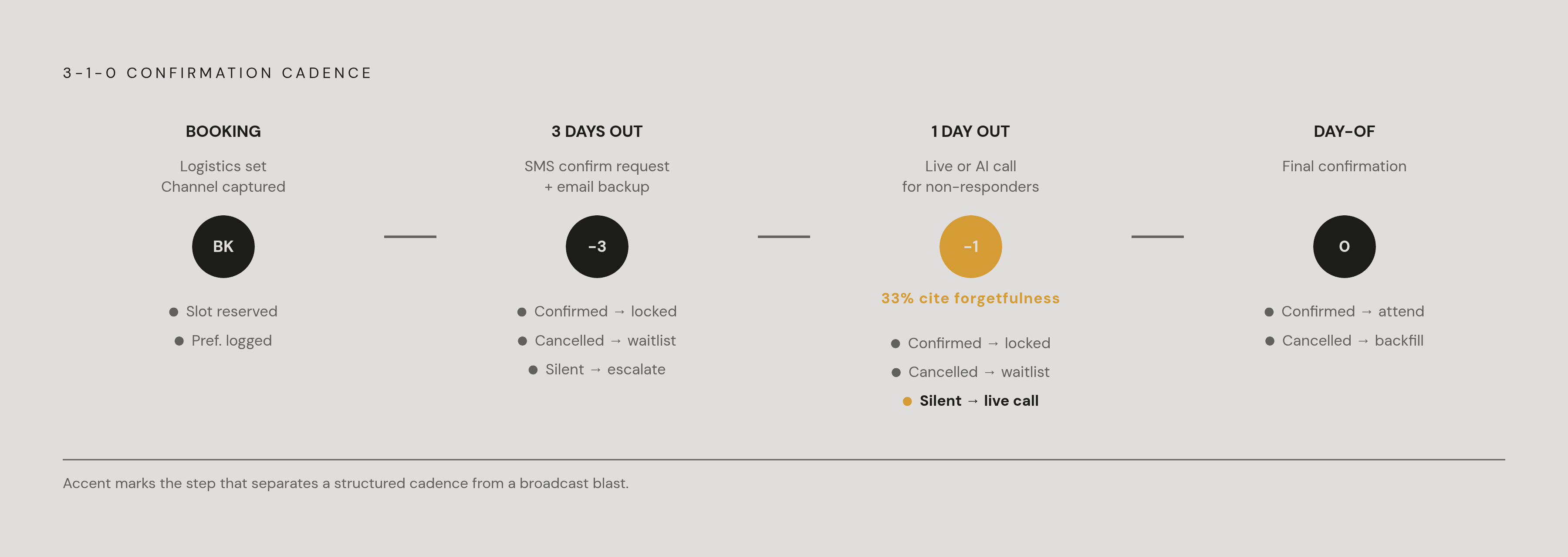
A workable starting cadence looks like 3-1-0: a touch three days out, one day out, and again on the day of. The spacing is deliberate. It's built around when a patient can still act on a reschedule request and when the practice can still realistically refill the slot if they don't.
At booking, the first confirmation does something different from the touches that follow. It fixes the appointment in the patient's mind as real, delivers the logistics (what, when, where, any prep needed) while attention is highest, and sets the channel and opt-in for everything downstream.
Three days out, the message needs to ask for confirmation, not just remind. A reminder tells the patient something; a confirmation request asks them to do something, and only the second kind tells the practice who's wavering while there's still time to backfill. SMS should lead here, with email as a secondary channel for patients who prefer it.
One day out, the target shifts to plain forgetfulness, which 33% of patients cite as the reason they missed a visit. The workflow needs to escalate at this stage: patients who never confirmed at the three-day touch should get a phone call, live or AI-assisted, not another automated nudge. That escalation is the exact point where a structured workflow parts ways with a reminder blast. Message content stays plain (what, when, where, prep), delivered in the patient's preferred language for greatest comprehension.
Response handling: what to do when a patient confirms, cancels, or goes silent
Every confirmation splits patients into three states, and each one calls for a different action. Treating them the same is the mistake that undoes everything built in the two sections above.
Confirmed patients are done. The slot locks, gets marked stable, no further outreach needed. Cancellations and reschedule requests open the slot immediately, and the workflow's job in that moment is triggering waitlist backfill before the gap sits open for hours. Two-way text and voice, letting a patient cancel or reschedule inside the conversation instead of routing them through a phone tree, is what turns a wavering appointment into either a kept visit or an early-enough cancellation to actually refill. If rescheduling requires calling the office during business hours, a real share of patients simply won't bother, and the slot dies quietly.
Silence is not a soft yes. An unconfirmed patient is not a likely attendee, full stop, and treating the absence of a response as implied confirmation is exactly the failure mode a structured workflow exists to prevent. For new patients, procedure visits, and clinically significant follow-ups, the standard practice is escalation to a live call, not another text that's easy to ignore.
Backfill is a core step, not something bolted on after the fact. A cancellation only has value if the freed slot gets filled, and waitlist automation that moves waiting patients into early openings is what captures that value. Structured Appointment Confirmation Services report scheduling optimization and revenue gains in the 10% to 20% range.
Most practices skip risk stratification entirely, calling the whole schedule with the same blind effort regardless of who's actually likely to miss. That's a fixable mistake: new patients, younger patients, lower-income patients, patients managing chronic conditions, and anyone booked far in advance all show higher no-show risk. That's exactly the group that warrants earlier, heavier outreach. Predictive models that flag high-risk appointments before the no-show happens sit as an emerging layer on top of this base workflow, and clinics deploying them have reported reductions in missed appointments as high as 50.7%.
Post-no-show recovery: what happens after the missed appointment
A missed appointment is a signal about whether the patient comes back. Patients who miss one visit are 70% more likely not to return within 18 months, which makes the 24 to 72 hours after a no-show the highest-leverage window a practice has for re-engagement. Wait a week, and that leverage is mostly gone.
Best practice calls for blame-free rebooking outreach within 24 hours, and a live call within 72 hours for anything clinically important. The blame-free part isn't a nicety, it's functional. Patients who sense judgment for missing a visit are less likely to rebook at all, so the point of that outreach is removing friction, not extracting an explanation for why they didn't show.
Recovery doesn't look the same for every visit type. Routine follow-ups can run on automated outreach and a direct rescheduling link, no live touch needed. Chronic condition management, post-procedure visits, and medication-dependent care are a different case entirely, and they call for a live or AI-assisted call with the relevant clinical context pulled up for whoever makes it.
No-show fees sit outside this workflow, and they're weaker than they look. About 42% of practices charge them, but the administrative cost of collecting can offset a meaningful share of whatever revenue gets recovered. They're also flatly prohibited for Medicaid visits and risk souring the patient relationship for a few dollars of recovered revenue. Treat fees as a policy footnote.
AI agents automating the confirmation workflow across EHR and scheduling systems
Everything described so far, multi-touch, response-differentiated, running the same way across every appointment every day, is a lot to sustain with manual staff effort once a practice spans multiple locations or carries real patient volume. That's the execution gap: manual staff effort can't sustain a workflow that must be response-differentiated and run the same way across every appointment every day once a practice spans multiple locations or carries real patient volume, so automation becomes the only way the workflow survives contact with a real schedule.
Screen-operating AI agents close that gap in a specific way. They interact with EHR scheduling modules, payer portals, and whatever else the front desk touches the same way a staff member would: reading the screen, clicking, typing, moving field to field. That matters because most EHR scheduling modules and payer portals aren't built API-first, and a computer-use agent doesn't need an API to run them. It extends automation to systems that were never designed to be automated, without the practice ripping out or reconfiguring anything already in place.
Earlier chatbots and reminder tools sent a message on a schedule and stopped. The moment a patient's response fell outside a predefined script, the work either stalled or landed back on a staff member's desk. Agentic systems close that loop end to end: sending the confirmation, parsing what the patient says back, updating the appointment status in the EHR, triggering waitlist backfill, and escalating unconfirmed high-risk appointments to a live outreach queue, without a person initiating each step by hand.
Healthcare organizations already run AI agents in production for clinical documentation, prior authorizations, claims appeals, and care coordination. Confirmation workflow automation belongs in that same category: repetitive, rules-based, high-volume work, where consistency produces fewer errors than case-by-case judgment made by a tired staffer at 4:45 on a Friday.
Measuring whether the workflow is working
None of this is verifiable without a baseline. Without no-show rates tracked by appointment type, service line, and patient population, there's no way to tell whether an intervention moved the number or the shift is just noise.
A single practice-wide average hides the difference every time. The metric that matters is no-show rate segmented by provider, specialty, and appointment type: a workflow that cuts no-shows in primary care might do nothing for a sleep clinic, and averaging the two together buries exactly the signal a practice needs to see. Tracking confirmation rates at each touch point in the cadence, plus the fill rate on backfilled slots, shows how well the individual stages are doing their jobs, rather than leaving the practice to guess from the end number alone.
Practices that measure at this level of granularity are the ones that can tell the difference between a workflow that's actually working and one that's merely running in place.
Sources
- Average Patient No-Show Rate: Your 2025 Guide to Statistics & Proven Reduction Strategies
- Checking your browser - reCAPTCHA
- No-Show Cost Calculator for Med Spas: Revenue & Contribution
- Patient No-Show Rates: What the Data Shows
- Patient no-shows in 2025: What’s changing and what to do about it
- 50+ Latest Patient No-Show Statistics You Need to Know
- mypreop.org
- scribeemr.com