New Patient Scheduling SOP for High-Volume Specialty Practices
Patients abandon practices during the referral-to-booking gap.
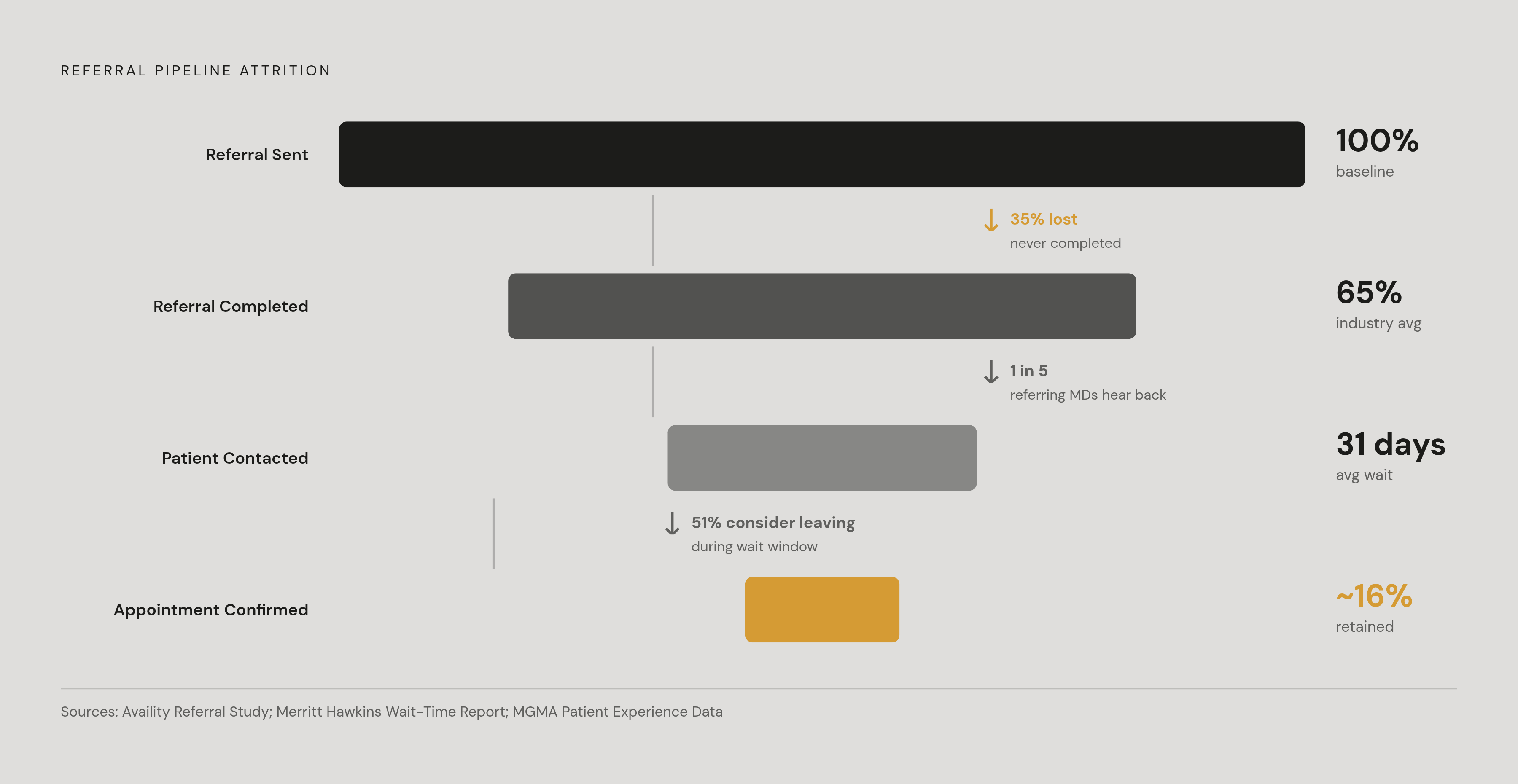
The national average wait for a new patient specialty appointment is 31 days. That number gets treated as a benchmark to hit, but it's actually a countdown clock: every day inside that window is a day a patient can find another practice, get a faster answer, and cancel out of your queue before you've even called them back.
The data backs up why that clock matters. Over half of patients, 51%, say they'd consider leaving a practice over long wait times, and 42% want easier appointment booking. In OB/GYN the average wait stretches to 42 days; in dermatology it's 36.5. Patients sitting in those queues are calling around. They're calling around. And the referral pipeline itself leaks before scheduling even starts: only 65% of referrals industry-wide ever complete, and referring physicians hear back on roughly one in five of the referrals they send. The gap between "referral received" and "patient booked" is where a specialty practice's revenue quietly disappears, and no amount of clinical excellence downstream fixes a scheduling process that loses the patient upstream.
What a new patient scheduling SOP needs to cover in a high-volume specialty context
Once a healthcare practice grows past 25 employees, it typically needs somewhere between 80 and 150 standard operating procedures to run without constant improvisation. Scheduling is a cluster of interdependent protocols that has to function as a single system, because a break at any point in the chain shows up as a lost patient at the end of it. A break at any point in the chain causes a lost patient at the end of it, because it's a cluster of interdependent protocols that has to function as a single system.
A specialty scheduling SOP has to govern five distinct stages: referral intake and qualification (whether the referral arrives by fax, portal, or direct call), insurance eligibility verification and prior authorization triage, patient outreach and self-scheduling, waitlist and open-slot management, and after-hours or overflow coverage. Treat these as four connected functional areas instead, Access, Engagement, Intake, and Payment Capture, rather than as five isolated tasks assigned to five different people with no shared visibility. Isolate the stages and handoff failures appear at exactly the seams where patients fall through: a referral gets qualified but never gets a phone call, or an appointment gets booked before anyone checks whether the payer required prior authorization.
This isn't a hypothetical concern for practice administrators. Practice leaders heading into 2026 consistently identify online scheduling, phone access, wait times, and no-show rates as their top operational priorities. Every one of the five stages above maps directly onto that list. The SOP that governs new patient scheduling either solves those priorities or leaves them as priorities that stay unmet.
Stage 1: Referral intake: standardizing the workflow from fax arrival to qualified record
Fax is still, remarkably, the dominant channel for medical communication between organizations: about 75% of it moves this way. A high-volume specialty practice can expect to receive anywhere from 50 to 200 faxed referrals a day, and each one has to be read, matched to a patient record (or turned into a new one), and entered into the EHR by a staff member.
That manual work costs real time. Estimates put the labor at 15 to 30 minutes per referral once you count reading, patient matching, and EHR upload. For a practice processing 60 faxes a day, that's 15 to 30 hours of staff time every week spent just getting referrals into a usable state, before a single patient has been contacted.
The SOP has to fix five things at this stage. First, a single intake queue: fax, portal, and direct referrals need to converge into one place, not sit in three separate inboxes that different staff members check on different schedules. Second, a triage protocol that flags clinical urgency, insurance type, and service line, since those three variables determine both scheduling priority and which authorization pathway applies. Third, a patient-match rule requiring staff to check for an existing EHR record before creating a new chart; duplicate records corrupt authorization and billing downstream in ways that are expensive to untangle later. Fourth, a stated maximum time-to-qualification, the number of hours from fax receipt to a record ready for outreach, because without a target, intake work simply expands to fill whatever staff time is available. Fifth, clear ownership: who checks the fax queue, how often, and what happens when volume spikes past what one person can handle in a shift.
Automation changes the arithmetic most visibly at this stage. AI fax processing tools can extract demographics, insurance details, referring provider information, and clinical context from an incoming fax in a fraction of the time it takes staff to do it manually, with estimates putting that manual work at 15 to 30 minutes per referral packet. The SOP doesn't need to mandate a particular vendor, but it does need to specify whether this stage is fully human, AI-assisted with a human checking the output, or AI-executed with human review only on exceptions. Leaving that unstated is itself a gap.
Stage 2: Insurance verification and prior authorization triage, run in parallel with intake
Prior authorization is one of the heaviest administrative burdens in specialty medicine. The average physician completes 39 prior authorizations, and staff collectively spend around 13 hours per week on PA-related tasks. That's before counting the downstream cost of getting it wrong: roughly 15% of healthcare claims get denied on first submission, often for reasons that were avoidable, and some of those denials happen even after a service was supposedly pre-approved.
The fix is sequencing. Verification has to happen at intake, not at the point of scheduling. Confirm eligibility before a slot is ever offered to a patient, because booking first and verifying later produces the exact scenario every scheduling coordinator dreads: a patient shows up, or is about to, and then gets turned away or rescheduled because the authorization never went through.
Build a payer-specific PA matrix directly into the SOP: which payer and service-line combinations require authorization, which are exempt, and what documentation each payer wants to see. This becomes reference material that both staff and any automated system need to consult before a submission goes out. Define the trigger point clearly too: PA submission starts once eligibility is confirmed and the clinical documentation from the referral packet is sufficient. If documentation is incomplete, it routes back to the referring office immediately rather than sitting in a coordinator's queue waiting for someone to notice.
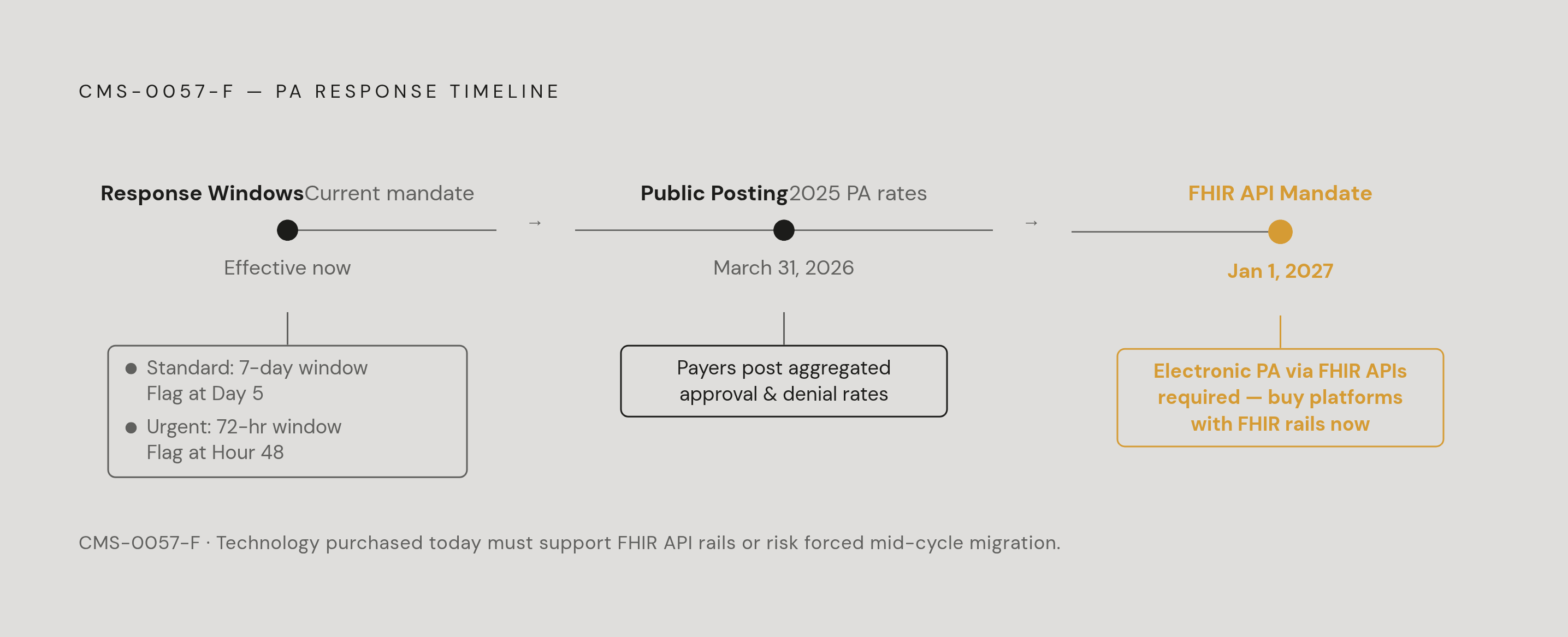
Regulation is now setting the clock on this stage. Under the CMS Interoperability and Prior Authorization Final Rule (CMS-0057-F), impacted payers, including Medicare Advantage, Medicaid managed care, CHIP, and Medicaid and CHIP fee-for-service programs, must respond to standard prior authorization requests within seven calendar days and urgent requests within 72 hours. The SOP should build follow-up triggers around those deadlines: a check at day 5 for standard requests, and one at hour 48 for urgent ones, so nothing silently blows past the payer's own deadline unnoticed.
Two further dates matter for planning purposes. By March 31, 2026, impacted payers are required to publicly post their aggregated 2025 prior authorization approval and denial rates, data that belongs in the PA matrix so cases can be routed toward payers with better-documented approval patterns when a clinical alternative genuinely exists. And on January 1, 2027, CMS-0057-F's mandate for electronic PA submission via FHIR APIs takes effect. Any scheduling or authorization technology purchased now should already be built to connect to those rails, so the practice isn't forced into a disruptive mid-2027 platform migration.
Stage 3: Patient outreach and self-scheduling: converting a qualified referral into a confirmed appointment
Patients have made their preference clear: 89% say the ability to schedule digitally at any time matters to them, and somewhere between 34% and 51% of self-scheduled appointments happen outside office hours. Yet only 11% of medical groups report that most of their patients actually use self-scheduling. That gap, between what patients say they want and what practices actually offer, is the defection window in concrete form.
Outreach speed is non-negotiable at this stage. The first attempt to reach a newly qualified referral needs to happen the same day, not the next business day, because speed to contact is a direct factor in whether the patient books with your practice or another. The SOP should specify the channel sequence too: text message first, followed by a portal message, then a phone call, with a defined retry cadence and a maximum number of attempts before the referral gets escalated internally or returned to the referring provider.
Self-scheduling links matter more than they get credit for. A link pre-filtered for the patient's specific insurance and service type converts; a generic booking link that shows unavailable slots or forces the patient to guess which service they need does not, and abandonment there is common. The SOP also needs to define, in writing, what "confirmed" actually means: insurance verified, authorization either in hand or actively in process, and any required deposit or consent collected. A booked slot missing those elements is not a confirmed appointment, no matter what the calendar says.
After-hours coverage belongs in this stage's SOP explicitly. Whether the practice uses an AI voice agent, an online booking portal, or a live answering service to handle new patient requests arriving outside staff hours, the SOP has to name the method and define what it's authorized to do. One AI voice agent platform in specialty scheduling, Assort Health, answers 80% of calls in under 45 seconds, around the clock, and books directly into the EHR using specialty-specific protocols, a useful reference point for what a practice should hold its own coverage model to, whether that model runs on AI or on people.
The stakes here go beyond the individual appointment. Ease of scheduling is one of the strongest drivers of likelihood-to-recommend scores, which have climbed 2.8 points industry-wide since 2019. The booking experience is part of the practice's reputation. It's part of the practice's reputation.
Stage 4: Waitlist management: turning cancellations and no-shows into filled slots
Practices that have integrated smart scheduling systems are seeing a 30% jump in provider utilization. That figure represents the space between a schedule that looks full on paper and one that's actually full of patients, and closing that gap is what waitlist management is for.
The waitlist itself needs structure. Segment it by service line, provider, insurance type, and patient geography, because an unsegmented list of names can't be worked efficiently the moment a same-day cancellation opens a slot. The SOP should define exactly when outreach starts once a cancellation hits the EHR, ideally within a set window measured in minutes, not "by end of day" or "next morning." It should also specify the fill order (highest clinical priority, longest-waiting patient, or closest proximity to the office, depending on the specialty) and the channel used to reach them.
Set a minimum acceptable fill rate as an actual KPI. Without a target, cancellation recovery becomes an activity people do rather than a result anyone is accountable for. Pair this with a no-show prevention layer, confirmation messages, staged reminders in the days before the appointment, and a same-day reminder, since fewer no-shows reduce reliance on the waitlist.
Computer-use agents fit this stage particularly well, since the work is mechanical and repetitive: monitor the schedule for an open slot, cross-reference it against the waitlist for matching insurance and service type, and start outreach, the exact sequence a coordinator would otherwise do by hand, checking the EHR, checking the waitlist, then picking up the phone. Whatever method a practice uses, the SOP should state how long an open slot can sit unfilled before it triggers escalation. A slot that closes without a patient in it is revenue that's gone permanently. It's revenue that's gone permanently.
After-hours and overflow coverage: the SOP gap that loses the most new patients
Between 34% and 51% of self-scheduled appointments happen outside office hours, making after-hours coverage a significant scheduling channel that most specialty practices leave uncovered or thinly covered. It's a primary scheduling channel. Most specialty practices leave it uncovered or thinly covered, underserving the single largest slice of patient demand for flexibility.
The SOP needs to define "after-hours" with precision: the hours the front desk is unstaffed, lunch closures, holidays, all of it, because vague boundaries produce vague coverage. For each gap, name the coverage tool, an AI voice agent, an online self-scheduling portal, an answering service with a defined handoff protocol, or some combination of these, then state what that tool is authorized to do: book an appointment, triage urgency, take a message, or escalate to a human. New patient referrals arriving by fax or portal outside business hours need their own stated pickup time and a maximum window before first outreach, the same discipline applied to daytime intake.
Whatever gets booked after hours has to flow into the same confirmation and insurance-verification process as anything booked during the day. A separate, unreviewed after-hours queue is where authorization failures quietly accumulate, because nobody checked eligibility before the slot was locked in.
For a sense of what good coverage looks like, one large health system reported cutting average hold time to 28 seconds, against a national average close to 126 seconds. The after-hours SOP should set a response-time standard for whatever digital or AI channel handles new patient inquiries, and that standard should be at or below what the best-performing systems are already achieving. Voice AI covers inbound calls during off-hours, but that's a narrow slice of the total after-hours workload. Fax processing, portal messages, and waitlist outreach all still need to run overnight, and computer-use agents can handle that work autonomously without anyone at a keyboard until morning.
Choosing the right technology architecture for each SOP stage
Five scheduling method types cover the range most practices will encounter, and which one fits depends on patient volume, specialty mix, and how many providers are sharing a single calendar. Technology selection should come after that assessment, not before it; buying a platform and then figuring out where it fits the workflow is how practices end up with tools nobody fully adopted.
Voice AI, traditional automation, and computer-use agents behave differently across the five SOP stages. Voice AI handles inbound and outbound calls and can schedule directly into the EHR through an integration; it's strong for after-hours phone coverage but limited to the voice channel alone. Traditional robotic process automation executes scripted click sequences inside known software interfaces, which works until a payer portal or an EHR layout changes, at which point the automation breaks and needs manual repair. Computer-use agents operate any software interface the way a staff member would, reading the screen, clicking, typing, and navigating, without needing an API integration or a workflow overhaul first. That makes them applicable across every stage of the SOP, from fax intake to EHR data entry to payer portal authorization to waitlist outreach.
That last point matters more in specialty practices than almost anywhere else in healthcare, because a single new patient workflow touches so many disconnected systems, a fax platform, the EHR, a payer portal, a scheduling system, and a separate patient communication tool. Building API integrations across all of them is expensive, and those integrations tend to be fragile, breaking whenever one vendor updates its interface. Computer-use agents work across whatever systems are already in place without forcing a practice to replace its EHR or commission custom integration work, which is a meaningfully lower bar to clear for a practice trying to modernize scheduling without a multi-year IT project attached to it. That's likely why 61% of organizations report they're already building agentic AI initiatives or have secured budget to do so: the technology fits the messy, multi-system reality of how specialty practices actually operate, rather than requiring them to rebuild that reality first.
Sources
- AI agents in healthcare: 12 real-world use cases (2026)
- AI Agent Examples: 10 Real-World Use Cases in 2026
- Best Patient Scheduling Software 2026: 15 Top Picks
- 2026 Guide to Patient Self-Scheduling Software for Specialty Care
- Top 7 Patient Appointment Scheduling Software (July 2026)
- Best Patient Scheduling Software for Every Practice Size
- prombs.com