AI Agent Audit Logs and Accountability in Healthcare Settings
Healthcare AI agents need audit logs built to capture decisions, not just access.
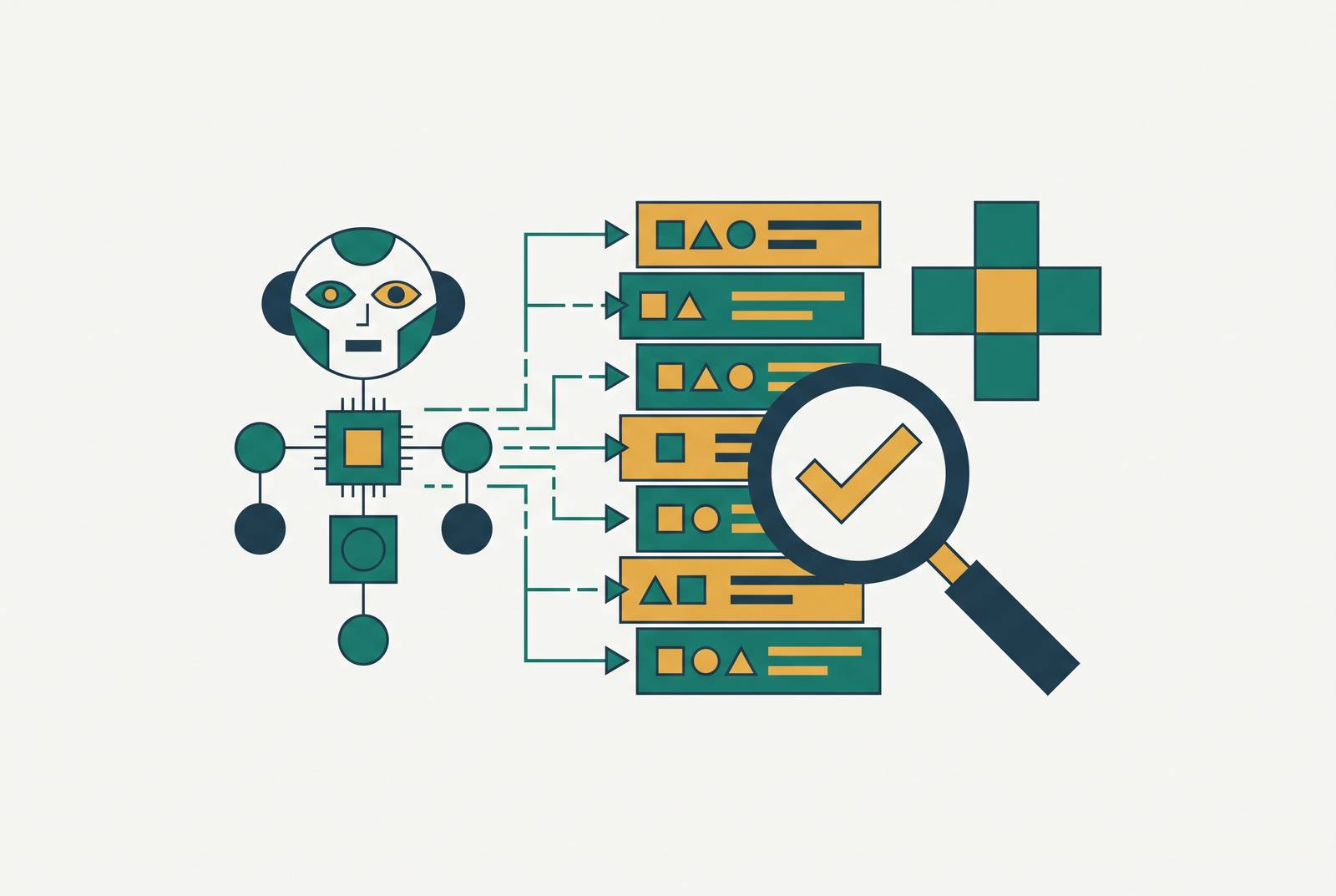
AI agents are no longer pilot projects sitting in an innovation lab somewhere. By HIMSS's 2026 count, 61% of healthcare organizations are already building agentic AI initiatives or have money set aside for them. That number matters because it marks a shift in kind, not just scale: these systems perceive data across EHRs, payer portals, and clearinghouses, decide what to do with it, execute multi-step workflows, and write results back into systems of record, often without a human checking each step along the way.
A human employee who works a denial or processes a prior authorization leaves a mess of evidence behind without even trying, including emails, keystrokes, badge swipes, a note scrawled on a sticky pad, and a verbal aside to a colleague. An agent leaves none of that unless someone builds it in on purpose. That's the accountability gap at the center of this piece, and it's not a small one.
HIPAA's Security Rule was drafted with a human user in mind, someone with a login, a shift, a chair. An agent that touches, edits, and transmits protected health information in milliseconds is operating under those same legal obligations while behaving nothing like the actor the rule was written for. Without a log built to match how these systems actually work, the entire decision chain an agent produces is invisible: not just to regulators, but to payers, to attorneys, and, worse, to the practice that deployed the thing in the first place.
What follows is an argument for what "adequate" actually means here. It is full accountability that goes beyond HIPAA checkbox compliance. It is the full reconstruction of every decision, action, and system touch an agent made, built to the same standard of accountability a human worker leaves behind whether anyone asked for it or not.
What an AI agent does when it processes a prior auth or works a denial, step by step
Take a prior authorization end to end. An agent pulls encounter data out of the EHR, checks that data against payer requirements through a clearinghouse, spots missing documentation, submits the request, watches for a response, and if that response is a denial, kicks off an appeal, all without a person approving each individual step. That is a materially different animal from what healthcare operations teams have automated before.
This is an agent that perceives its environment, reasons, and acts. It's not a macro. It's a system that reasons through each decision as it encounters a live, unpredictable interface. It's not a chatbot answering a question and handing off. The agent perceives its environment, reasons about what it's seeing, and acts, and its decisions aren't pre-scripted the way a rules engine's are. That distinction is the whole reason audit logging has to change.
Computer-use agents raise the stakes further. These systems operate EHR screens, payer portals, and clearinghouse interfaces the way a person would: reading text on a screen, clicking buttons, typing into fields. The "action" a log has to capture is the messy, human-like interaction of reading text on a screen, clicking buttons, and typing into fields. It's an interaction with a live, sometimes unpredictable user interface, and that has consequences for what a usable log entry even looks like.
Consider the friction points that come with that territory: multi-factor authentication handoffs, CAPTCHA interruptions, session timeouts, or a payer portal that shifted its layout overnight. Each of those is a moment where an agent's behavior can look ambiguous, or worse, indistinguishable from an error, unless there's a log entry explaining exactly what it ran into and how it responded.
None of this is happening in a vacuum, either. Payer-side AI is already denying claims at a pace no human review team could match, and the share of providers reporting denial rates above 10% climbed from 30% in 2022 to 41% in 2025. Provider-side agents are being built to respond in kind, which means the audit log has to capture both halves of that exchange, including the provider's side of the conversation. Every one of those micro-decisions, the ones an agent makes dozens of times inside a single workflow, is something that could eventually be audited, disputed, or argued over in a deposition.
What HIPAA requires from an audit log, and the shortfalls of those requirements for agents
The statutory floor is 45 C.F.R. §164.312(b): covered entities have to implement mechanisms that record and examine activity in systems containing ePHI. That's the baseline, and it breaks into three required categories. User audit trails cover user ID, log-on and log-off times, and authentication attempts. System audit trails cover credentials, timestamps, device identifiers, IP addresses, and whether access came from inside or outside the firewall. Application audit trails, meanwhile, track when ePHI files are accessed, created, modified, or deleted.
Layered on top of that is the minimum necessary standard under 45 CFR 164.502(b): an agent is only supposed to touch the PHI its specific task requires. A scheduling agent has no legitimate reason to pull a full clinical note. The log has to actually demonstrate that boundary held, not just assume it did because nobody complained.
Retention adds another layer. HIPAA guidelines call for six years of records; OMB M-21-31 tacks on a requirement that logs stay accessible online for 12 months and archived for 18 months; and for High-Impact AI systems specifically, OMB M-25-21 requires documenting the AI model version and the prompts used to generate outputs. That last piece is where the framework starts showing its age.
HIPAA's audit provisions were built around a world of human users with stable identities: one person, one login, one shift. They were never written to answer which model version made a given decision, what reasoning produced a specific output, or how one agent delegated a task to another in a multi-agent handoff. Nor does HIPAA require tamper-evidence or cryptographic integrity for these logs; the rule requires that logs exist, not that they can't be quietly altered after the fact. Where HIPAA falls short for agents, its audit requirements were designed around human users with stable identities. They do not address which model version made a decision, what reasoning produced a specific output, or how a multi-agent handoff was delegated. The gap is that a log which satisfies HIPAA's letter can still be useless in a dispute because it cannot reconstruct why the agent did what it did.
What a genuinely accountable audit log must capture that HIPAA does not mandate
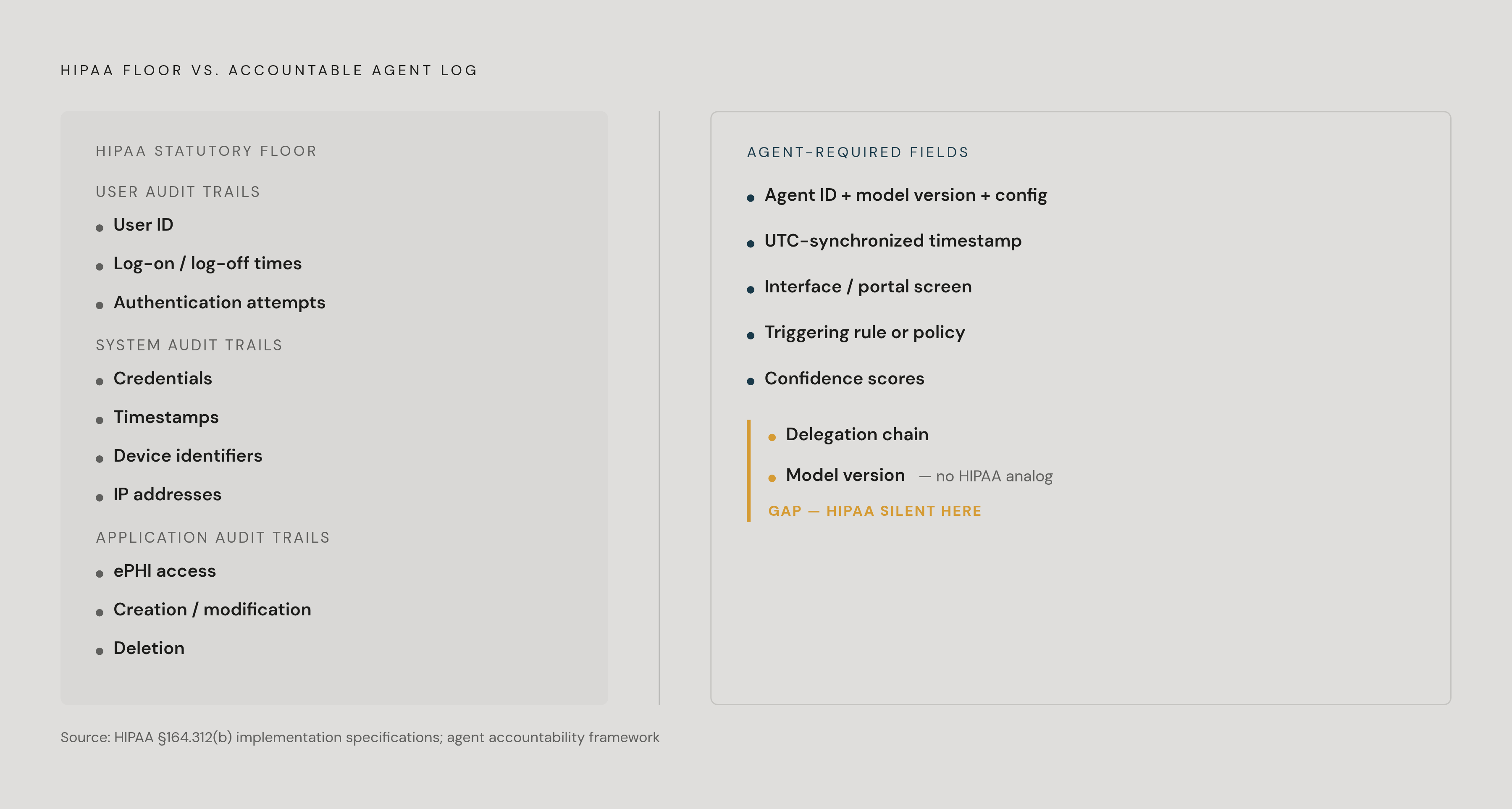
Censinet's 2026 documentation guidance lays out a six-element standard that closes some of that gap. Every log entry should capture who, what, when, where, why, and outcome. For an agent, "who" isn't just a user ID, it's the agent ID, the model version, and the exact configuration running at the moment of the action. "When" The timestamp needs to be synchronized within one minute of UTC, as OMB M-21-31 requires. "Where" covers IP address and device, and for a computer-use agent specifically, the actual interface or portal screen it was operating on when it acted. "Why" means the triggering rule, policy reference, or SOP that caused the action to happen at all.
Agents also generate fields that simply have no human equivalent. Model version and the prompt used to generate an output are mandated for High-Impact AI systems under CMS's OMB M-25-21 guidance Censinet. Confidence scores matter too, wherever an agent chose between competing paths and had to weigh one against another. Delegation chains matter in multi-agent setups: which orchestrating agent instructed which sub-agent, and under what policy authority. Stale retrieval is a genuine audit risk in its own right; an agent reasoning over an 18-hour-old care plan can produce a materially different outcome than one working from the current version, and if the log doesn't show what was retrieved and when, there's no way to know after the fact which version drove the decision.
Tamper-evidence closes the loop. The ALCOA+ principles, cited in Censinet's guidance, require log data to be attributable, legible, contemporaneous, original, and accurate, plus complete, consistent, enduring, and available. Cryptographic hashing and immutable storage are how that gets implemented in practice. For clinical decision support specifically, audit trails need the source data, the processing steps, and the confidence score behind each automated decision.
None of this is pure overhead, either. Organizations running audit trails built to this standard save somewhere between 40 and 60 hours per compliance audit and cut disputes over AI-driven decisions by roughly 60%, hours a practice gets back. That's a direct return on operational time. That's hours a practice gets back.
Why the PHI exposure surface for agents is wider than most compliance teams expect
Traditional audit architecture was built around a database and a query log. Atlan's 2026 analysis identifies three PHI exposure surfaces that traditional audit architecture was not built for. First, training data: PHI can get embedded directly in model weights during fine-tuning on clinical notes, and it can be reproduced through adversarial prompting regardless of whatever access controls sit on the original source tables. Second, retrieval windows: RAG-based agents pull PHI into their context window the moment they retrieve it, which means the minimum necessary standard requires logging what got retrieved, full stop, not just what the agent eventually decided to use. Output logging is required here because it is the only place where exposure appears.
There's a structural wrinkle underneath all of this, too. A lot of RAG architectures store patient data inside vector databases, and those embeddings create their own deletion obligations, the kind GDPR Article 17 spells out, that log design has to account for from the start. Deleting a row in a source table doesn't mean the information is gone if a copy of it is sitting inside an embedding somewhere.
Cross-organization workflows make exposure worse, not better. The moment an agent interacts with a payer portal, it's crossing an organizational boundary, and evidence of what was sent, what came back, and what each party did with it becomes the thing that matters most if a dispute ever occurs. Researchers at Northern Arizona University, working on cross-organization agent messaging, have proposed preserved evidence-bundle models built specifically for this scenario, because the live systems involved may simply be unavailable, or controlled entirely by the other party, by the time anyone goes looking. The practical takeaway for log design is that access controls and logging need to live at the point where context gets delivered to the model. A scheduling agent that pulls a full chart when it only needed a name and a time slot has logged a minimum-necessary violation. That's not a design inefficiency. That's a compliance finding waiting to happen.
The enforcement reality practices are already operating inside
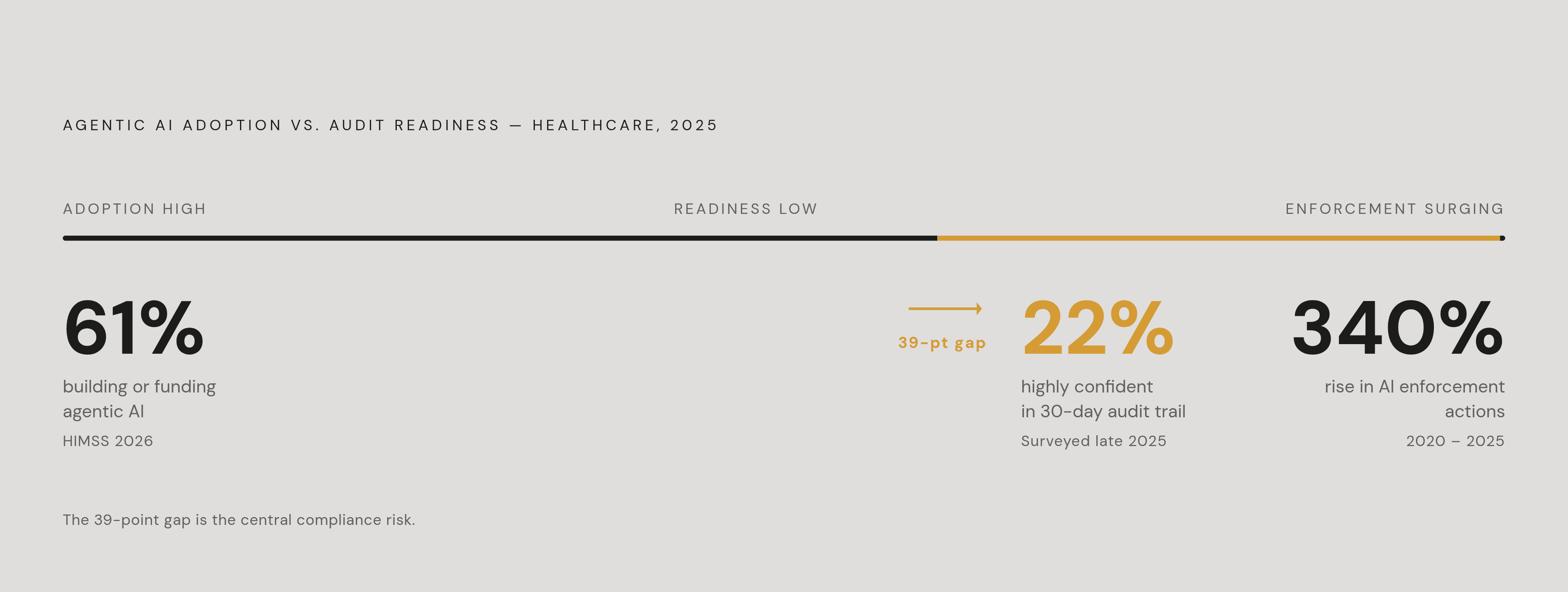
Readiness is not keeping pace with deployment. Surveyed in late 2025, only 22% of hospital leaders said they were highly confident they could produce a 30-day AI audit trail if a regulator or a payer asked for one Censinet. That gap between how fast these systems are getting deployed and how ready anyone is to explain them is not a footnote; it's the central risk of this entire moment.
OCR's Phase 3 audits are already running across 50 entities, and the most common finding coming out of them is incomplete risk analysis. Any AI deployment running without a documented audit trail sits directly in that blast radius. A single AI tool that touches PHI without proper approval, or without adequate logging, is enough on its own to add a practice to that count Automation Anywhere. And the trend line isn't flattening: AI-related enforcement actions rose 340% between 2020 and 2025 Censinet.
Litigation is moving just as fast. In Lokken v https://arxiv.org/pdf/2605.21816. UnitedHealth Group, a federal court order issued in March 2026 compelled broad discovery into UnitedHealth's nH Predict algorithm, granting or partially granting six of the seven document categories plaintiffs asked for Agentic AI in Healthcare: Navigating Regulatory Uncertainty and Build…. Plaintiffs allege the algorithm drove post-acute care denials that were reversed on appeal roughly 90% of the time Agentic AI in Healthcare: Navigating Regulatory Uncertainty and Build…. This is the first major case where an AI decision system's internal logic has been forced into the open through discovery, and the audit log is the only mechanism available to reconstruct that logic after the fact. Plaintiffs' attorneys aren't waiting for governance frameworks to mature, either: the same firms that built a business around website-disclosure litigation are already moving into ambient AI and wiretapping claims, and medical malpractice attorneys are watching agentic AI specifically.
International exposure adds a deadline of its own. Any US practice with international exposure should treat that timeline as real pressure, not distant paperwork. EU AI Act Article 12 requires automatic logging for high-risk systems; the Digital Omnibus on AI, proposed November 2025 and adopted June/July 2026 (Parliament 16 June, Council 29 June, in force 27 July 2026), defers Annex III obligations to December 2, 2027 and Annex I to August 2, 2028 (US-based organizations with any international exposure should note the window is closing).
How to structure audit logging for agents that operate across multiple systems in a single workflow
A single prior auth workflow can touch the EHR, a payer portal, a clearinghouse, and an internal task queue, and every one of those systems generates its own separate event record. The job of the audit trail is to stitch those fragments into one coherent chain that shows what the agent did, in what order, and why, because none of those systems was built to talk to the others in a way that tells the full story on its own.
Scope enforcement has to come first. Each agent should operate inside a defined boundary, what systems it can touch, what data it can pull, and the log has to show that boundary was actually honored during the run, not merely that the agent completed its task. That's the only way minimum-necessary compliance becomes something a practice can actually demonstrate rather than assert.
Human-in-the-loop checkpoints deserve their own event type in the log, distinct from everything else the agent did. For any workflow carrying real clinical or financial risk, the record should show who approved an escalation, at what point in the process, and what the agent was proposing to do before that human stepped in. Cross-organization exchanges need something sturdier still: when an agent hits a payer portal, the log has to preserve evidence that both sides can independently verify later, sender authentication, an authenticated commitment on the log itself, the full delegation chain, not just one side's private record of what it believes happened. The preserved evidence-bundle model proposed by Alshammari and Bahsi in 2026 was built for exactly this kind of agent-to-agent exchange.
Incident response has to be written before any of this goes live, not improvised afterward. That means documented escalation paths for unsafe outputs, a defined workflow for privacy events, and a protocol for catching model drift before it causes damage. The audit log feeds every one of those processes, which means it cannot be retrofitted once an incident has already happened; by then the evidence that would have explained it is usually already gone.
A working checklist follows from all of this. Log storage needs to be immutable and tamper-evident, secured with cryptographic hashing. Timestamps need to be synchronized within one minute of UTC across every system touched in a given workflow. Agent ID and model version belong on every single entry. Retrieval records need to show what the RAG layer actually surfaced. OMB M-21-31 requires storage to have real-time alerts once utilization crosses 80%. A BAA is required with every vendor in the chain that touches PHI, since compliance depends on deployment and legal terms, not the model.
What good audit log design means for staff, operations, and the practice's ability to improve over time
The same log built to satisfy a regulator turns out to be the best performance record a practice has. It shows whether an agent completed workflows correctly, where it escalated something it shouldn't have, and where it simply stalled out, which is exactly the data a practice needs to judge whether its automation is actually delivering against the KPIs it was built to hit.
Staff benefit from this directly. An agent running with a full audit trail can be supervised and corrected the same way any new hire would be, because the log shows precisely where it deviated from the expected workflow. Retraining becomes targeted instead of a guessing game.
40 to 60 hours are saved per compliance audit, and disputes over AI-driven decisions are cut by around 60%. Time not spent reconstructing what happened last quarter is time spent managing what's coming next quarter.
There's a trust dimension here too, and it's not soft. A practice that can hand a payer, a patient, or a regulator a complete record of every decision an agent made is standing on far firmer ground than one that can't, and as payer-side AI keeps getting more aggressive about denials, that documentation of process is increasingly the thing a denial dispute turns on. Censinet's 2026 governance guidance is blunt about the sequencing: the audit-ready record, covering how a model was built all the way through to how it's supervised day to day, needs to exist before a system goes live, not after something goes wrong.
Computer-use agents fit this model particularly well, precisely because of how they work. They operate existing systems the way a person would, without requiring new API integrations or a wholesale EHR replacement, which means their logs can be structured to mirror the same accountability trail a human employee leaves behind, just in a form nobody has to piece together by hand.
Sources
- AI Agents in Healthcare: Build Trust & Compliance in 2026
- HIPAA Compliant AI: Tools and Agents for Healthcare | Automation Anywhere
- The Audit Trail Imperative: Documentation Standards for Healthcare AI | Censinet
- Offline-Verifiable Accountability for Cross-Organization Agent Messaging: A Preserved Evidence-Bundle Approach
- Agentic AI in Healthcare: Navigating Regulatory Uncertainty and Building Governance That Lasts
- Why 2026 May Be the Defining Year for AI Governance in Healthcare | Censinet
- AI Agent Examples: 10 Real-World Use Cases in 2026