Gold Carding Programs and Prior Auth Exemption Pathways
Gold carding offers partial PA relief, but qualification rules vary sharply by payer and state.

Gold carding lets a doctor skip prior authorization on specific procedures if their approval history proves they don't need the checkpoint. It sounds like a fix for one of medicine's most hated administrative habits, and in a narrow sense, it is. But the qualification bars, the payer-by-payer scope, and the state-by-state patchwork mean the relief is real only for a slice of providers on a slice of their work. Understanding exactly where that slice ends is the first step any practice needs before leaning on gold carding as a strategy rather than a footnote. Gold Carding Programs and Prior Auth Exemption Pathways.
Why prior authorization remains a defining operational burden for medical practices
Prior authorization is a structural cost center tucked into the billing process. It's a structural cost center that eats staff time, delays care, and shows up on the bottom line every single month. The AMA's 2024 physician survey found that 93% of physicians say PA delays patient care, and 29% have watched a serious adverse event unfold, including hospitalization or permanent harm, because a treatment sat waiting on approval. That's a patient safety problem dressed as an administrative detail. That's a patient safety problem wearing an administrative costume.
The dollar figures back up what the survey suggests. MGMA research shows PA staffing spend at practices rose 43% between 2019 and 2024, even while reimbursement failed to keep pace. A study found that 92% of medical groups have hired or reassigned staff specifically to handle prior authorizations, which tells you this has become its own dedicated task, separate from existing workflows chartahealth.com. It's its own job function.
The weight falls unevenly. High-volume specialties and multi-location groups carry a disproportionate share of the PA load, simply because volume multiplies the friction. And the downstream effects compound: denied claims, delayed care, staff attrition, and revenue that leaks out through the cracks. Experian Health's State of Claims report found 41% of providers now report more than 10% of their claims denied, up from 30% in 2022 Prior Authorization White Paper MultiState. So gold carding changes some of this in a way that matters, but only for whom it applies. The answer, as the rest of this piece lays out, is yes, but only for the providers and procedures that clear a fairly high bar.
Gold carding and how the exemption mechanism works
Gold carding exempts individual providers, not entire practices by default, from PA requirements on specific procedures, based on a documented track record of high approval rates. If a provider consistently gets approved for a given service, the PA step is adding friction without changing the outcome, so the exemption just removes the friction.
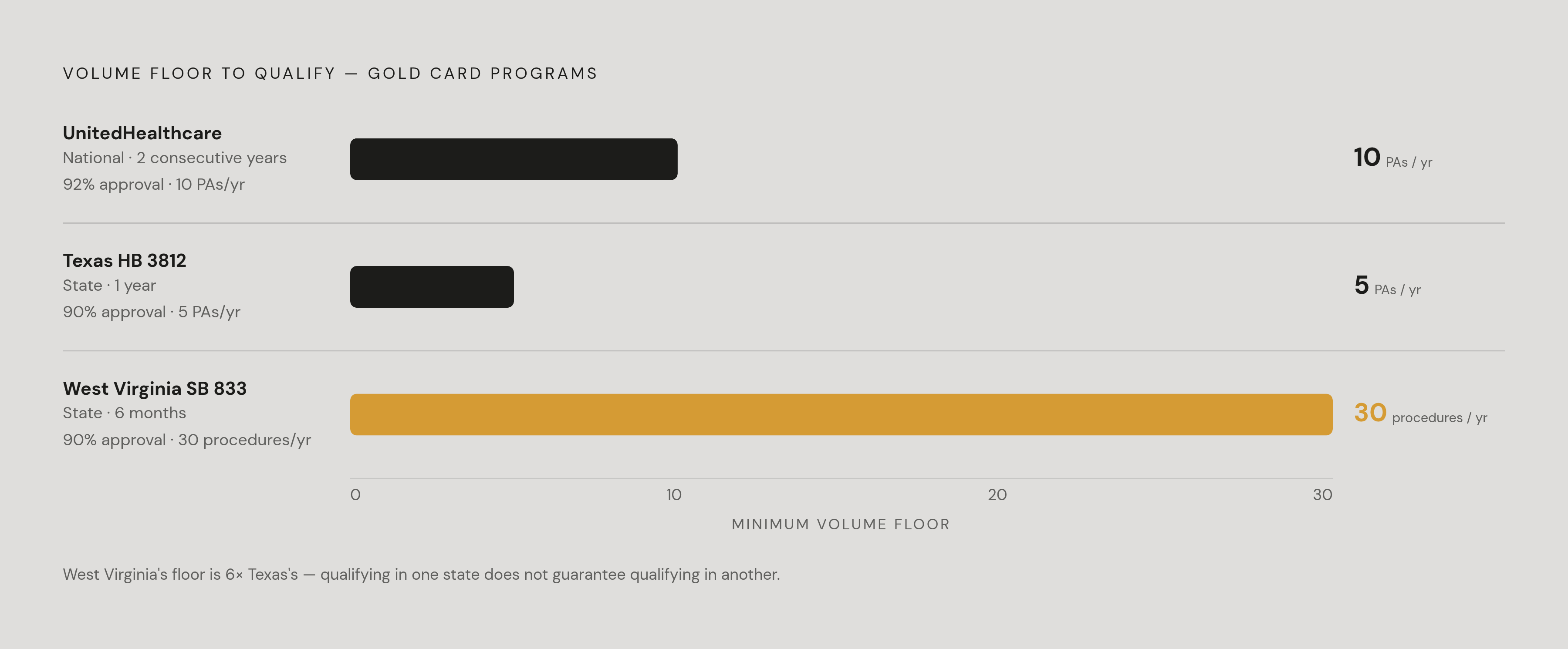
But approval rate alone doesn't qualify anyone. There's also a volume floor, a minimum number of PA requests submitted during the look-back period, and this is where programs start to diverge sharply. UnitedHealthcare's national Gold Card program requires at least 10 eligible prior authorizations in each of two consecutive years Prior Authorization White Paper MultiState. Texas law under HB 3459 requires only 5 over a six-month period Prior Authorization White Paper MultiState. West Virginia asks for an average of 30 procedures per year Prior Authorization White Paper MultiState. Three programs, three very different definitions of "enough history to trust."
Once a provider qualifies, the exemption usually runs six to twelve months forward, and the health plan decides the exact length. In practice, qualifying providers don't skip notification altogether, they follow a simplified advance notification process for eligible codes instead of submitting full clinical documentation. Under UHC's program, that notification confirms eligibility and network status but doesn't require clinical information.
None of this adds up to a provider being free of PA altogether. Gold carding is procedure-specific: a provider might be exempt on certain codes and still face full authorization requirements on everything else. Status doesn't mean PA disappears, it means PA is waived for the specific services where approval history already lines up with clinical criteria. That granularity, procedure by procedure and plan by plan, is what makes gold carding useful in a limited way rather than transformative. Most programs require between 80%–90% PA approval rates to qualify, while some reach as high as 95–100% Prior Authorization White Paper MultiState. The look-back period typically evaluates six to twelve months of historical data, though Texas HB 3812 extended this to one year.
The state legislative landscape of gold carding programs
As of 2026, states with active gold carding legislation include Texas, Louisiana, West Virginia, Vermont, Colorado, Michigan, Arkansas, and Wyoming, with more under active consideration. The 2025 legislative session saw Arkansas, Texas, and West Virginia each amend their existing programs, and the direction of travel is expansion and refinement, not retreat.
Texas remains the bellwether. Under HB 3812, the look-back period stretched from six months to a full year, and providers now need at least 5 eligible prior authorizations for each specific service during that year, with a 90% or greater approval rate. This only applies to state-regulated insurers, which cover roughly one fifth of the state's market. Arkansas's HB 1301 took a different tack in 2025, removing insurers' ability to strip gold card status just because a provider's gold-carded procedure volume rose by 25%, and extending the privilege to the provider's whole group practice CMS. West Virginia's SB 833 requires an average of 30 procedures a year and a 90% final approval rating over six months, with insurers barred from requiring PA for at least the following six months.
California's approach, under SB 306, is structurally different: instead of an individual-provider exemption, it mandates exemption from PA for any service approved 90% or more of the time, phased in on a set timeline. Plans report approval-rate data by service category by the end of 2026, the exemption list publishes in July 2027, and the mandate itself takes effect no later than January 1, 2028. The law carries a 2034 sunset clause and carves out exceptions for experimental treatments and fraud concerns tied to specific providers.
Not every state is building a gold card program. Iowa's HF 303 dropped its gold card pilot before passage and instead set decision timeframes, 48 hours for urgent requests, 10 calendar days for non-urgent ones, along with annual reporting to the Insurance Commissioner. Indiana's SB 480 set similarly tight windows, 24 hours urgent and 48 hours non-urgent, and requires new insurers to honor a previous insurer's authorizations for at least the first 90 days of coverage. Maryland's HB 820 goes after a different problem altogether, requiring insurers using AI in utilization review to rely on patient-specific data rather than group datasets, and to report to the Insurance Commissioner whenever AI contributes to an adverse determination.
Montana's HB 398 requires new plans to honor prior approvals for at least three months after a plan switch, restricts adverse determinations to physicians with the relevant specialty, and makes PA approvals valid for a full year for enrollees with chronic conditions. Across several states now, continuity of care has become its own parallel trend, with new plans required to honor prior authorizations from 90 days up to a full year, especially for chronic and rare conditions.
The scope limit that cuts across nearly every one of these programs is the same one: state gold card laws only reach state-regulated insurance markets. In many states that's a fraction of the commercially insured population, since self-funded employer plans fall under ERISA and sit outside state authority entirely. States including Maryland are moving to constrain how insurers use AI in adverse determinations, which is relevant context for any practice tracking gold carding and automation as part of the same workflow.
Voluntary payer programs: how UnitedHealthcare's Gold Card and CMS's WISeR model extend exemption beyond state law
State law isn't the only place gold carding lives. Both matter precisely because they reach populations state law can't touch.
UHC's program launched October 1, 2024, with its third annual eligibility update published September 1, 2026. UHC calls it a "first-of-its-kind national" program built to recognize provider groups that consistently follow evidence-based care guidelines. Qualification requires being in-network for at least one line of business, a minimum of 10 eligible prior authorizations in each of two consecutive years across Gold Card eligible codes, and a PA approval rate of 92% or higher in each of those two years, calculated after appeals chartahealth.com. Starting October 1, 2026, more provider groups become eligible, and status shows up directly in the UHC Provider Portal CMS. Since launch, the number of qualifying provider groups has grown 80%, and in UHC's own survey of its most active Gold Card users, 94% reported overall satisfaction, with the same share saying the program cut down their administrative work.
UHC has paired the program with other PA reductions: eliminating authorization requirements for 30% of healthcare services that previously required approval, exempting qualifying rural providers from most medical PA requirements, and removing two-thirds of authorization requirements for members under age 18 by year's end.
CMS's WISeR model, launched January 1, 2026, takes a different shape entirely: a six-state Medicare pilot built around AI-powered prior authorization, running in New Jersey, Ohio, Oklahoma, Texas, Arizona, and Washington. It's a six-year model, running from January 1, 2026 through December 31, 2031. Participant portals went live January 5, 2026, and PA requests submitted through them get a 72-hour turnaround, a rule that applies to dates of service on or after January 15, 2026. Anything rendered before that date sits outside WISeR's reach. The model doesn't change Medicare payment rates, but providers in WISeR states who choose not to submit a PA request face pre-payment medical review instead, for dates of service on or after January 15, 2026. CMS published the participant list on November 6, 2025, and providers with questions can reach out to their MAC, whether that's Noridian, Novitas, or CGS, or the model participant directly.
Taken together, UHC's program and WISeR show that voluntary and federal programs are stepping into gaps that state law simply can't reach, particularly for self-funded plans and Medicare populations. For any practice working with more than one payer, that means gold card eligibility has to be tracked separately, payer by payer. There's no such thing as a single, unified gold card status that follows a provider across every plan they touch. Two significant national programs operate independently of state mandates: UHC's voluntary Gold Card and CMS's WISeR Medicare pilot. Gold Card status applies across UHC Commercial, Individual Exchange, Medicare Advantage, and Medicaid plans, while delegated membership is excluded.
The limits of gold carding: why qualification rates and scope are smaller than they appear
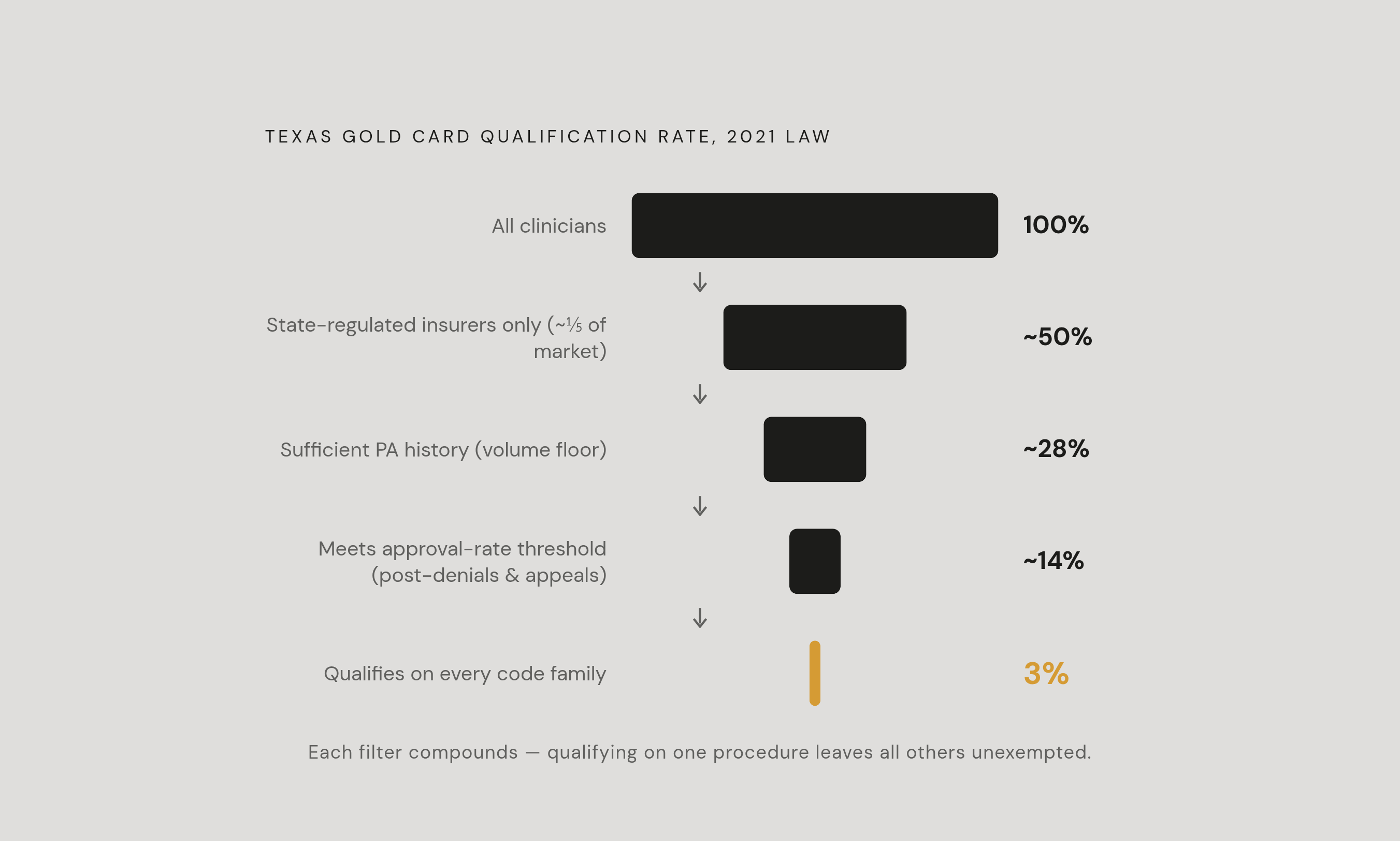
Texas offers the clearest cautionary tale here. It's an early adopter, with a law dating back to 2021 and amended twice since, and yet testimony from the Texas Department of Insurance put the actual qualification rate at just 3% of clinicians statewide. Dr. Ezequiel "Zeke" Silva III, who chairs the Texas Medical Association's Council on Legislation, called the result "underwhelming," adding: "We would have hoped for a greater percentage of our physicians to have been granted the 'gold card' status". That's a widely shared complaint among physicians. That's the chair of the state medical association's own legislative body saying the flagship program fell short of expectations.
Several mechanical reasons explain why qualification rates stay this low. Volume floors filter out providers who simply don't submit enough PA requests during the look-back window, regardless of how clean their approval history is. Approval-rate thresholds get calculated after denials and appeals run their course, so a provider with strong final outcomes can still land below 90% if the plan is measuring initial determinations rather than the appealed result. And because exemptions are procedure-specific, qualifying on one code family doesn't touch the rest of a provider's PA workload at all. Add the scope limit already covered, state laws reaching only state-regulated insurers, which in Texas means roughly a fifth of the commercial market, with self-funded employer plans sitting entirely outside the law's reach, and the picture narrows considerably.
There's also a category of PA that gold carding barely touches at all. Most current programs focus on medical-benefit PA, while pharmacy-benefit specialty drug authorization remains largely untouched, West Virginia explicitly exempted prescriptions, and CMS-0057-F doesn't currently apply to drug PA either. Payers themselves reportedly acknowledge, internally, that somewhere between 40% and 60% of PA requests could be auto-approved without any real risk, but operational habit and contractual inertia keep that reform incremental rather than structural. Gold carding reduces PA friction for a subset of providers, on a subset of procedures, within a subset of their payer mix. That's a real benefit. It's also a bounded one, and treating it as a full solution to the PA burden would be a mistake.
CMS-0057-F, the federal regulatory layer that operates parallel to gold carding
Running alongside all of this state and payer-level activity is a federal rule that reshapes the PA process itself, without exempting anyone from it. CMS-0057-F, the Interoperability and Prior Authorization Final Rule, applies to Medicare Advantage organizations, Medicaid managed care plans, CHIP entities, and ACA exchange plans. It sets hard decision timelines already in effect: seven calendar days for standard requests, 72 hours for urgent ones.
Starting in January 2026, every denial has to come with a specific, structured reason attached to it, closing the door on vague "not medically necessary" rejections that leave providers guessing. Payers also have to publish annual PA metrics, approval rates, denial rates, average decision times, with the first reports due March 31, 2026. The rule's biggest technical lift lands January 1, 2027, when payers must have HL7 FHIR-based APIs live for electronic PA, opening up real-time interoperability between payer systems and provider EHRs. CMS projects the rule will save the healthcare system around $15 billion over ten years.
One carve-out matters as much as anything the rule does cover: it doesn't currently apply to drug prior authorizations, though a CMS proposal on the table would eventually bring drug PA into the same interoperability framework healthcarebusinesstoday.com. That proposal isn't finalized yet. Related certification work is already moving, though. HTI-4, finalized July 31, 2025, adds certification criteria for electronic prior authorization and real-time prescription benefit, directly relevant to EHR-embedded PA and prescribing workflows. ONC's proposed HTI-5 rule, floated in December 2025, would strip out more than half of the current certification criteria if it goes through, which would ease compliance burden considerably, but as of now it remains unfinalized healthcarebusinesstoday.com.
Compliance pressure is starting to bite. Payers who fail to comply face public reporting of their decision timelines and denial rates, and that kind of exposure is pushing compliance pressure up into C-suite priority queues and compressing procurement evaluation cycles. For practices watching all of this unfold, the takeaway is straightforward: CMS-0057-F doesn't exempt anyone from prior authorization. It restructures the process around it, tighter timelines, denial reasons that actually mean something, electronic workflows replacing fax machines and portals. That's friction reduction through a different mechanism than gold carding, running on a separate track, but aimed at the same underlying problem.
Sources
- Prior Authorization White Paper
- Prior Authorization Reform Gains Momentum in States | MultiState
- How the UnitedHealthcare Gold Card program helps modernize prior authorization | UnitedHealthcare
- WISeR Model Frequently Asked Questions | CMS
- State-Mandated ‘Gold Card’ Programs to Ease Prior Authorization Burdens Offer Little Relief, Experts Say
- AMA survey: Prior authorization reform pledge falls short with physicians | American Medical Association
- CMS Interoperability and Prior Authorization Final Rule (CMS-0057-F) | CMS