Clearinghouse Rejection vs Payer Denial Differences in Medical Billing
Clearinghouse rejections are fixable errors; payer denials demand formal appeals.

Every biller has gotten the call: a claim comes back with the word "rejected" stamped on it somewhere, and the first question isn't "why," it's "from whom." A clearinghouse rejection and a payer denial are not two flavors of the same problem. They happen at different points in the claims lifecycle, for different reasons, and they demand entirely different responses. Confuse them, and the consequences aren't cosmetic: treat a denial like a quick resubmit and the appeal window closes behind you; treat a rejection like a formal denial and staff burn hours drafting an appeal for something a five-minute typo fix would have solved.
Industry sources report that roughly 20% of all medical claims come back denied, rejected, or underpaid, and up to 60% of those never get resubmitted. That failure to act traces back, more often than billing teams want to admit, to a failure to correctly identify what kind of failure they're looking at. This piece is for the practice administrators, billing staff, and revenue cycle managers who see both events daily and need a working mental model for triaging them fast and correctly.
What a clearinghouse does before a claim reaches a payer
A clearinghouse sits between the provider's billing system and the payer, and its job is narrow but essential: scrub the claim for technical validity before it ever reaches anyone who makes a coverage decision. It checks that required fields are populated, that formatting matches what the specific payer expects, that codes are structurally valid, and that basic demographic data lines up internally. Patient name, date of birth, member ID, payer ID, diagnosis code validity, referrer ID presence, zip code validity, format compliance, these are the gatekeeping checks a claim has to clear before it's even allowed into the payer's world.
That last point matters more than it sounds like it should. A claim that fails clearinghouse scrubbing never enters the payer's adjudication system. The payer hasn't seen it. The payer hasn't made a coverage decision on it. There is no record of it existing anywhere in the payer's files, because it never arrived. That single fact is the hinge the rest of this article turns on.
The infrastructure behind this scrubbing step is more fragile than most practices would like to believe. The February 2024 ransomware attack on Change Healthcare, attributed to the ALPHV/BlackCat group, took down claims processing across a huge swath of the industry overnight. A survey of nearly 1,000 hospitals conducted by a national hospital trade group found that 94% reported a financial impact, 33% lost more than half their revenue during the disruption, and 60% needed anywhere from two weeks to three months to get back to normal operations. The TriZetto Provider Solutions breach, occurring in the 2025–2026 timeframe, exposed protected health information for around 3.4 million individuals, and it drove the same lesson home for mid-market practices that don't run at hospital scale but depend just as heavily on a single clearinghouse vendor. Single-vendor dependency in the claims pipeline is a documented risk. It's a documented one.
What a clearinghouse rejection requires
A rejection happens when the clearinghouse, or sometimes the payer's own front-end validation layer, spots a discrepancy that stops the claim from moving forward. The claim bounces back to the provider before adjudication ever starts. It hasn't been evaluated on its merits, because it's incomplete. There's nothing to evaluate.
The causes tend to cluster around the same handful of culprits: invalid or missing patient information (wrong name, wrong date of birth, mistyped member ID), a missing or incorrect payer ID, a missing referrer ID where one's required, a diagnosis code that's truncated or from the wrong code set or listed out of sequence, a zip code that doesn't match the state on file, formatting errors or stray special characters sitting in the wrong field, a duplicate submission, or a claim that missed the payer's filing deadline.
Fixing a rejection is mechanical. Read the rejection report, which clearinghouses typically return within 24 hours, identify the flagged error, correct it, and resubmit. No formal appeal, no supporting documentation packet, no waiting on a payer's review board. The rejection code names the problem directly, which is more than a denial is ever obligated to do. Resolution runs in hours to a few days, and the cash flow hit, if the correction happens promptly, is a delay rather than a loss.
The catch is that the filing deadline clock doesn't pause just because a claim got kicked back. It keeps running from the original date of service. A rejected claim that sits untouched in someone's queue past the payer's timely filing limit can become permanently unpayable because it was never resubmitted in time. A five-minute fix ignored for three weeks turns into money the practice never sees.
What makes a payer denial harder to resolve
A denial is a different animal. It happens after the claim has already passed clearinghouse scrubbing, entered the payer's system, gone through adjudication, and come out the other side with a decision: the payer isn't paying. The claim was complete. It was evaluated. The problem isn't missing data, it's a judgment call the payer made about coverage or policy.
The most common reason, across the sources, is a service simply not covered under the patient's plan. Beyond that: prior authorization that should have been obtained before the service but wasn't, a medical necessity determination where the payer decides the documentation doesn't justify the procedure, an out-of-network provider, benefits exhausted or policy limits already met, a patient who wasn't actually enrolled on the date of service because coverage lapsed or terminated, a credentialing inconsistency, a coordination of benefits dispute over which payer is primary, or a coding and documentation issue that slipped past clearinghouse scrubbing but failed the payer's own clinical review.
Resolving a denial requires a formal appeal. That usually means gathering additional documentation, sometimes looping in the patient directly, and often engaging the payer in a back-and-forth that has nothing to do with fixing a typo. Payers are required to give a specific reason for a denial, which stands in contrast to rejections and gives billing staff something concrete to build an appeal around.
The financial stakes compound quickly. A denial that exhausts every appeal option becomes uncompensated care, full stop. Yet according to the same sources, 65% of denials never get reworked at all, largely because staff simply don't have the bandwidth. Denial rates vary sharply by payer and plan type: the national average for in-network ACA Marketplace claims sat at 19% in 2023, out-of-network claims averaged 37%, and employer-sponsored plans averaged 21%. Individual insurers spread even wider, with some denying below 7% of claims and others denying more than a third.
A direct comparison of rejections and denials across the dimensions that drive billing decisions
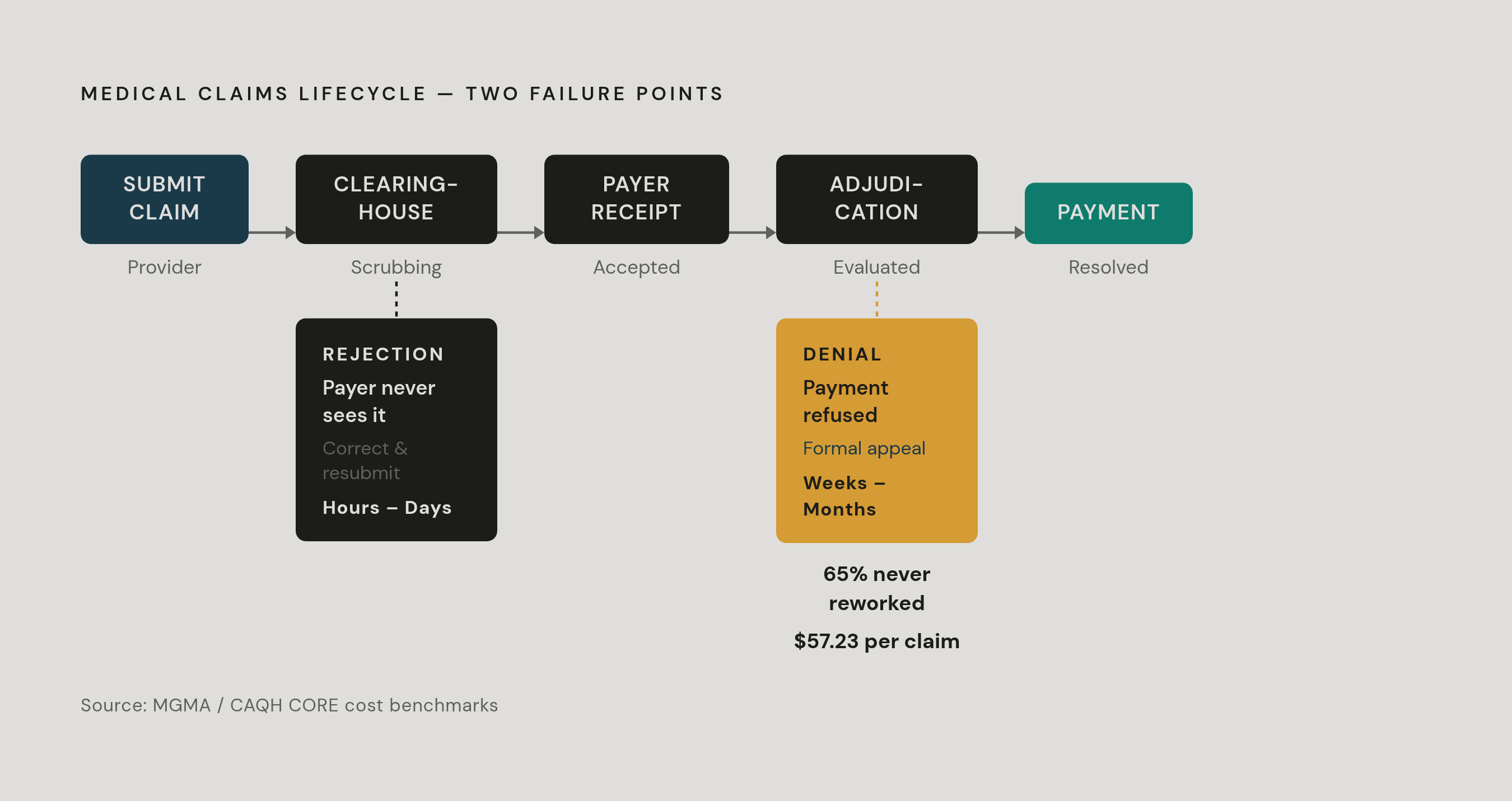
Laid side by side, the two events diverge on almost every axis that matters to a billing department.
On timing: a rejection happens before the payer ever receives the claim, while a denial happens after the payer has already adjudicated it. On claim status: a rejection is incomplete and was never evaluated, while a denial is complete and was evaluated, with payment specifically refused. On who generates the event: a rejection comes from the clearinghouse or the payer's front-end validation system, while a denial comes out of the payer's adjudication process itself.
Root cause splits the same way. Rejections trace to technical or administrative errors, bad formatting, missing fields, invalid codes, while denials trace to substantive decisions about coverage, policy, clinical necessity, or authorization. The required response follows directly from that: correct and resubmit for a rejection, file a formal appeal with supporting documentation for a denial.
Explanation obligations differ too. A rejection carries a code identifying the error, with no further explanation owed. A denial comes with a legally mandated, specific reason from the payer. Resolution timelines stretch from hours or days for a rejection to weeks or months for a denial working through appeals. And the revenue risk profile is asymmetric: a rejection risks a payment delay if it's caught promptly, or a permanent loss only if the filing deadline slips past uncorrected. A denial risks becoming uncompensated care the moment an appeal fails, or more commonly, the moment nobody ever files one.
Staff time tells the same story from a different angle. A rejection, caught quickly, consumes almost no staff resources. A denial consumes a great deal: investigation, documentation gathering, payer phone calls, sometimes direct patient outreach. The asymmetry is the whole point here. A rejection is recoverable with minimal effort if someone addresses it promptly. A denial that goes unanswered becomes permanent, and with 65% going unworked, that is what happens to most of them.
A payer can reject a claim at its own front-end, after the clearinghouse has already passed it through, usually for missing information the clearinghouse's checks didn't catch, and this edge case gets confused with a denial constantly. It looks and feels like a denial because it came from the payer directly. It looks and feels like a denial because it came from the payer directly, but the resolution path is still resubmission, not appeal, and treating it as a denial wastes exactly the kind of time this whole distinction is meant to save. The resolution path is still resubmission, not appeal, and treating it as a denial wastes exactly the kind of time this whole distinction is meant to save.
The financial scale of getting this wrong across the revenue cycle
Hospitals spent close to $18 billion overturning denials in 2025 alone. That figure alone should reframe how any revenue cycle team thinks about the rejection-versus-denial distinction, standing as a direct measure of how much confusion and delayed action costs the system every year.
The per-claim cost of working a denial has climbed to $57.23, up from $43.84 the year before. Claim volume at any mid-size practice or hospital system makes nearly any investment in cleaner upstream claim submission look cheap by comparison. The 2026 landscape only tightens the vise: denial rates approaching 12%, paired with severe staffing shortages in billing departments, are putting intense pressure on revenue cycle operations.
Prior authorization sits at the center of a lot of this pain. Practices handle an average of 39 PA requests a week, and a failed or missing authorization remains one of the most common denial triggers on record. A national physicians' trade group puts physician and staff time spent on prior authorization at an average of 13 hours a week, which CMS estimates translates to roughly $34,000 per provider annually in lost time and effort.
And that 65% of denials that never get reworked isn't an appeals-quality problem. The appeals that do get filed represent recoverable revenue that would otherwise be written off. It's a capacity problem, plain and simple: staff triage toward rejections because they're faster to close out, and denials, which take longer and demand more documentation, get pushed to the bottom of the queue until the appeal window closes on its own. The financial argument for getting the rejection-denial distinction right from the start isn't theoretical. A claim getting fixed in an afternoon versus a claim getting written off six months later depends on whether someone got to it in time.
The correction and resubmission path for responding to a rejection
Start with the rejection report itself. Clearinghouses generally return these within 24 hours, and the report will point to the specific field or error code that triggered the bounce. From there, find the actual source: was it a data entry slip at scheduling or intake, an eligibility mismatch nobody caught, or a diagnosis code that got truncated or misformatted somewhere along the way? The fix depends entirely on where the error originated.
Correct the specific field the report flagged, and resist the urge to second-guess every other field on the claim while you're in there. Targeted correction moves faster and avoids introducing a brand-new error into a claim that was otherwise clean. Resubmit, then give it 24 to 72 hours to clear the clearinghouse again; if no new rejection report comes back, that's generally a good sign the claim has moved into the payer's system for processing.
The deadline risk here is real and easy to overlook: the timely filing clock started running on the date of service, not on the date of the rejection. A claim sitting in someone's correction queue past that deadline can't be submitted at all, no matter how minor the original error was. Staff need the filing deadlines for every payer they touch memorized, or at minimum readily accessible, because that clock doesn't care whether the claim is sitting in a "to fix" folder.
Prevention beats correction every time. Training staff on the fields responsible for the bulk of rejection volume, member ID, diagnosis code specificity, payer ID accuracy, pays off fast. Real-time eligibility verification at the point of scheduling catches coverage mismatches before a claim ever gets built, which is a far cheaper place to catch the problem than after submission. The broader market has been moving in this direction for a while now: predictive scrubbing tools that flag likely rejections before a claim ever leaves the practice are becoming standard rather than novel, and that shift toward pre-submission catch rather than post-rejection correction is where the real efficiency gains sit.
The appeal and rework path for responding to a denial
Everything starts with the denial reason itself, and unlike a rejection code, payers are legally obligated to spell it out specifically. That reason dictates the entire path forward, so read it carefully before doing anything else.
Categorize it next. Is this a coverage issue, a prior authorization failure, a medical necessity dispute, a credentialing problem, a coordination of benefits question, or a coding and documentation error? Each category runs down a different track, and treating them interchangeably wastes time.
Some denials are straightforwardly correctable. Prior auth that should've been obtained but wasn't sometimes allows for retrospective authorization. Coverage that appears to have lapsed might just need a date verification and refile. A coding error that slipped past the clearinghouse but tripped the payer's clinical review can often be corrected and appealed directly. Other denials require the patient's involvement: coordination of benefits disputes typically need the patient to contact the insurer directly, and out-of-network denials may leave the patient owing a balance, unless a waiver applies. Medical necessity denials sit in their own category, demanding a compiled packet of clinical documentation, physician notes, and whatever criteria the specific payer uses to judge necessity.
Whatever the category, file within the payer's appeal window. Missing it turns a denial that had a real shot at reversal into a permanent write-off, the same outcome a rejection risks when the filing deadline passes uncorrected. Track appeal deadlines by payer with the same discipline used for filing deadlines, because the two clocks don't run on the same schedule and mixing them up is an easy way to lose a winnable claim.
Document everything: the denial, the action taken, the outcome. Denial trending by payer, by CPT code, and by denial reason reveals systemic problems that no volume of one-off appeals will ever fix on their own. And for Medicare Advantage, Medicaid managed care, CHIP, and ACA exchange plans, CMS-0057-F now requires payers to respond to standard prior authorization requests within 7 calendar days, and urgent requests within 72 hours; when a PA request is denied under that rule, the payer has to give a specific, clear reason, which only strengthens the appeal a practice can build in response.
As for that 65% of denials nobody works, the practical barrier is almost always capacity, not appeal quality. Staff gravitate toward rejections because they're quicker wins, and denials, being slower and more document-heavy, get deferred until they age past the appeal window. A triage system that routes denials by dollar value and appeal likelihood, rather than by arrival order, keeps the most recoverable ones from falling off the edge of that deadline unnoticed.
How AI agents and automation are changing where rejections and denials get caught
The industry's center of gravity is shifting from correcting errors after a claim goes out to catching them before it ever leaves the building. AI systems trained on historical claims data can score a claim for rejection or denial risk before submission, flagging the fields most likely to bounce and the clinical scenarios most likely to trigger a coverage dispute, all before the claim reaches the clearinghouse.
It helps to separate the technology types a billing team is likely to run into. Traditional robotic process automation, RPA, handles rule-based steps well, filling in known fields, checking known formats, but it tends to break the moment a payer portal changes its layout or a field requirement shifts without warning, because RPA follows a fixed script rather than adapting to what it's actually seeing on the screen.
That brittleness is exactly the gap that predictive, learning-based systems are built to close, scoring claims against patterns pulled from thousands of prior rejections and denials rather than a static rulebook. Whether a given tool actually delivers on that promise varies practice to practice and depends heavily on how clean the underlying claims data is to begin with. What's clear across the industry is the direction of travel: fewer claims bouncing back after the fact, more claims getting checked, scored, and corrected before they're ever transmitted. That shift doesn't eliminate the need to understand how a rejection differs from a denial. It just means fewer billers will need to make that judgment call under deadline pressure, because more of the errors never make it out the door.