Secondary Insurance Billing Workflow for Dual-Eligible Patients
Medicare must bill first, then Medicaid picks up cost-sharing.
Dual-eligible billing follows a fixed sequence, and getting the order wrong is the single most common way these claims stall. Medicare pays first, the claim crosses over to Medicaid automatically or manually, and Medicaid picks up whatever cost-sharing is left as payer of last resort. Roughly 12.1 million people, about 20% of all Medicare beneficiaries, fall into this category, and every one of them represents a claim that has to move through two federal-state systems correctly or it stalls. This piece maps that sequence step by step, covering the forms it depends on, the deadlines that compound against each other, the denial codes that show up when something breaks, and the cost of running this process by hand in 2026.
Dual eligibles split into two groups, and treating them as one is the first mistake most billing teams make. Partial duals get limited help with Medicare cost-sharing through a Medicare Savings Program. Full duals get comprehensive Medicaid benefits, including long-term care. The MSP tier a patient falls into determines which costs Medicaid will actually cover, whether that's just the Part A premium or the full range of Part A and B deductibles, coinsurance, and copays. A billing team that doesn't know which tier applies is billing blind, and no amount of downstream diligence fixes that.
This isn't a secondary-payer arrangement in the ordinary commercial sense, where there's room to negotiate billing order or let the patient choose. Federal law fixes the sequence: Medicare first, Medicaid last, no exceptions. Billing a dual-eligible patient for a Medicare-covered service is also unlawful, and that single rule reshapes how a practice handles patient balances across the board. The old assumption, that the patient owes whatever's left over, simply doesn't hold here.
Dual Special Needs Plans add another layer. A Coordination-Only D-SNP handles very little integration between Medicare and Medicaid benefits. A Highly Integrated D-SNP (HIDE) and a Fully Integrated D-SNP (FIDE) go much further. Billing a CO D-SNP the same way a practice would bill a FIDE plan causes a denial that appears later rather than at the point of submission, so nobody catches the mistake until the claim is already stuck.
Coverage doesn't sit still either. The Medicare Rights Center reports that 1 in 10 Medicaid beneficiaries gets disenrolled and re-enrolled within a single year, with average coverage length running under 10 months. A patient can lose Medicaid, regain it, and switch D-SNP plans in the gap between two office visits. The Center's findings point to something specific: administrative delays in recertification, unrelated to actual financial eligibility, are a documented cause of dual eligibles losing coverage. The billing workflow has to account for a population whose coverage is inherently unstable, sitting inside a payer structure that's rigid by design. That tension runs through everything that follows.
The fixed billing sequence: Medicare first, crossover, Medicaid last
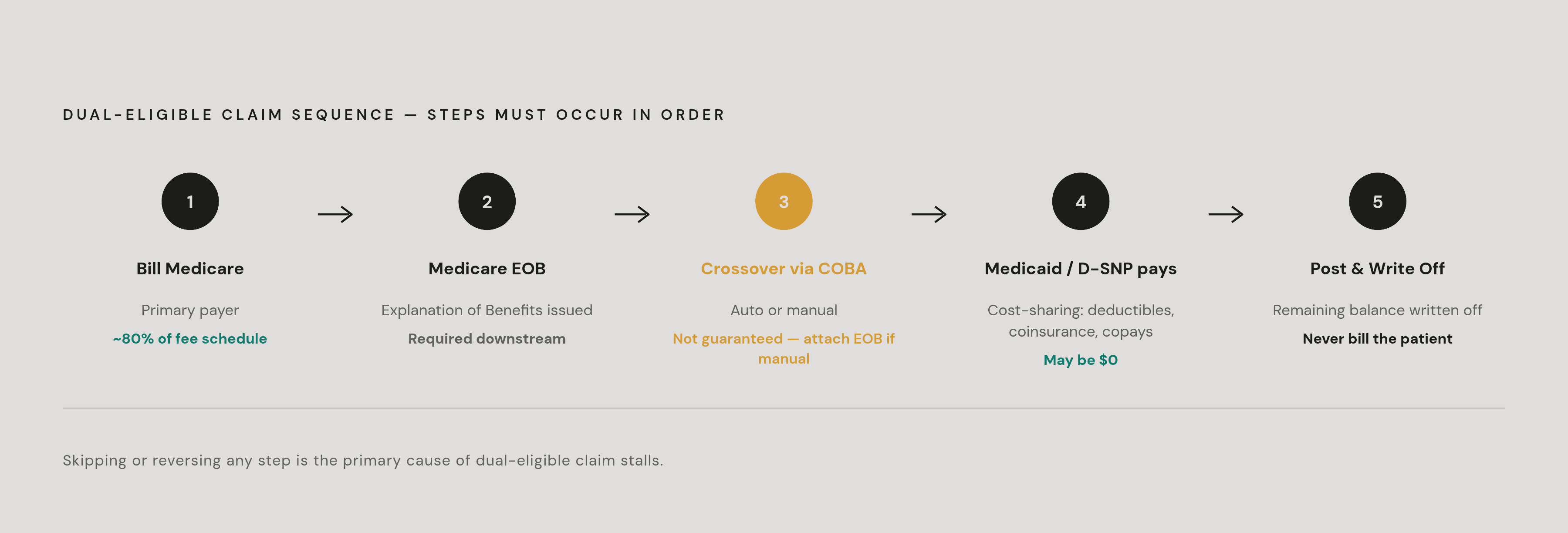
Bill Medicare as primary. Always, regardless of what other coverage the patient carries. No scenario allows this step to get skipped.
Medicare then processes the claim and issues an Explanation of Benefits, typically paying around 80% of the Medicare fee schedule for physician services, a figure that anchors every downstream calculation. That EOB is the document everything else depends on.
From there, the claim crosses over to Medicaid through the Coordination of Benefits Agreement (COBA), administered by CMS's Benefits Coordination & Recovery Center. When it works, it's automatic. Medicaid, or the relevant D-SNP managed care plan, then pays the remaining cost-sharing: deductibles, coinsurance, copays. That dollar amount can be small or nothing. In California, for instance, Medi-Cal reimbursement on Medicare crossover claims is minimal or $0 under state law, which catches billing staff off guard when they expect a meaningful secondary payment every time.
Last comes posting: confirm the claim is fully adjudicated, post the payments, and write off whatever balance remains under the applicable rules. Do not send that balance to the patient, ever.
Automatic crossover isn't guaranteed, and treating it as guaranteed is where a lot of teams get burned. COBA moves plenty of claims through without anyone touching them, but not all of them make it. When crossover fails, someone has to submit the Medicaid claim manually, with the Medicare EOB attached as proof of what was paid and what's left.
That manual submission splits into two very different paths depending on how the patient's Medicaid is delivered. Fee-for-service claims go to the state Medicaid agency through the state's MMIS. Managed care claims go to the MCO instead, and nationally, a large majority of Medicaid beneficiaries are enrolled in managed care. Being enrolled with the state doesn't mean a practice is credentialed with a given MCO: each one runs its own credentialing process, its own claims portal, and its own timely filing clock. Treating FFS and MCO enrollment as interchangeable is one of the more common, and entirely avoidable, ways a claim ends up denied for reasons that have nothing to do with the clinical service itself.
Five steps, a fixed order, one rule about what the patient owes. Nearly every denial or delay covered in the rest of this piece traces back to a break at one of those five points.
Claim form requirements and field-level accuracy that crossovers depend on
Professional claims run on the 837P or CMS-1500. Institutional claims run on the 837I or UB-04. Using the wrong form is an immediate rejection.
Within the form, a handful of fields cause most of the crossover failures. NPIs, both billing and rendering, have to match enrollment records exactly, character for character. Taxonomy codes matter more here than in commercial billing because many state Medicaid programs use them to route claims to the right specialty review. Place of service codes affect both the Medicare fee schedule calculation and how Medicaid determines coverage, so getting this field wrong throws off payment on both ends of the crossover. Wrong or missing modifiers trigger CO-97 (bundled service) and CO-11 (diagnosis-procedure mismatch) denials, both of which force a resubmission rather than a quick fix. ICD-10-CM codes have to support medical necessity for both payers at once, and gaps here cause CO-50 or CO-167 denials downstream.
Secondary claims carry an extra requirement: the primary EOB has to travel with them. Medicaid, or the MCO, needs to see what Medicare paid, what adjustments were applied, and what's left before it pays its share. Missing or inconsistent EOB data is among the most frequent reasons secondary claims get rejected.
Some Medicare Administrative Contractors also require the secondary payer to be listed on the claim at initial submission, not added later. This varies by MAC, so assuming a default rule applies without checking local guidance is a real risk.
CMS supplemental data found that 77.17% of Medicaid improper payments came from insufficient documentation, not from fraud and not from coding errors. That number should reorganize how billing teams spend their audit time, and most haven't acted on it yet. The data says documentation completeness is where the money actually leaks, and that's a process problem before it's a technology problem.
Timely filing windows and the compounding deadline problem
Because Medicaid billing depends on Medicare finishing first, the clock doesn't start when the service happens. It starts when the primary EOB lands, and that creates a compounding problem that's easy to underestimate.
Some secondary plans give as little as 60 days from the primary EOB date to file, Staffingly reports. Run the math: if Medicare takes several weeks to process the claim, and the billing team takes additional time to turn around the secondary submission, the window on some plans can close before anyone's done anything wrong on purpose. It's arithmetic working against the process, not negligence.
State Medicaid FFS programs generally allow anywhere from 90 days to 12 months from the date of service, with federal rules capping the maximum at 12 months, though the actual number varies by state and has to be checked rather than assumed. MCO plans layer another set of deadlines on top of that, published separately from the state FFS timeline and varying by plan.
Missed deadlines don't get a second chance. There's no commercial-style flexibility that softens this: a CO-29 denial for timely filing exceeded means a write-off, period.
Enrollment churn makes it worse. If a patient loses Medicaid and gets it back between the date of service and the date the secondary claim goes out, the filing window gets tangled up with a separate eligibility question: did the coverage active now actually apply on the date the service was performed? That has to be confirmed, never assumed.
The discipline that protects revenue here is simple to describe and hard to run consistently: trigger the secondary submission the moment the primary EOB comes in. Don't batch it. Every day a recoverable claim sits in a queue is a day closer to a deadline that won't bend for anyone.
The most common denial codes in dual-eligible billing
Denials in this space cluster around four causes: coordination-of-benefits errors, documentation gaps, coding mismatches, and authorization failures. Each code points to a specific fix, and knowing that fix without an escalation is what separates a fast billing team from a backed-up one.
On the coordination side, CO-22 occurs when the payer thinks another insurer should have paid first. It requires proof of Medicare's primary payment plus correct COB documentation to resolve. CO-29, timely filing exceeded, needs to be prevented rather than fixed, since the appeal path once it's triggered is narrow to nonexistent.
On documentation, CO-16 means a field is blank or doesn't match, and the fix is to run back through the checklist: NPI, taxonomy, place of service, modifiers. CO-15 means the prior authorization number is missing, and no clinical argument overrides that. The claim isn't payable without it, regardless of how appropriate the care was. CO-197 is a related authorization denial code applied by specific payers with their own pre-certification requirements.
On coding and necessity, CO-11 means the ICD-10 code doesn't support the CPT billed, and the fix is correcting the linkage between the two. Medical necessity, coded CO-50, often needs additional clinical documentation or a formal appeal with supporting records. CO-97 means the billed procedure is bundled into something already paid, so the fix means checking modifier usage and unbundling rules. CO-167 means the diagnosis itself isn't covered under the plan, and the fix means checking the state or MCO's covered diagnosis list before resubmitting.
CAQH data cited by Staffingly puts the cost of COB-related billing errors to the national health care system above $800 million a year. MGMA figures, also cited by Staffingly, put the rework cost at $25 to $50 per claim. A practice handling 200 claims a week at a 5% error rate generates 10 claims going into rework every single week, indefinitely, until the underlying process changes rather than the staff working harder against it.
Coordinating benefits at the front desk before the claim is ever submitted
COB verification isn't something to check once at intake and forget. Patients age into Medicare at 65, lose Medicaid during periodic redeterminations, and switch D-SNP plans, sometimes all within the same benefit year. Verification belongs at every visit.
The Medicare Rights Center's March 2026 findings back this up directly: administrative delays in recertification, not actual changes in financial eligibility, are a documented cause of dual eligibles losing Medicaid coverage. The paperwork lags behind the reality, and the billing system has no way to know that unless someone checks.
A front-desk verification pass for a dual-eligible patient needs to confirm current Medicare coverage type (Traditional or Medicare Advantage/D-SNP); D-SNP integration level (CO, HIDE, or FIDE, since a CO D-SNP may not cover the crossover portion); active Medicaid enrollment and which delivery model applies (state FFS or a specific MCO); MSP tier; and that the practice itself is contracted with that specific MCO, not just enrolled with the state.
Skipping that checklist brings the same mistakes back: relying on coverage data from a prior visit instead of running a real-time eligibility check, billing an MCO the practice was never credentialed with, and missing that a patient's D-SNP switched over at the start of a new plan year.
Getting the billing order wrong at the front desk adds 30 to 60 days to payment as the claim works its way through denial and resubmission, Staffingly reports. Catching it at check-in costs a few extra minutes. Catching it after denial costs weeks.
Patients don't get to pick which plan pays first, and some push back on that, especially if they're used to choosing among commercial plans. Front-desk staff who can explain that the payer order is set by federal rule, not up for negotiation, head off a lot of friction before it turns into a billing dispute.
Where the manual workflow breaks down at scale
Denial rates across health care climbed from an average of 11.8% in 2024 to roughly 12% in 2025, while net revenue lost to denials grew 25% year over year in that same span. Dual-eligible billing sits inside that environment more exposed than most claim types, for every reason covered above: multiple payers, tight and inconsistent filing windows, coverage that shifts under a patient's feet, and a documentation burden the PERM data already flagged as the leading cause of improper payments.
Aspirion reports that the share of providers with denial rates above 10% jumped from 30% in 2022 to 41% in 2025, and a meaningful chunk of the industry is losing ground on denials even as claim volume and payer complexity both keep climbing.
Staff capacity is the wall most practices hit, and no amount of process documentation fixes a capacity problem. The same person clearing COB verifications at check-in is also chasing EOBs, submitting secondary claims, and reworking denials at $25 to $50 a pop. None of those tasks disappear when volume increases. They pile up, and the queue grows faster than any team can staff against it by hand, which is the real ceiling here, not effort or training.
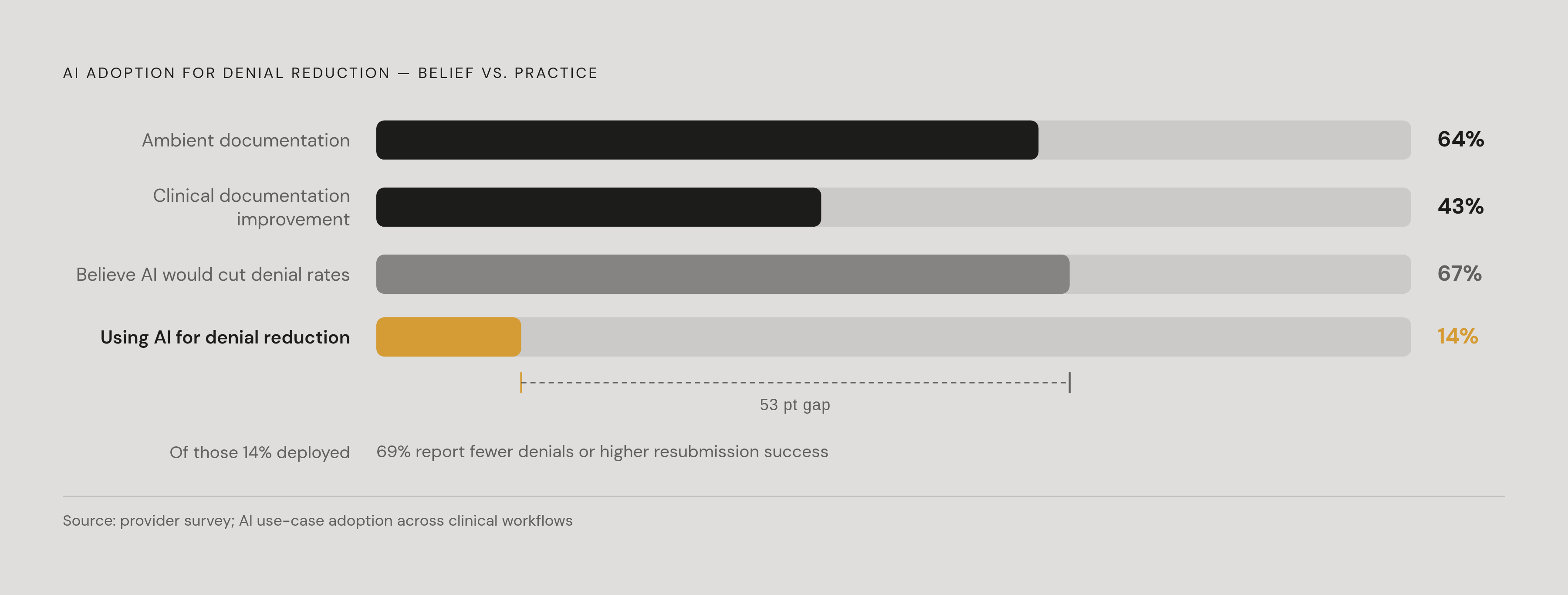
This is, oddly, the part of the workflow AI has barely touched so far. Recent benchmark data shows 64% of providers using AI for ambient documentation and 43% for clinical documentation improvement, but only 14% applying it specifically to denial reduction. Meanwhile 67% of providers believe AI would cut their denial rates. Among the 14% who've actually deployed it for that purpose, 69% report fewer denials or a higher rate of successful resubmission. The gap between what providers believe and what they've actually built sits directly on top of the highest-error-rate workflow in the entire revenue cycle, and that gap is the argument for what follows.
How computer-use AI agents automate the dual-eligible billing sequence
The core problem in dual-eligible billing is fragmentation. One patient might touch a federal claims processing entity, a state MMIS system, and a specific MCO's proprietary portal, each with its own login, its own claim format, and its own timely filing clock. A human biller has to hold all three in their head at once, for every patient, on every visit, while coverage details shift underneath them between recertification cycles. That is a volume problem, not a training problem. It is a volume problem, and volume is what breaks manual workflows first.
Computer-use AI agents, the kind that can navigate a web portal or a legacy system interface the way a person would, by clicking, reading fields, and entering data, are built for this kind of fragmented, multi-system task. Applied to the five-step sequence described earlier, an agent can check Medicare eligibility, submit the primary claim, watch for the EOB, and route the secondary claim to the correct destination, either a state MMIS or a specific MCO portal, without a person manually toggling between systems for each patient.
The same logic applies to the front-desk verification checklist. An agent checking D-SNP type, MSP tier, and current Medicaid enrollment status at every visit, rather than relying on data pulled at intake months earlier, directly addresses the enrollment churn the Medicare Rights Center documented. On the documentation side, where the CMS PERM report placed 77.17% of Medicaid improper payments, an agent working from a fixed field-level checklist (NPI match, taxonomy code, place of service, modifier consistency, EOB attachment) can catch the same gaps a trained biller would catch, without a resubmission cycle in between.
None of this changes the underlying rule structure. Medicare still pays first. Medicaid is still the payer of last resort. The filing windows are still fixed by federal and state rule, not by how fast a system can move. What changes is how much of the five-step sequence runs without a person manually bridging one payer's portal to the next, and how much sooner a documentation gap gets caught, before it becomes a denial instead of after.