Eligibility Verification Failures and Claim Rejection Patterns
Eligibility errors at scheduling create a cascade of preventable claim rejections downstream.
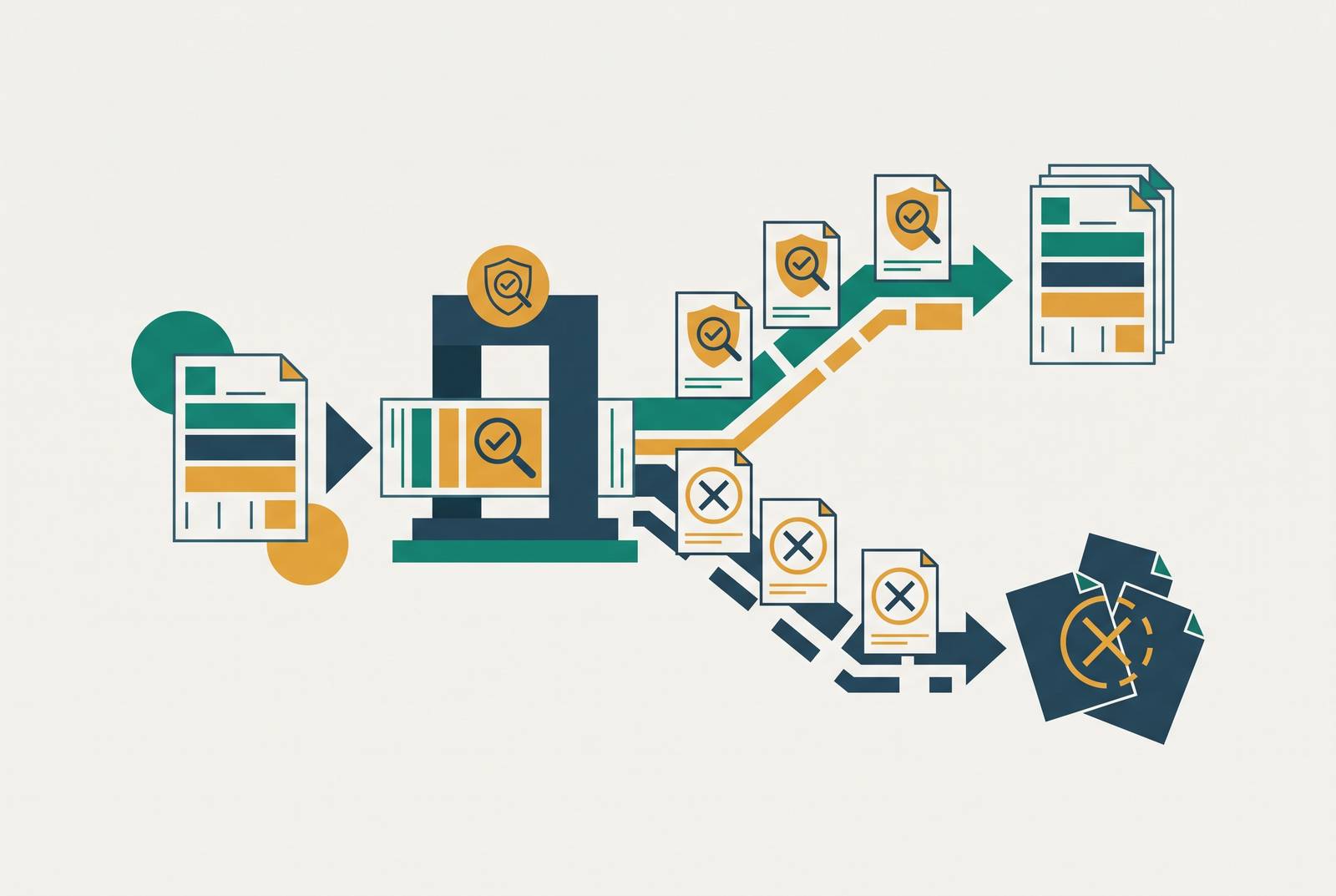
Most claim rejections don't start at the payer. They start weeks earlier, at the front desk, when eligibility verification gets rushed, skipped, or done once and never checked again. That single upstream failure sets off a chain of rejection codes, resubmissions, and lost revenue that administrators routinely treat as separate problems instead of one traceable cause. It isn't. Every link in that chain, the codes, the prior authorization gaps, the payer-specific denial patterns, traces back to the same weak checkpoint, and treating them as unrelated is exactly why practices keep losing to the same failure month after month.
The distinction between a rejection and a denial matters more than it sounds. A rejection stops a claim before it ever reaches a payer's adjudication system: something in the submission doesn't match what the payer has on file, and the claim bounces back automatically. A denial is different. That's a claim the payer actually reviewed and decided not to pay. Rejections don't get appealed, because there's nothing to appeal. They get corrected and resubmitted, which sounds manageable until a practice is doing it hundreds of times a month against a growing backlog.
Eligibility sits at the top of this chain because it's the first checkpoint where a claim can go wrong, and payer intake systems are built to catch mismatches instantly, before a human ever looks at the file. A wrong character in a member ID, a name that doesn't match the payer's format, a secondary policy that never made it into the record: any one of these stops the claim cold. And because a single broken eligibility record often feeds multiple claims for the same patient, one missed detail can generate rejections across a whole string of visits, not just one.
Kodiak Solutions and HFMA put the initial denial rate at 11.8% in 2024, and that figure doesn't even capture pure rejections, which usually don't make it into denial-rate reporting at all. The rest of this piece works backward from that number: which rejection codes eligibility failures actually generate, why payer behavior varies so widely, and what it takes to close the gap before a claim ever leaves the building.
What eligibility verification actually checks, and where practices routinely miss
A full eligibility check covers more ground than most front-desk workflows treat it as. It confirms active coverage and effective dates, the correct payer (not just the parent company but the specific plan), the member ID and subscriber relationship, dependent status, and the plan's actual benefit structure: covered services, exclusions, deductible status, copay amounts, and whether the patient has already hit an out-of-pocket max. It also has to catch prior authorization requirements tied to the specific service being scheduled, and referral rules where a PCP has to sign off first.
Most practices do some version of this at scheduling, then stop. That's the mistake. The plan on file at booking isn't always the plan active on the date of service, and Medicaid makes the point sharpest: coverage can change between the time of scheduling and the date of service, and a patient covered recently may not be covered on the day they walk in. January compounds it across the board, deductibles reset, patients switch plans during open enrollment, and eligibility mismatches become more likely to surface. Re-verifying right around the year-end reset helps catch rejections before they ever get filed. A single check at booking is only a surface-level pass, not verification. It's a snapshot that expires.
Secondary insurance is another quiet failure point. A patient with dual coverage often has only the primary policy on file, because nobody asked the follow-up question or the intake form never had a field for it. Even when coverage gets verified correctly, plenty of practices confirm that a plan exists without confirming whether the specific service being billed requires prior authorization under that plan. That's a separate check, and skipping it is its own failure mode, the one the next section covers directly.
All of this stems from a basic asymmetry: payers maintain their own enrollment files, and whatever a practice has on record is a copy, not the source of truth. When the two don't match, the payer's version wins, every time.
The specific rejection codes eligibility failures generate, and what each signals
Coverage and subscriber mismatches show up as specific, repeatable codes. A8 and A37 flag subscriber or relationship errors, where the patient's plan or dependent status on the claim doesn't match what the payer has on file. MA131 flags patient identifier mismatches, often something as small as a name entered in a different format, a transposed digit in a date of birth, or a member ID off by one character. None of these get adjudicated. There's nothing to appeal. Staff has to find the correct data, fix the record, and resubmit.
Demographic errors follow the same pattern. Other demographic codes point to missing or badly formatted patient data, while MA130 signals an incomplete front-end submission, frequently because a field that eligibility verification should have populated was left blank. Payer systems check submitted data against their enrollment file exactly, so even a minor typo blocks the claim before anyone reviews the clinical content.
Then there's a category that looks like a coding problem on the surface but traces back to eligibility underneath. A9 and A16 flag diagnosis or procedure codes that fail payer validation, often because the billed service simply isn't covered under the plan that got verified, or because place-of-service rules were never checked against that plan's network. A49 specifically flags a place-of-service mismatch, which again connects straight back to an eligibility check that skipped network rules before the appointment got scheduled. Office Ally's research puts routine coding or documentation issues at up to 49% of claims in some analyses, and a meaningful share of that traces to incomplete eligibility data rather than an actual coder mistake.
The resubmission burden is the part that's easy to underestimate. Each of these codes means a staff member has to stop what they're doing, track down the correct information, update the record, and resubmit the claim. Multiply that across claim volume and it stops being a minor annoyance. It becomes a full-time job nobody budgeted for.
How prior authorization failures extend the rejection chain beyond intake
A complete eligibility check identifies whether the specific service being scheduled needs prior authorization under that plan. Skip that step and the practice finds out the hard way, after the service has already happened, when the claim comes back rejected for lack of authorization. There's no fixing that after the fact. The service was delivered without the required approval, and the claim reflects it, permanently.
PA failures are the second-biggest driver of denials industry-wide, and arguably the most preventable one, since the requirement is knowable in advance. Industry data puts 42% of denials tracing to prior authorization problems, and 35% of revenue cycle leaders name authorization issues as a top denial driver for the year. The administrative weight behind this is heavy on its own: physicians and staff spend an average of 13 hours a week handling prior authorizations. Medicare Advantage PA determinations grew from 37 million in 2019 to 50 million in 2023, and commercial payers are moving along a similar curve. Provider spending on PA-related administrative costs has been reported at $1.3 billion in 2023, a 30% jump year over year.
Some payers concentrate this risk far more than others, which is the part flat industry averages hide. KFF's 2024 data shows 97% of denial reasons for Blue Cross Blue Shield of Arizona came down to a missing prior authorization or referral. At a payer like that, an eligibility check that misses the PA requirement is a serious gap. It's close to a guaranteed denial. Administrative reasons account for 25% of denial reasons reported to CMS for ACA Marketplace plans, and lack of prior authorization or referral accounts for an additional 9% as its own separate category.
The clinical cost is documented too, not just the financial one. The AMA's 2024 Prior Authorization Physician Survey found 93% of physicians say PA delays hold up necessary care, and 29% report a serious adverse event tied directly to those delays. Regulators are responding: CMS's Interoperability and Prior Authorization Final Rule (CMS-0057-F, finalized January 2024) requires payers to build FHIR-based PA APIs. By March 31, 2026, affected payers have to publicly post their aggregated 2025 PA approval and denial rates. By January 1, 2027, they need to support electronic PA submission through FHIR APIs, with Coverage Requirements Discovery, Documentation Templates and Rules, and Prior Authorization Support named as the implementation guides payers are strongly encouraged to follow.
How the pattern looks across payers, and why payer behavior determines risk exposure
The national numbers set a baseline, but they flatten a picture that varies enormously underneath. KFF and MoneyGeek's analysis of CMS data puts the 2024 ACA Marketplace in-network denial rate at 19.1%, essentially flat against 19% in 2023, and the first year-over-year decline in four years, though still above the 16.7% recorded in 2021. That's 8.8 million denied claims out of 46 million filed, in one year, in one market segment.
Payer type changes the picture substantially. Premier Inc.'s 2024 survey of hospitals, health systems, and post-acute providers found private payers denying claims at close to 15% initially, Medicare Advantage at 15.7%, and managed Medicaid at 15.1%. Traditional Medicare came in lowest at 8.4%, while Medicaid posted the highest rate in the entire survey. State-level variation stretches even wider: Hawaii carriers denied 26.9% of in-network claims in 2024, while South Dakota and New Hampshire insurers rejected only about 7%. Same eligibility gap, same front-desk workflow, wildly different exposure depending on where the practice happens to sit.
Individual insurers moved sharply within a single year, too, which is the strongest argument against treating "denial rate" as a static number worth checking once. UnitedHealthcare cut its denial rate by 15 points, from 34.2% down to 19.1%, across 6.4 million claims. Oscar Health went the other direction, climbing from roughly 17 to 18% up to 25.3%. Molina Healthcare rose to 22%. A practice billing heavily into any one of these payers faced a materially different rejection environment in 2024 than it did the year before, and none of that shows up if a practice tracks only its own internal denial rate without segmenting by payer.
The denial reasons reported to CMS reinforce the same point from another angle. "Other" accounts for 36%, administrative reasons for 25%, excluded services for 13%, lack of prior authorization for 9%, and medical necessity, the reason most people assume dominates, is just 5%. Structural and administrative failures are the majority. Clinical judgment calls are the minority, and a small one. That's the argument for treating payer-specific denial patterns as part of the prevention framework itself, not an afterthought bolted on top of it.
What a complete prevention framework addresses across the revenue cycle (not just at check-in)
Experian Health's 2025 data names missing or inaccurate patient data as the single biggest driver of rising denial rates, cited by 50% of revenue cycle leaders, up from 46% in 2024. That's the eligibility layer, plain and simple. Prior authorization failures come in second at 35%. Coding and documentation issues follow behind both, and a good share of those trace straight back to incomplete eligibility data captured at intake. Fix the front end and the rest of the list shrinks with it.
A prevention framework that works has to touch every stage of the cycle, not just the front desk. Before scheduling, PA requirements and network status need identifying while there's still time to act on them. At scheduling and registration, demographic and insurance information needs capturing in full and checking against the payer's own records, not just whatever's already sitting in the practice's system. The day before or day of service, coverage needs a fresh check, especially for Medicaid patients or anyone whose plan year just reset. Before the claim goes out, every required authorization needs confirming, and code-diagnosis combinations need validating against that specific payer's rules. After submission, rejections need to surface fast: a denial alert that forces staff to log into a separate portal and manually start a response is a lot less useful than one that shows up inside the workflow they're already using, with a corrected version drafted and ready.
Appeals matter here too, because prevention failures don't have to be permanent losses if someone follows through, and most don't. Fewer than 1% of denied claims get appealed by patients directly. Providers do better, and when they appeal, the overturn rates are high enough to make the case on their own: Premier Inc. found private payers reversing roughly 54% of initial denials, and Medicare Advantage reversing around 80% of prior-authorization-related denials and 57% of all claim denials. That's a lot of recoverable revenue sitting untouched whenever prevention fails and nobody follows up.
The dollar figures settle the argument either way. The American Hospital Association estimates providers spend nearly $20 billion a year just reprocessing denied claims. Chief Healthcare Executive reported hospitals spent $25.7 billion in 2023 adjudicating denials. Rework at that scale costs far more than preventing the failure in the first place. A framework that checks eligibility once, at booking, and never again is guaranteed to keep generating the same rejections for the same patients every time their coverage or authorization status shifts mid-cycle.
Where automation closes the loop, and what it takes to actually automate the full chain
Not all automation closes this loop the same way, and the difference matters more than most vendors let on. Traditional RPA scripts a fixed set of steps inside a single system, which works fine for payer portals without an API, but it only ever does what it was built to do. The moment a payer changes its portal layout or updates a rule, the script breaks and needs reprogramming, and someone has to notice it broke before anyone fixes it.
Computer-use agents work differently. They operate software the way a staff member would, reading the screen, clicking, typing, and moving across the EHR, the payer portal, and whatever else the workflow touches, without needing an API integration or a rebuilt workflow to do it. That's the practical advantage. When a payer redesigns its portal, an agent navigating the way a person does adapts to the new layout. A scripted bot follows a fixed path regardless of what it encounters. It just stops.
Even solid rule-based systems leave a gap. They handle routine PA volume well, but the harder cases, the edge cases, the payer criteria that changed last month, the documentation that's incomplete, still fall back on human staff exactly as they did before. At high PA volume, that leftover share of exceptions adds up to something close to a full-time job on its own, which defeats a good chunk of the point of automating in the first place.
Closing the loop fully means eligibility verification that runs before scheduling, runs again before service, and flags changes in between, not a single batch check that goes stale the moment a plan updates. It means PA requirements get identified as part of that same eligibility check, not as a separate step discovered too late to matter. It means claims get validated against payer-specific rules before submission, rejections surface inside the existing workflow with the fix already attached, and appeals don't force staff to reconstruct the whole denial from scratch.
Allegheny Health Network offers a concrete benchmark here. Its partnership with Humata deployed AI-driven PA automation that now processes more than 200,000 authorizations a year, with a first-pass approval rate of 96%, covering the full workflow from clinical data extraction through submission and status tracking. Reporting on current automation tools has also found AI cutting PA processing time by 80% in deployments that operate across the entire workflow rather than a single step of it.
None of this requires a practice to tear up its existing systems. Agents built to work across what's already in place, deployed from a single login within weeks, are the realistic path for a practice trying to close the eligibility-rejection gap without committing to a year-long implementation project. The real test is how well a tool automates some step of the process. It's whether it can carry a claim from verification through submission through rejection response, the way a trained staff member would, at any hour, without waiting on a queue.
Sources
- Medical Rejection Codes: Why Claims Get Rejected
- ACA Health Insurance Claim Denials: 2026 State & Insurer Rankings
- Health insurers rejected 19% of claims for exchange plans in 2024
- Breaking down claim denial rates by healthcare payer | TechTarget
- Claims Denials and Appeals in ACA Marketplace Plans in 2024 | KFF
- Top 5 Claim Denial Triggers in 2025 — And How to Avoid Them — Medviz Systems
- What Causes Claim Denials in Medical Billing?
- linear.health