Automating ERA Posting and Payment Reconciliation in Medical Practices
Automation handles the high-volume ERA posting but leaves exceptions and reconciliation for humans.
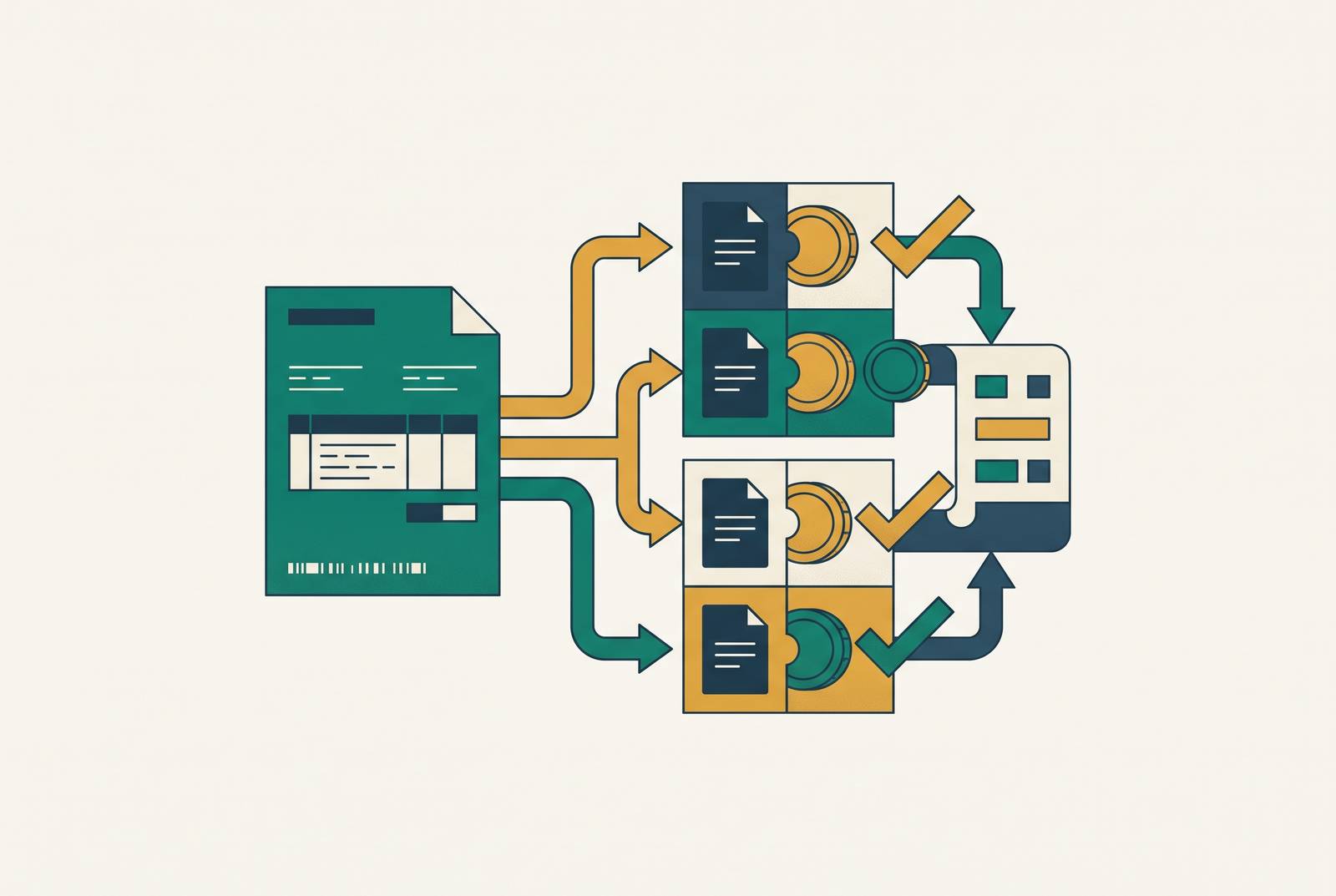
An ERA is a standardized electronic document a payer sends after adjudicating a claim: it explains what got paid, what got adjusted, what got denied, and why. Understanding how it's built, and how a practice turns that file into a reconciled bank account, is the starting point for understanding what automation actually fixes in medical billing, and what it doesn't.
The format is the ANSI X12 835 transaction set, a HIPAA-mandated standard used by every payer, Medicare, Medicaid, and commercial insurers alike. Every payer builds on the same base standard, though each one layers its own conventions on top through a companion guide. Two 835 files from two different payers can look meaningfully different even though they follow the same rulebook.
The file itself has a fairly plain structure. A header identifies the payer and the transmission date. Claim-level detail gives the claim reference number, the total billed, and the payment applied. Below that sits service-line detail: CPT codes, billed charges, allowed amounts, actual payments, and the adjustment or denial reason codes tied to each line. A totals section at the end lets the receiving system check its own math.
Two adjustment code groups matter most to a billing team reading these files. CO, for Contractual Obligation, marks a write-off required by the payer contract; the patient can't be billed for it. PR, Patient Responsibility, covers deductible, coinsurance, and copay, and routes straight to the patient's balance. Layered under both are reason codes, explaining why a given line was reduced or denied. A single 835 file can carry hundreds of claims and thousands of service lines, and that scale, not any one line's complexity, is what makes manual review slow and mistake-prone.
An ERA is not an EOB. The ERA goes to the provider through a clearinghouse, built for posting. The EOB goes to the patient, explaining that same adjudication in plainer terms. Billing staff should never post off a patient's EOB; the formats look similar but they're built for different readers and different purposes. And the ERA isn't the money either. The ERA explains the payment; a separate electronic funds transfer, the EFT, actually delivers it. They travel through different systems and have to be matched up, by hand or by software, before anyone can call the account reconciled.
By 2026, close to 80% of eligible providers had moved onto ERA. The remaining fifth, still working from paper remittances, carries an inefficiency that compounds with every claim volume increase. The 835 is a machine-readable, well-structured file by design, and that is why automation is achievable here in a way it isn't for messier parts of the revenue cycle. Understanding its structure is the prerequisite for understanding what automation solves, and what it leaves for a human to sort out.
The posting workflow from claim adjudication to reconciled account
Getting from an adjudicated claim to a reconciled account runs through six steps, each with its own failure points.
First, the ERA arrives. A clearinghouse delivers the 835 file to the practice management system, usually within 24 to 72 hours of adjudication. Best practice is automated retrieval.
Second, payments get matched to claims: software or a person lines up each ERA payment and adjustment against the right patient claim in the billing system. Third, adjustments get applied at the line-item level, CO write-offs, PR balances, and other contractual reductions posted line by line rather than as a lump sum.
Fourth comes the internal check: confirming that payments, patient responsibility, and adjustments together add up to the billed amount. Fifth, patient accounts get updated, with any remaining patient balance flowing into the patient billing workflow and secondary payer balances routed for coordination of benefits. Sixth, and often skipped or delayed in practice, the posted numbers get reconciled against the actual bank deposit. That last step is what closes the loop and makes the financial reporting trustworthy.
Underneath all six steps are three separate payment streams a practice has to manage at once. Electronic remittance through ERA and the 835 carries the largest volume and is the most automatable. Paper EOBs, lockbox checks, and payer correspondence arrive completely outside that electronic flow and need someone to read and post them by hand. Patient payments, collected through portals, card terminals, and mailed statements, form a third stream that has to land against the correct account regardless of how it came in.
On top of those three streams sit exceptions, partial payments, takebacks, adjustments that don't match any expected pattern, and the bank reconciliation step itself. This is where most of the remaining manual labor actually lives. ERA auto-posting, on its own, touches only one of these streams. Solving that stream doesn't mean posting, as a whole, is solved.
The cost of manual posting breakdowns
Start with the raw volume. A practice with 150 daily claims generates roughly 450 payment transactions a week. At two minutes per transaction for matching, keying, and verifying, that's 15 staff hours a week spent just posting.
MGMA's 2023 Cost Survey put a number on the staffing behind that: practices typically dedicate one to two full-time staff to payment posting alone, running $45,000 to $65,000 a year in salary and benefits. Deloitte has gone further, estimating that manual payment posting can eat up to 30% of a billing team's total effort, a striking share of skilled labor spent on a task that is, structurally, repetitive data entry.
The failure modes are specific. Transcription errors appear as mistyped amounts, reversed digits, or a payment applied to the wrong patient. Partial payments get misread as full payments, and denial patterns go unnoticed until they've already piled up. Underpayments slip through because staff post the number on the remittance without checking it against the contracted rate, so a systematic shortfall on every claim from one payer can run for months before anyone notices. And reconciliation against the bank account often lags posting by days or weeks, which stretches out days in accounts receivable and muddies the monthly close.
None of this is helped by the fact that ERA files arrive from dozens of payers on different schedules, each with its own quirks in how it applies adjustment reason codes. Every one of those variations needs a human to interpret it before a system can safely post against it.
The denial side makes the stakes concrete. The US healthcare system is projected to process an estimated 6.4 billion medical claims in 2026. At a 12.6% average initial denial rate, that's roughly 806 million claims denied on the first pass, each one needing investigation, correction, appeal, or a write-off decision. McKinsey's research found that 60% of denied claims never get appealed at all, because the cost of manual follow-up outweighs what the practice expects to recover. MGMA puts the share of denied claims that never get reworked at 50% to 65%, and estimates the cost of reworking a single claim at $25 to $118 in administrative labor.
The 2024 Change Healthcare cyberattack showed what the paper backup dependency actually costs when the electronic pipe breaks. With ERA delivery disrupted, one billing professional reported manually posting more than $3 million in payments off paper remittances, showing what "manual" means when it is the only option rather than an occasional exception. These are what manual posting produces reliably, once it's run at real volume. They're what manual posting produces reliably, once it's run at real volume.
What ERA auto-posting automates, and what it leaves behind
Automatic posting of clean electronic remittance isn't a differentiator anymore. Every serious RCM platform, clearinghouse, and practice management system handles it competently at this point; the Honey Health 2026 payment posting guide calls ERA auto-posting table stakes, and that's a fair label.
A full-featured auto-posting engine takes in the 835 file, matches each payment to its claim using configurable rules, applies CO write-offs and PR balances at the line-item level, and routes anything clean and matched straight through without a person touching it.
What it doesn't touch is most of the rest of the work. According to Honey Health's analysis, paper EOBs and lockbox checks sit entirely outside the electronic flow. Patient payments through portals and terminals form a third stream auto-posting engines were never built to handle. Correspondence and takeback adjustments still need a human reader. Exceptions, anything that doesn't match cleanly, partial payments, adjustments that don't fit the expected pattern, get kicked out of the automated queue and land back on someone's desk. And bank reconciliation, confirming that what got posted matches what actually showed up in the account, remains the step that closes the books, whether or not the posting above it was automated.
There's a real risk that scales right alongside the benefit. A misconfigured posting rule, or a fee schedule mapping that's gone stale, will repeat its error across hundreds of claims before anyone catches it. The same speed that makes automation valuable makes a configuration mistake expensive.
Automation also isn't a universal fit. A practice that deals with a single payer whose ERAs are already handled cleanly gains little from new tooling. Below roughly $500,000 in annual payer collections, the cost of a reconciliation tool often doesn't pay itself back within a year. And if the existing practice management system already handles every ERA with no manual review needed, there's no gap left to close. The real evaluation question for any tool is not whether it auto-posts ERAs, since they all do. It's how much of the paper, patient-payment, exception, and reconciliation work it actually removes, versus how much it quietly leaves for staff.
Intelligent reconciliation and exception handling's effect on operational logic
Traditional posting catches errors only when a human happens to notice one. Automated reconciliation with variance flagging inverts that: underpayments and mismatches become visible by default, and the burden of catching problems shifts from staff vigilance to how the system itself is built.
KATPRO's analysis breaks an intelligent reconciliation engine into several working parts. It automatically matches ERA data, EFT data, and claims data against each other, checking what was promised against what actually arrived. It routes exceptions, underpayments, denials, mismatches, into a workflow built for quick human review instead of burying them inside the general posting queue. Its posting rules are configurable enough to adapt to each payer's particular remittance format and logic. And it gives staff a real-time dashboard on posting accuracy, payment variances, and trends over time, instead of a picture that only resolves at month's end.
Underpayment detection is where this pays off most directly as revenue recovery. Even a small, consistent underpayment on a given payer's claims goes unnoticed in a manual workflow, because staff post the number on the page without checking it against the contracted rate. Automated variance flagging identifies that mismatch the moment it happens, rather than months later during an audit. Analytics-driven reconciliation has been linked to recovering a meaningful share of otherwise lost revenue each year. EY's figures, also cited by KATPRO, put the cash-flow improvement from automating revenue cycle processes at 25% to 40% faster timelines.
The exception queue is the actual design principle at work here: automation absorbs the routine postings, and human judgment gets concentrated where it's genuinely needed, unusual adjustments, payer disputes, takebacks, instead of getting spent on claims that would have posted cleanly anyway.
There's a second-order benefit too. Once ERA data runs through a system consistently, denial reason codes start accumulating into visible patterns, with a particular payer or a particular code recurring repeatedly. That kind of cluster becomes visible weeks earlier than it would in a manual workflow. A practice can fix the root cause once instead of appealing the same denial claim by claim.
The month-end close feels this shift directly. Reconciliation delays of days or weeks stretch out accounts receivable and leave financial reporting unreliable in the meantime. Reconciling against the bank account automatically compresses the lag between posting and closed books. The operational logic moves from reactive, post first, find the problems later, to proactive: post and surface the exceptions at the same time.
The denial crisis that makes posting accuracy a revenue-critical problem
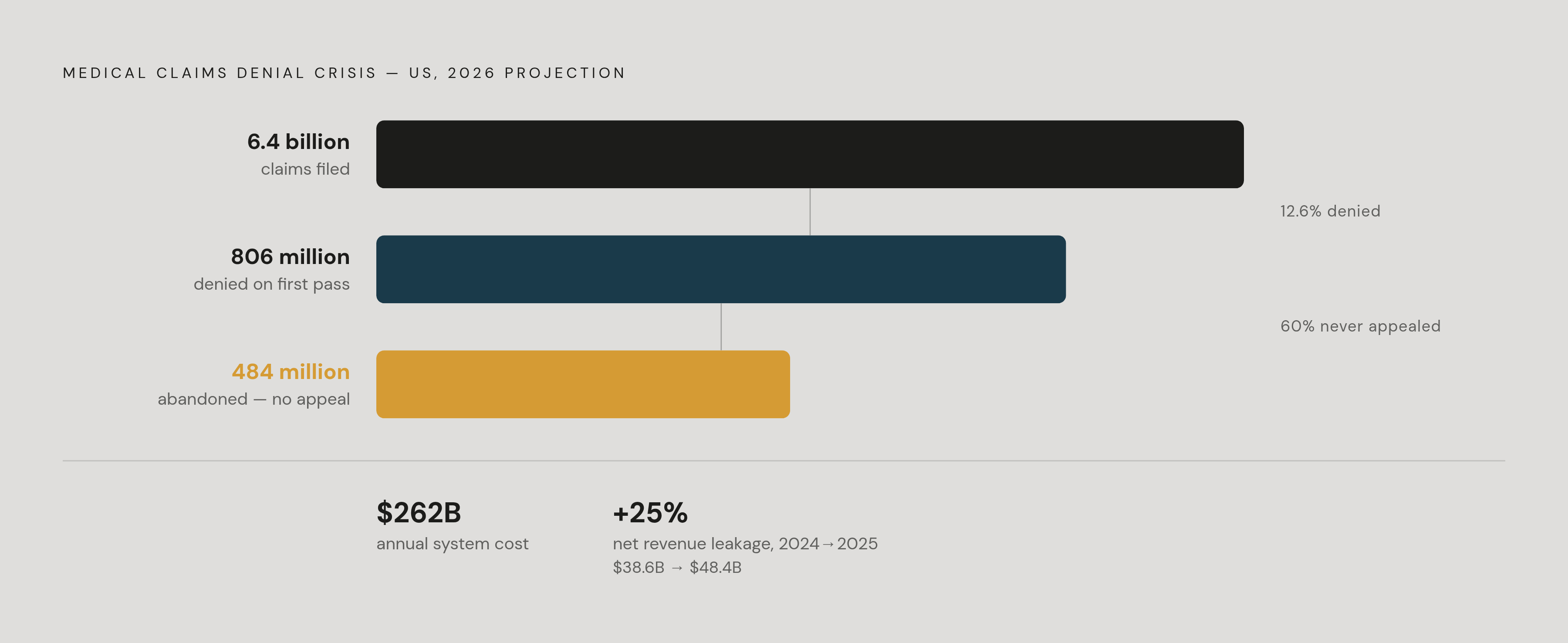
Scaled out, the numbers get uncomfortable. With 6.4 billion claims projected for 2026 and a 12.6% average initial denial rate, roughly 806 million claims get denied on first submission. Counting rework, administrative overhead, and revenue that's permanently written off, the total cost to the system runs an estimated $262 billion a year.
That leakage is getting worse, not just staying steady. Net revenue leakage from denials rose from $38.6 billion in 2024 to $48.4 billion in 2025, a 25% jump in a single year, suggesting the complexity of managing denials is outrunning the growth in denial volume itself.
Denial rates aren't evenly spread across payer types either. Enjoin CDI's 2026 data puts the Medicaid inpatient initial denial rate at 44%, meaning nearly half of inpatient Medicaid claims get denied the first time around. Commercial inpatient claims see a 21% initial denial rate, more than four times Medicare's rate, largely from aggressive prior authorization and medical necessity review. Across more than 2,300 hospitals, the median final denial rate is 2.7%, even as the average dollar value of denied inpatient claims climbed 12% and outpatient denials climbed 14% year over year.
Posting accuracy sits right at the front of this problem. A partial payment misposted as a full payment, or a denial that gets buried in the posting queue instead of surfaced for appeal, directly feeds this leakage. Accurate posting with variance detection built in is the earliest possible point of denial identification, and it's a lot cheaper than fighting the denial later. Premier estimates US hospitals spend roughly $19.7 billion a year overturning denials, at about $57 per reworked claim, though industry figures on rework cost range from $25 to $181 depending on complexity. Preventing the denial through accurate posting costs a fraction of appealing it after the fact.
And a large share of denials never even reach the appeal stage. McKinsey's 2026 figures put the share of denied claims that never get appealed at 60%, since the manual follow-up cost outweighs what a practice expects to recover. MGMA's estimate that 50% to 65% of denials never get reworked traces back, in no small part, to denials that were never cleanly flagged at the moment of posting.
Missing or inaccurate data is the single biggest cause producing all of this, and it is mundane. Incomplete patient information, a missing prior authorization number, an incorrect billing code. Eligibility issues alone drive 22% of preventable denials. And the staffing side makes it worse before it gets better: billing and coding vacancy rates run 15% to 18% industry-wide, and an understaffed team posts more slowly, makes more mistakes, and has less time left over for denial follow-up. As staffing pressure rises, automation functions as a financial control rather than a convenience.
Computer-use agents versus traditional RPA for payer portal and posting workflows
For a long stretch, revenue cycle automation meant traditional RPA, scripted bots that clicked through screens the way a person would, but only within tightly structured, predictable inputs. That approach worked reasonably well for tasks with a fixed shape. It broke down the moment the input varied.
Payer portal and posting workflows are exactly the kind of variable, unstructured territory that breaks a script-based bot. ERA files arrive from dozens of payers in formats that shift from one to the next, and payer portals themselves change their layouts, their login flows, and their navigation without warning. A traditional RPA bot, built against one specific screen layout, has no way to adapt when that layout moves; it simply fails, and someone has to notice, diagnose, and rebuild the script. That fragility is the core limitation RPA has carried through its use in revenue cycle work: it assists a human operator well within a narrow, stable process, but it doesn't hold up against the format variation that payer-facing work throws at it every day.
Sources
- ERA in Medical Billing: Streamline Payments & Claims
- Honey Health Articles | 10 Best Payment Posting Software for Medical Billing (2026)
- ERA Auto-Posting & Payment Reconciliation - KATPRO
- Automate ERA/EOB Payment Posting in Medical Practices - Cevi
- How to Reconcile Remittance Advice to Claims in 2026?
- medheave.com
- enjoincdi.com
- aptarro.com