Prior Authorization Denial Appeal Process for Medical Offices
Most denied prior authorizations get overturned on appeal, but practices rarely try.
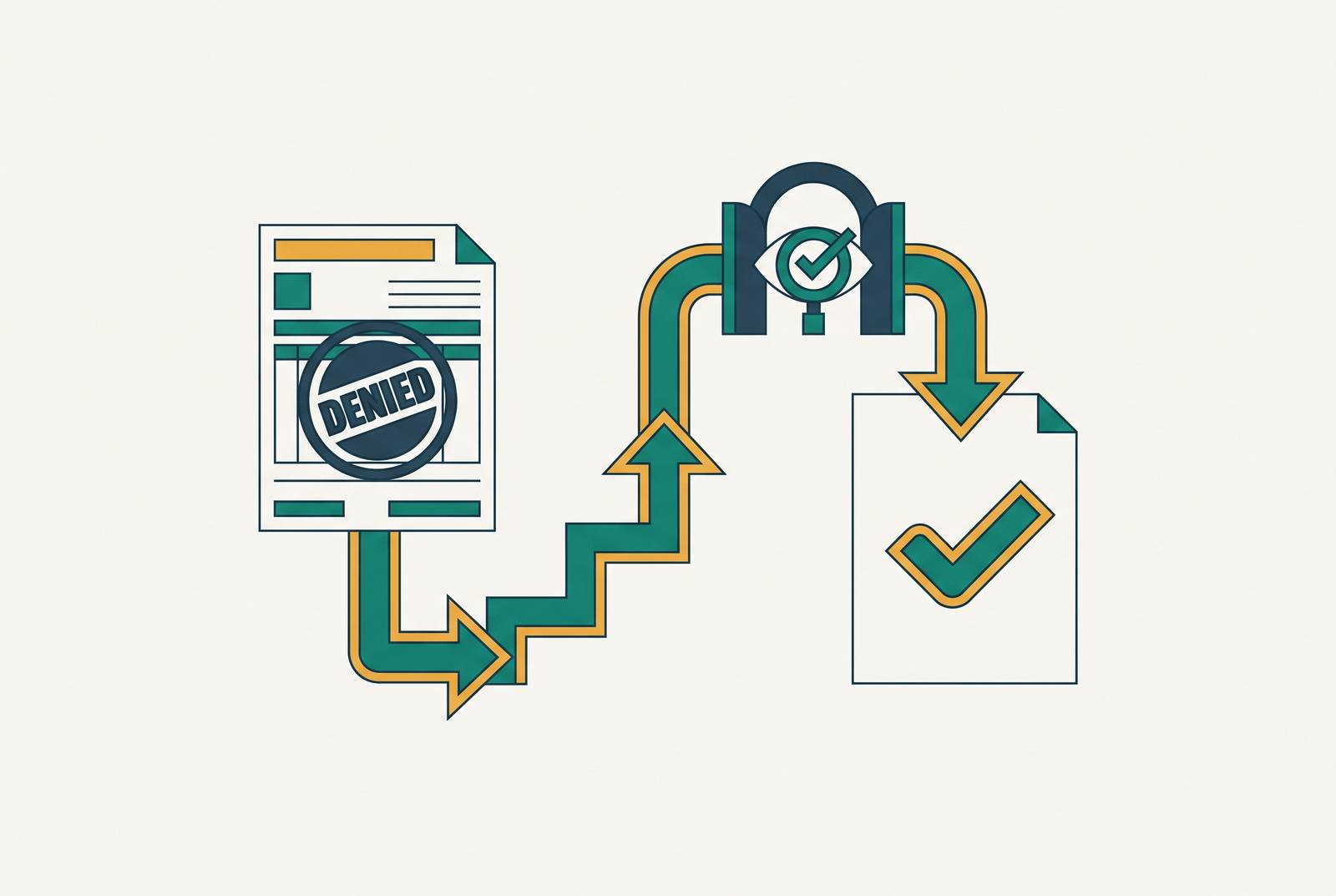
Nearly 53 million prior authorization requests hit Medicare Advantage plans in 2024, and insurers denied 4.1 million of them. The appeal that follows a denial is a substantive process. It's a defined sequence: peer-to-peer review, internal reconsideration, formal appeal, external review. Skip a step or file it out of order, and the mistake costs practices money and costs patients care they've already been prescribed. Most practices get the sequence wrong before they even open the denial letter, and that single error is why so much recoverable revenue never gets recovered.
Why appealing is worth the effort, and why most practices don't do it
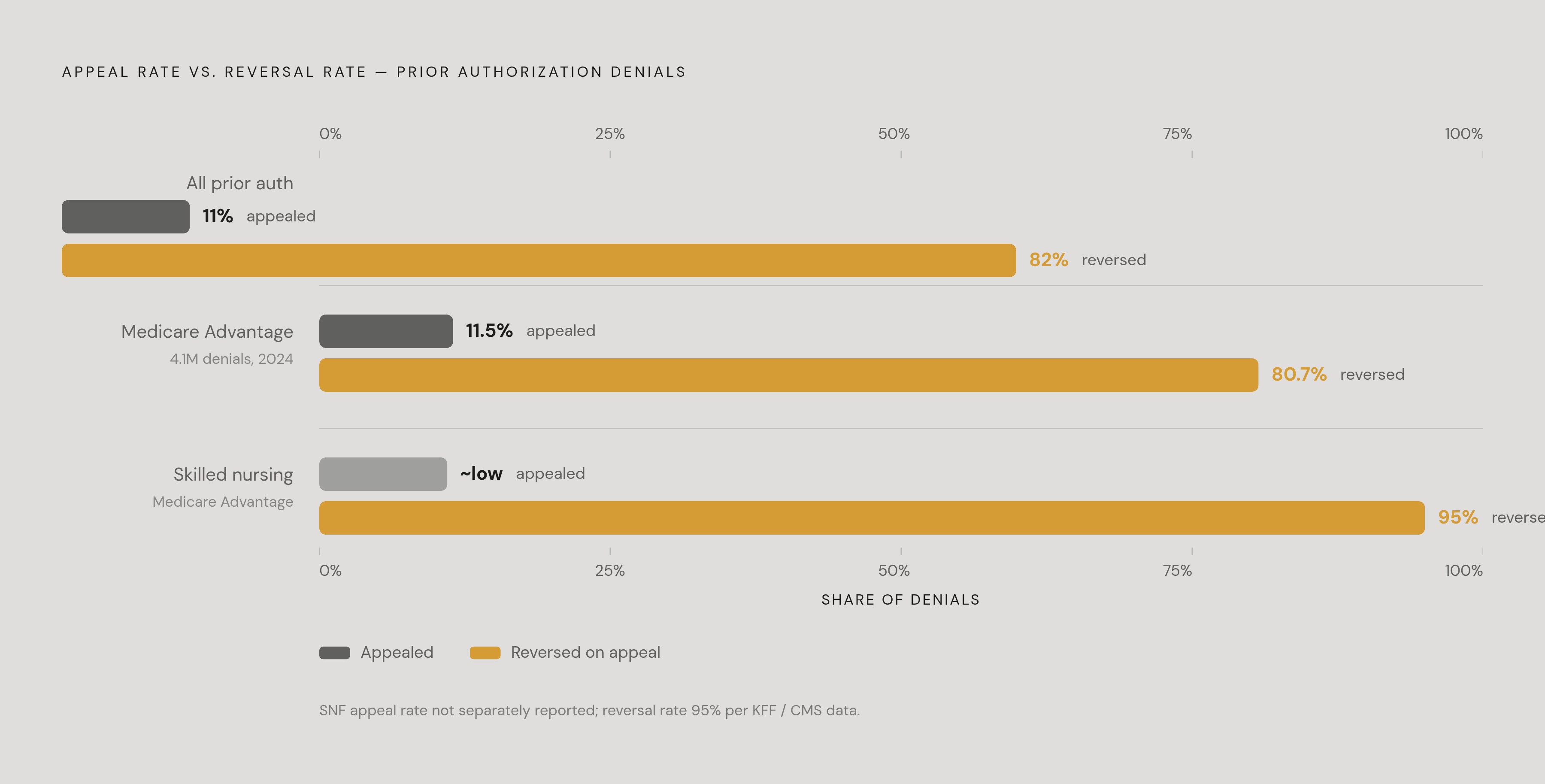
The numbers here don't line up the way you'd expect. About 6% of prior authorization requests get denied on first pass, and of those, only 11% ever get appealed. Yet among the ones that do get appealed, 82% come back fully or partially reversed. Medicare Advantage shows nearly the same split: 11.5% of the 4.1 million 2024 denials were appealed, and 80.7% of those appeals ended in a full or partial overturn. Skilled nursing facilities post the starkest number of all: a federal oversight body found 95% of appealed SNF denials in Medicare Advantage got reversed. That is a skewed outcome. It's a sign that most initial denials don't survive someone actually pushing back on them, which means the real failure in this system lies elsewhere. It's the appeal rate.
So why does the appeal rate sit at 11% instead of somewhere close to 100%? Mostly because nobody tells the patient or the practice that appeal is a live option with real odds attached, and billing staff, already stretched across dozens of payers and dozens of separate deadlines, don't have the hours to chase every denial down. A national physicians' organization has found that 78% of physicians say patients abandon treatment altogether because of prior authorization delays and denials. That's care that never happens, not because the clinical case was weak, but because nobody filed the paperwork in time.
The gap between what's recoverable and what actually gets filed is where the money sits, mostly untouched, for any practice willing to build a process around catching it. The rest of this piece covers how: reading a denial correctly, picking the right lever to pull first, and working the escalation ladder without burning your best shot at reversal before you've used it.
How to read a denial before doing anything else
The whole strategy lives inside the denial letter, which contains the reason code, the specific clinical criteria the payer cited, the reviewer's name and credentials, and the appeal deadline. Save it or photograph it the moment it arrives. Insurers don't always resend it, and portals bury old notices fast.
Then call the insurer and ask for five things by name: the exact clinical policy bulletin or criteria set used, including version number; which specific criteria the patient failed to meet, not the vague "does not meet medical necessity" line, the actual requirement; the reviewer's name, credentials, and specialty; whether that reviewer has relevant specialty expertise, which matters later for peer-to-peer and external review; and the confirmed deadline and method for filing an appeal.
Denials fall into a handful of recurring buckets, and each one tells you exactly what to build. "Not medically necessary" makes up roughly 45% to 50% of denials and needs the insurer's own clinical criteria cited back at them, point by point, showing why the patient meets those criteria or qualifies for an exception. Step therapy denials, around 20% to 25%, need a documented treatment history: dates, doses, duration, outcomes proving the conservative approach was tried and failed. Experimental or investigational denials, about 10% to 12%, need FDA approval records, peer-reviewed studies, and guidance from the relevant medical society. Insufficient clinical information runs 8% to 10% of cases and usually just means the original submission was incomplete, which is exactly where peer-to-peer earns its keep, since a live conversation can supply what a form couldn't. Out-of-network denials, 5% to 8%, require showing there's no comparable in-network expertise or reasonable geographic access. And denials for services simply not covered under the plan, under 5% of cases, call for pulling the Summary of Benefits and checking state mandates or ACA essential health benefit rules that might override the plan language.
Knowing which criteria system the payer used matters just as much as knowing the reason code. InterQual, now owned by Optum after UnitedHealth's 2022 acquisition of Change Healthcare, MCG (formerly Milliman Care Guidelines), and various insurer-internal rule sets all define medical necessity differently. Documentation written to satisfy InterQual won't automatically satisfy MCG, so it has to speak that specific system's language, not a generic one.
One more branch point is worth checking before anything else. If the denial traces back to a coding error, a wrong CPT or HCPCS code, a truncated ICD-10, or a missing secondary diagnosis, the fix is a corrected PA resubmission, not a formal appeal. Confirm with the payer before committing staff time to the wrong track.
Starting in 2026, under CMS-0057-F, payers covered by the rule have to give a specific clinical reason for every denial. A generic denial code won't satisfy the requirement anymore, and that stated reason becomes the exact target everything downstream should aim at.
Peer-to-peer review: the highest-ROI first step and why sequence is everything
Peer-to-peer review puts the ordering physician on the phone directly with the insurer's medical director. It moves faster than a written appeal, and it lets a physician explain nuance a form can't capture. Published research puts overall P2P overturn rates above 50%, and in imaging and certain specialty procedures, that number climbs closer to 70%.
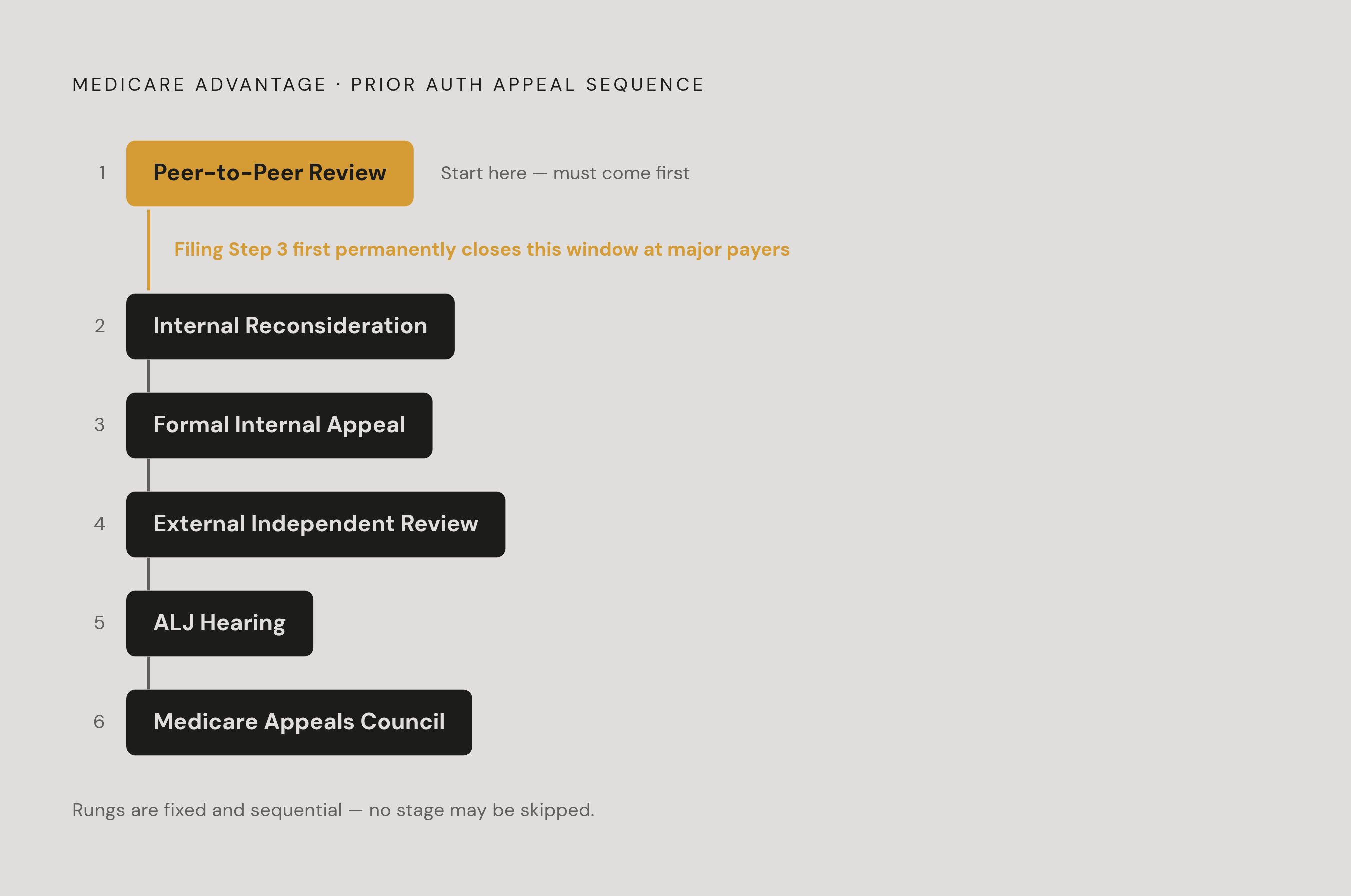
Here's where practices trip themselves up: at several major payers, filing the formal written appeal before requesting peer-to-peer closes the P2P scheduling window for good. File in the wrong order, and the single highest-return option on the table disappears before anyone's had a chance to use it. Get the sequence right, request the P2P first, always, and the rest of the process only improves from there.
A national physicians' organization's 2024 Prior Authorization Physician Survey found P2P requirements rising across specialties. The friction comes from P2P sitting underused despite its strong reversal rates.
The clock on P2P runs short, typically days from the denial date depending on the insurer, which means staff have limited time, not weeks, to request the call. While waiting, two things should happen at once: gather the supporting clinical documentation in case the call doesn't resolve things, and where the payer allows it, file the written appeal on a parallel track to protect the deadline. Confirm the payer's specific policy on parallel filing first, since some treat it as a waiver of P2P rights.
A clean paper trail from the original PA submission makes the call itself stronger. A documented call log, reference number, the rep's name, the stated decision date, hands the medical director a clear record of exactly what was requested and when.
The internal appeal process: reconsideration, formal Level 1 appeal, and what documentation each stage requires
Before the formal appeal clock even starts, there's often room for internal reconsideration: new clinical documentation, submitted on top of the original request, aimed at resolving the denial before it becomes a Level 1 matter.
If that doesn't work, the Level 1 formal internal appeal runs on its own timeline. Filing windows stretch anywhere from 15 to 180 days from the denial depending on the insurer and how urgent the service is. Standard internal appeals for pre-service prior authorization denials require a decision within 30 days. Expedited appeals, used when delay could harm the patient, require a faster response than standard appeals. Starting January 1, 2026, under CMS-0057-F, standard PA decisions must come within 7 calendar days and urgent ones within 72 hours, tighter than most practices have ever worked under.
A well-built appeal letter carries specific pieces, and none of them are optional: the previous PA reference number; the diagnosis and CPT codes tied to the requested procedure; full clinical documentation, meaning consult notes, test results, imaging, functional assessments; where step therapy is the issue, a record of failed conservative treatments with dates, doses, duration, and outcomes attached; peer-reviewed literature and guidelines from the relevant clinical society, whether that's the AMA, AAOS, AAD, or another body specific to the specialty; and a physician narrative, in plain terms, explaining why this particular patient needs this particular service now, covering quality-of-life impact and the clinical risk of leaving it untreated. Where the payer uses a proprietary criteria set like InterQual or MCG, the appeal should name exactly which criteria the patient meets and answer every unmet criterion directly rather than skip past it.
Well-documented appeals succeed somewhere between 62% and 74% of the time. That word "well-documented" is doing real work in that sentence, because incomplete appeals fail at a much higher rate, and there's no partial credit for a packet missing the treatment history.
Medicare Advantage carries a rule worth citing by name every time it applies: MA plans cannot deny prior authorization for a service traditional Medicare would cover. If the service in question falls inside that scope, say so directly in the appeal, and say it early.
For practices working inside an HMO or IPA structure, there's an added rung most people forget about. If the medical group or IPA denies the appeal, it escalates to the health plan itself, which holds the authority to overrule the IPA's decision.
Beyond the paperwork, one habit keeps appeals from stalling out in a queue somewhere: call the insurer on a regular cadence, ask directly whether anything else is needed, and keep the physician's office looped in, since insurers sometimes call the physician directly instead of going through billing.
External independent review and the Medicare escalation ladder
If the Level 1 internal appeal comes back denied, the next step is external independent review, run by an organization with no ties to the insurer. The request has to go in within the insurer's specified window after the internal denial, and a decision follows within a defined period under standard review or on an expedited basis if urgency warrants it.
In urgent cases, where waiting on the internal appeal risks harming the patient, expedited appeal pathways are available and should be requested promptly.
For Medicare Advantage specifically, the ladder runs in a fixed order, and skipping rungs isn't an option. Peer-to-peer review comes first, then internal reconsideration, then the Level 1 formal internal appeal, then external independent review, then an Administrative Law Judge hearing, and finally the Medicare Appeals Council, which reviews the case after an unfavorable ALJ decision and can uphold it, modify it, reverse it, or send it back down to the ALJ.
The SNF number from the OIG, 95% of appealed denials reversed, makes the case for persistence better than any argument could. Most practices never make it past the first rung or two of that ladder, and that's exactly where the recoverable revenue and the recoverable care sit unclaimed. Stopping after the first internal appeal is the single most expensive habit in this entire process.
Worth flagging directly: this full ladder applies mainly to Medicare Advantage and Medicaid managed care. Commercial plans run under ERISA and state law instead, and those timelines and procedures shift considerably from one plan, and one state, to the next.
What the 2026 regulatory changes mean for how practices should file appeals now
CMS-0057-F was finalized in February 2024 and takes effect January 1, 2026. It covers Medicare Advantage organizations, Medicaid managed care plans, CHIP, and ACA marketplace plans sold on the federally facilitated exchange. It doesn't touch commercial employer-sponsored plans governed by ERISA. And even among the plans it covers, the scope of specific requirements varies by plan type, so practices should confirm which provisions apply to each payer they work with: denial reasons, API access, and public reporting.
The provisions that matter most for how appeals actually get filed: standard PA decisions now have to come within 7 calendar days, urgent ones within 72 hours, every denial has to carry a specific written clinical reason instead of a generic code, and payers have to publish their PA requirements through FHIR-based APIs so practices can look them up directly instead of guessing or calling in.
That clinical reason requirement changes the whole shape of how an appeal gets built. Instead of assembling a broad clinical package and hoping it happens to cover whatever the payer might object to, staff can read the stated reason and build the appeal to answer that exact point, nothing more. Practices that keep building broad packets after 2026 are wasting the one advantage the new rule hands them.
Come March 31, 2026, payers covered by the rule have to publicly report their 2025 prior authorization numbers: approval rates, denial rates, average processing times, appeal outcomes. That's the first point at which practices can size up payer behavior against real numbers instead of guesswork, and it should sharpen the decision of which denials are worth fighting hardest.
Four FHIR APIs, covering Patient Access, Provider Access, Payer-to-Payer, and Prior Authorization, have to be running by January 1, 2027. That's the infrastructure for electronic submission and tracking, and practices should start planning around it now rather than after the deadline lands.
There's new ground opening in traditional Medicare too. Starting January 1, 2026, applying to services delivered on or after January 15, 2026, a federal payment model brings prior authorization to Traditional Medicare Part B for the first time, in six states, covering 14 service categories including epidural steroid injections, cervical fusion, and skin substitutes. Fee-for-service Medicare has never required prior authorization for outpatient services at this scale before, and practices that treat this as a Medicare Advantage problem alone are going to miss it.
CMS estimates CMS-0057-F saves close to $15 billion over ten years, largely by cutting friction out of the PA process itself. That adjustment goes beyond a minor technical fix. It's a structural rewrite of how the whole system runs.
Where automation fits in the appeal workflow, and what each layer of technology actually does
Running all of this by hand costs more than most practices realize. Tracking deadlines across dozens of payers, each with different windows and forms, building documentation packets, checking status, drafting letters, it's high-volume, repetitive work that eats staff time without offering much room for shortcuts.
Robotic process automation was the first real answer. RPA bots mimic what a person does inside a payer portal: logging in, filling fields, checking status around the clock. For structured, repetitive portal work, it holds up, and there are documented cases of it cutting cost per transaction and speeding up processing, including one case study showing a 90% faster PA packet submission.
But RPA has a known weak spot, and it's a bad one: the bots are brittle by design. Change the layout of a payer portal, and the script breaks. Keeping scripts working across dozens of different payer portals takes ongoing development work most practices can't keep funding indefinitely, a real cost that RPA hides from the people buying it.
AI agents move past that limitation in a way that actually holds up. Instead of just filling fields, they reason through clinical documentation, pull the relevant details out of unstructured notes, adapt to a payer's specific requirements, and keep working even when a portal changes its layout, with nobody rewriting a script to catch up. Some now handle submission across channels: the web portal, digital fax for payers still running legacy systems, and voice agents for the payers that still demand a phone call, capable of sitting in a hold queue and talking to a live representative once the call connects.
Denial-triggered automation is the newest layer, and arguably the one worth watching most. These systems watch for a payer's response and start the appeal workflow the moment a denial lands, pulling the stated reason, matching it to the right documentation template, and queuing the appeal before a staff member would have otherwise noticed the denial at all. For a process where sequence and deadlines decide the outcome, that head start is the whole game.
Sources
- What to Do if Health Insurance Denies a Prior Authorization for Treatment
- Prior Authorization Denied? Complete 2026 Action Guide for Providers
- Prior Authorization Denied? How to Appeal and Win (2026 Guide) | CareRoute
- What Happens If Prior Authorization Is Denied 2026: 5-Step Escalation Guide
- Prior Authorization Denied? How to Appeal and Win (2026 Rules) - Health Bill Central
- Medicare Advantage Prior Auth Appeals Guide - Dastify Solutions