Single Login AI Agent Setup vs Full EHR Integration Projects
Screen agents deliver savings in weeks; full integration takes months before any return arrives.
The choice between a single-login AI agent and a full EHR integration project does not come down to which technology performs better in the abstract. It comes down to how much time, money, and disruption a practice can absorb before automation produces any return at all. Framed as a technical question, the comparison invites a debate about accuracy and sophistication. Framed correctly, it is a question about runway: what a practice administrator can tolerate between the day a project starts and the day it actually changes the workload on staff. The distance between the two paths, measured in time to first value, upfront spending, and the operational risk a practice takes on during the transition, is wide enough to count as a strategic decision rather than a matter of preference. What follows lays out what each path requires, where each one holds up under real workflow pressure, and what an administrator needs to weigh before signing off on either one.
How screen-operating agents work without integration
A computer-use AI agent does what a staff member does at a keyboard. It reads whatever is on the screen, clicks, types, moves between applications, and carries out multi-step tasks without needing an API or a custom-built connection to the systems involved. The mechanism behind that is a loop: the agent takes in the current screen through a screenshot or similar visual input, decides on the next action, carries it out with mouse and keyboard, and repeats the cycle until the task is done. That loop runs the same way regardless of which application is on screen, which is what lets one agent move across a payer portal, a browser-based EHR, and a scheduling tool without a separate build for each.
Reliability varies by the type of interaction involved. There are three tiers of computer interaction in 2026: API integration, which is highly reliable but depends on both systems having APIs and someone available to build the connection; browser automation, which is reliable but limited to web-based tools; and OS-level desktop control, which works across any application on screen but is only moderately dependable. Most healthcare administrative work, payer portals, web-based EHRs, scheduling platforms, is in the browser automation tier, where reliability runs in the 85 to 95 percent range. That is a meaningful number, not a rounding error, and any practice evaluating this path should know which tier a given workflow falls into before assuming a blanket reliability figure applies.
The distinction from older automation matters here. Traditional RPA tools, the Selenium-based scripts many practices already have some experience with, rely on fixed locators in a page's HTML, things like XPath, CSS selectors, or element IDs, and they break the moment a portal changes its layout. A computer-use agent works differently: it interprets what it sees the way a person does, so when a payer redesigns a portal or adds a new multi-factor authentication step, the agent adapts instead of failing outright.
Getting one of these agents running does not require a project. It requires a login. The agent authenticates with an existing staff credential, one to the EHR, one to each payer portal that needs to be touched, and starts working immediately, with no API keys to request, no vendor to negotiate with, and no integration timeline to wait out. Novoflow's agents follow this exact model: they authenticate with existing staff credentials, operate payer portals and EHRs the way a staff member would at a keyboard, and move into production within days rather than months, without any API work or vendor coordination required. The onboarding resembles how a new hire starts on the job, handed a login and walked through the workflow, not how a software integration team starts after a scoping phase that can run for months before a single task runs.
What a full EHR integration project requires
A full EHR integration project is a different kind of commitment entirely. It means building certified API connections, typically using FHIR or HL7 standards, with bidirectional data pipelines and workflow logic embedded in both systems, and none of it produces a single automated action until the infrastructure is finished. The work involved is substantial: certifying APIs with each system individually, mapping data fields between schemas that were never designed to match each other, testing across multiple environments, clearing a security review, and coordinating with vendors on both the EHR side and the payer side.
These timelines have historically stretched across many months. AI-assisted tooling is now compressing that process, but the basic dependency has not gone away: nothing runs until the plumbing is finished. A completed integration gives a practice structured, bidirectional data flow, so an agent or automated process can read a patient's record and write clean, structured results directly back into the chart. That produces an audit trail and downstream reporting that a screen-operating agent does not generate on its own.
The financial case for integration gets stronger once it is live, but that word, once, hides real cost: staff time pulled away from other work, IT resources committed for months, vendor fees, and a transition period where the old manual process has to keep running in parallel. The people who absorb the heaviest burden during that stretch are clinical staff and the IT departments of the health systems running the project. If staff were never consulted during the planning stage, disruption during the transition breeds resistance. None of this makes the integration path the wrong choice. It makes it a choice with a cost structure that has to be understood up front, not discovered halfway through.
Why the time-to-value gap changes the ROI math
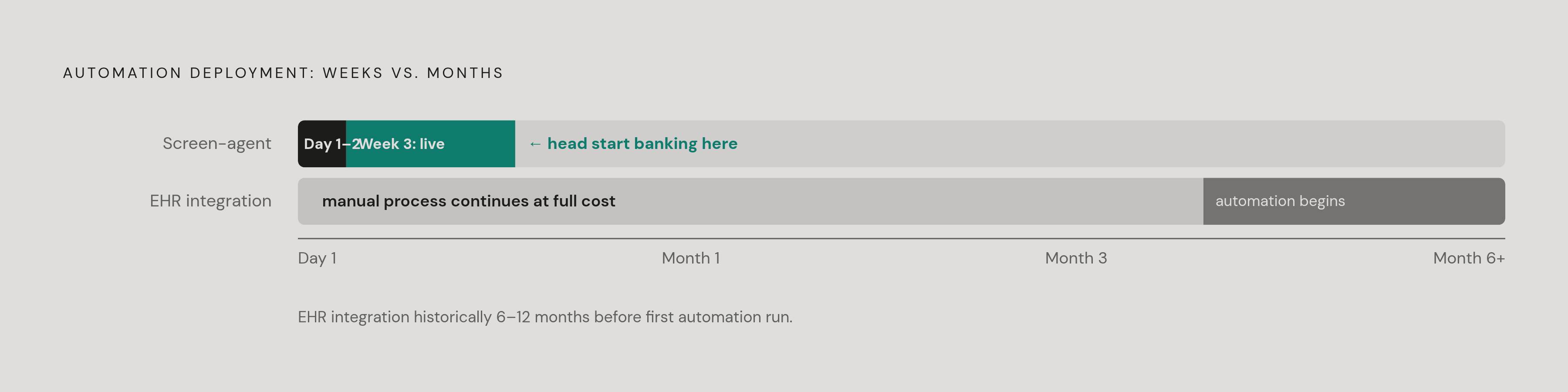
Every week a practice spends waiting for an integration to go live is a week the manual process keeps running at full cost. The integration path's long-run advantages have to make up for a head start the single-login path has already banked by the time integration work finishes. Screen-agent platforms can have a pilot running in as little as one to two days using existing credentials and batch data, with full production workflows live in roughly three weeks. Full EHR integration projects have historically taken many months before any automation runs at all, and while AI-assisted tooling shortens that window, it does not remove the upfront dependency on finished infrastructure.
During that gap, staff keep handling prior authorizations, denial appeals, referral scheduling, and cancellation recovery by hand, at the same labor cost, with the same error rates, and none of that lost time comes back once the integration eventually launches. For independent practices and mid-market groups working under staffing pressure, an argument about which tool is better in the long run loses to a simpler question: which tool is actually running next month. Many of these practices cannot sustain a runway of six to eighteen months before automation delivers anything measurable.
Large health systems with dedicated IT staff, legal review, and vendor management resources face a different calculation. For them, the integration timeline is a known, budgetable cost, and the structured write-back and audit trail that come with it are worth the wait. The choice between these paths turns less on which technology performs better and more on operational tolerance: whether a practice can absorb months of planning and build work before seeing any return, or whether it needs staff capacity back and administrative cost down within weeks.
A screen-agent deployment that starts producing value in weeks may still need to be supplemented or replaced later as FHIR-based APIs become mandatory on the payer side. What matters more is which path a practice can sustain given its own operational constraints.
Performance and failure points in prior authorization
Prior authorization is the workflow that tests both deployment philosophies at once, because it combines portal fragmentation, heavy documentation, denial risk, and strict time pressure in a single process. Payer portal fragmentation, the reality of dozens of different portal layouts, login flows, and MFA requirements across payers, is precisely the problem browser-based AI agents were built to handle. Where a traditional RPA script breaks the moment a portal gets redesigned, a computer-use agent reads the new layout visually and keeps working.
Every prior authorization run through a screen-agent should generate a complete audit trail, screenshots and replay capability included, which is how HIPAA's documentation requirements get satisfied even without a structured write-back into the EHR. That last point marks the real limitation of this path: the agent submits a request and reads back the payer's response, but it does not automatically write a structured result into the patient's chart. Practices running this way may need a downstream manual step or a separate reconciliation process to get that outcome recorded cleanly.
Regulation is reshaping this workflow on a fixed timeline. CMS-0057-F took operational effect on January 1, 2026, and requires impacted payers to decide standard prior authorization requests within 7 calendar days, expedited requests within a matter of hours, and to provide a specific reason for every denial. FHIR-based electronic prior authorization API requirements follow on January 1, 2027, at which point payers must have FHIR Prior Authorization APIs in place for end-to-end programmatic exchange. Once those APIs are mandatory, programmatic submission through integration becomes both available and, for many payers, preferred. Practices running screen-agent PA automation will need to decide whether to layer API connections in as payers adopt them, or to keep screen-agent submission running in parallel for the payers that lag behind the deadline.
Where each path performs in scheduling and referral operations
Scheduling and new-patient referral management show the single-login path's advantages at their clearest, because the work happens in browser-based tools, runs at high frequency, and turns missed volume directly into lost revenue. A typical medical practice in 2026 runs its EHR, a separate scheduling platform, a separate patient portal, a separate telephony system, and sometimes a separate prior authorization tool, none of them natively connected to one another. A screen-operating agent bridges all of those systems at once without touching the integration layer of any single one of them.
Memorial Hospital at Gulfport implemented a voice AI patient scheduling system and generated substantial additional revenue within seven months by cutting down on no-shows, using a data and analytics platform rather than the voice AI scheduling tool itself to measure the result. That distinction between the automation and the measurement system matters for anyone trying to replicate the outcome: the gain came from the scheduling change, but the evidence of it came from separate analytics.
Full integration adds something the screen-agent path does not produce on its own: clean, structured data on scheduling outcomes, no-show patterns, referral-source conversion rates, slot utilization, written directly back into the EHR and available for reporting without someone reconciling it by hand. That capability matters most to multi-location groups and health systems that need visibility across an entire portfolio of sites. For independent and mid-market practices, the priority runs the other way. The screen-agent path recovers lost revenue right away, so the deeper reporting that comes with full integration can wait until the basic recovery work is already paying for itself.
The compliance requirements both paths share
HIPAA compliance does not change based on which deployment path a practice chooses. What changes is where protected health information gets exposed, how credentials are managed, and what audit evidence each architecture generates automatically. Both paths handle PHI, and both require Business Associate Agreements with every vendor touching that data, the AI provider itself, any MLOps tooling involved, any third-party model in the chain, with no exceptions carved out for smaller vendors or lighter-touch tools.
The exposure looks different depending on the architecture. On the screen-agent path, the agent authenticates as a human user through staff credentials. Session tokens, screenshots that may contain PHI, and intermediate data buffers all need the same safeguards that would apply to direct database access. That is a configuration requirement to build into the deployment. The mitigation is well understood: self-hosted or VPC deployment keeps PHI off shared infrastructure, and every automated run should generate a full audit trail with screenshots and replay capability, functioning as the documentation equivalent of the structured write-back that comes built into full integration.
Full EHR integration carries its own distinct exposure. These projects typically authenticate as a single application or service account rather than as an individual user, which collapses the EHR's normal per-user permission model unless the integration layer is explicitly built to restore role-based scoping. That is a known architectural risk that has to be addressed directly, not something a practice can assume the EHR will handle on its own. HIPAA penalties for violations can run into the millions of dollars per violation category per year, which makes clear that this infrastructure is not optional on either path. Treating compliance as a feature that differentiates one vendor from another misstates what every practice is already required to do. The one vendor-side credential worth checking for is SOC 2 Type II certification, which signals that a provider's security controls have been audited by an outside party rather than simply claimed by the vendor itself.
The interoperability gap that neither path fully closes
Most practices cannot pursue deep EHR integration even if their leadership wants to, because the systems they actually run, the EHR, the scheduling platform, the patient portal, the telephony system, a prior authorization tool, are too fragmented and too varied for any single integration project to cover all of them. That fragmentation is structural.
It is the reason the single-login path functions as a durable option. A screen-operating agent does not need every system in a practice's stack to expose an API before it can start working across all of them. It needs a login to each one. That is a materially lower bar, and it is why the gap between fragmented healthcare IT and clean, fully connected infrastructure is likely to persist well past any single practice's integration timeline, leaving screen-operated automation as the practical way to cover the systems that full integration will never reach.