Measuring AI Agent Performance in Administrative Healthcare Workflows
Healthcare systems need workflow-specific metrics to evaluate whether AI agents actually work.

AI agents now run daily administrative work across a large share of health systems, handling prior authorization, scheduling, and denial appeals without a human at every step. The technology has moved from pilot to production, but the measurement infrastructure has not kept pace: most organizations that have deployed these agents still lack a standardized way to know whether they are actually performing. The argument of this piece is that gap, not the underlying technology. Measuring agent performance correctly requires workflow-specific KPIs agreed before deployment, because the right metrics for a prior authorization agent differ fundamentally from the right metrics for scheduling or denial appeals, and applying a single universal benchmark across all three produces conclusions that are wrong in ways that matter.
Workflow-specific KPIs as the starting point, not a refinement
The scale of the measurement gap is larger than most procurement conversations acknowledge. Hyro's benchmark data shows that a large majority of healthcare leaders consider their deployed AI agents critical to daily operations, yet only 59% of those same organizations have standardized performance measurement in place. That gap widens, rather than closes, as deployments scale. Vendor selection criteria, not deployment conditions, explain the gap. Vendors are still selected on feature sets, perceived flexibility, and compelling demos, none of which predict live performance. A demo reflects an ideal scenario built to showcase the product. Real deployments surface edge cases, payer-specific exceptions, and system constraints that a sales demonstration is never built to expose. Without KPIs defined and agreed before an agent goes live, an organization has no reliable way to tell whether an agent is performing at the level of a trained staff member or quietly failing at scale while its dashboard still shows green.
The natural counterargument is that a single resolution rate benchmark should be sufficient to compare vendors and deployments against one another, since it offers a clean, universal number. That argument fails on contact with how differently resolution rate behaves across workflows: it means something structurally different in scheduling than it does in prior authorization, and something different again in denial appeals. Applying one threshold across all three does not simplify the comparison. It produces conclusions that range from misleading to actively damaging, because an organization acting on a flawed benchmark will either abandon an agent that is working or keep funding one that is not. The rest of this piece builds the case for workflow-specific measurement as the only approach that reflects how these agents actually operate.
Agentic AI in administrative workflows
Understanding why one KPI framework cannot cover every use case starts with understanding what these systems are actually built to do. Agentic AI completes multi-step administrative workflows end to end: it reads unstructured records, navigates payer portals and EHR screens, and resolves exceptions rather than stalling on them. That capability is precisely what makes a simple pass/fail task metric inadequate for measuring it. A system that completes ten steps correctly and fails cleanly on the eleventh has performed very differently from one that fails silently on step three.
The architectural distinction matters here. Rules-based RPA repeats fixed screen steps and breaks the moment it encounters an exception. Generative AI summarizes and drafts text but does not act across systems on its own. Agentic AI plans, acts, reflects on whether the action achieved its goal, and retains memory across steps. Planning means deciding which steps to take given a defined goal; action means executing those steps across integrated systems; reflection means evaluating whether the action actually produced the intended outcome; memory means retaining context from prior interactions so the system improves over time. It is that reflection and exception-handling layer, absent from both RPA and generative AI alone, that changes what counts as a successful outcome in the first place. Deployed examples already span clinical documentation, prior authorization, claims appeals, scheduling, eligibility verification, and denial management, and each of those workflows carries its own success conditions, its own timeline, and its own downstream consequences when something goes wrong.
Applying a single resolution rate benchmark across workflows like prior authorization and scheduling produces two errors: declaring a scheduling agent underperforming when its ceiling is structurally lower, or declaring a denial appeals agent successful when it is resolving the easy cases and abandoning the complex ones. Screen-operating agents, the kind that navigate payer portals and EHR screens the way a staff member would, add a layer of measurement difficulty because their actions are not logged through an API by default. Auditability has to be built in deliberately; it does not come for free with the architecture. Research published in Frontiers in Digital Health identifies fragmented workflows, excessive documentation, and poorly integrated clinical systems as compounding drivers of physician burnout and clinical error, and agentic AI is positioned as a response to all three at once. That breadth of purpose is why a single KPI cannot capture performance across all three problems simultaneously.
Resolution rate as the anchor metric, and its limits without workflow context
Resolution rate deserves its place as the central performance metric for administrative AI agents. It measures whether the agent actually finished what it was deployed to do. But the value of that number collapses the moment it gets aggregated across workflows, because scheduling, prior authorization, and denial appeals carry fundamentally different resolution ceilings and fail in different ways.
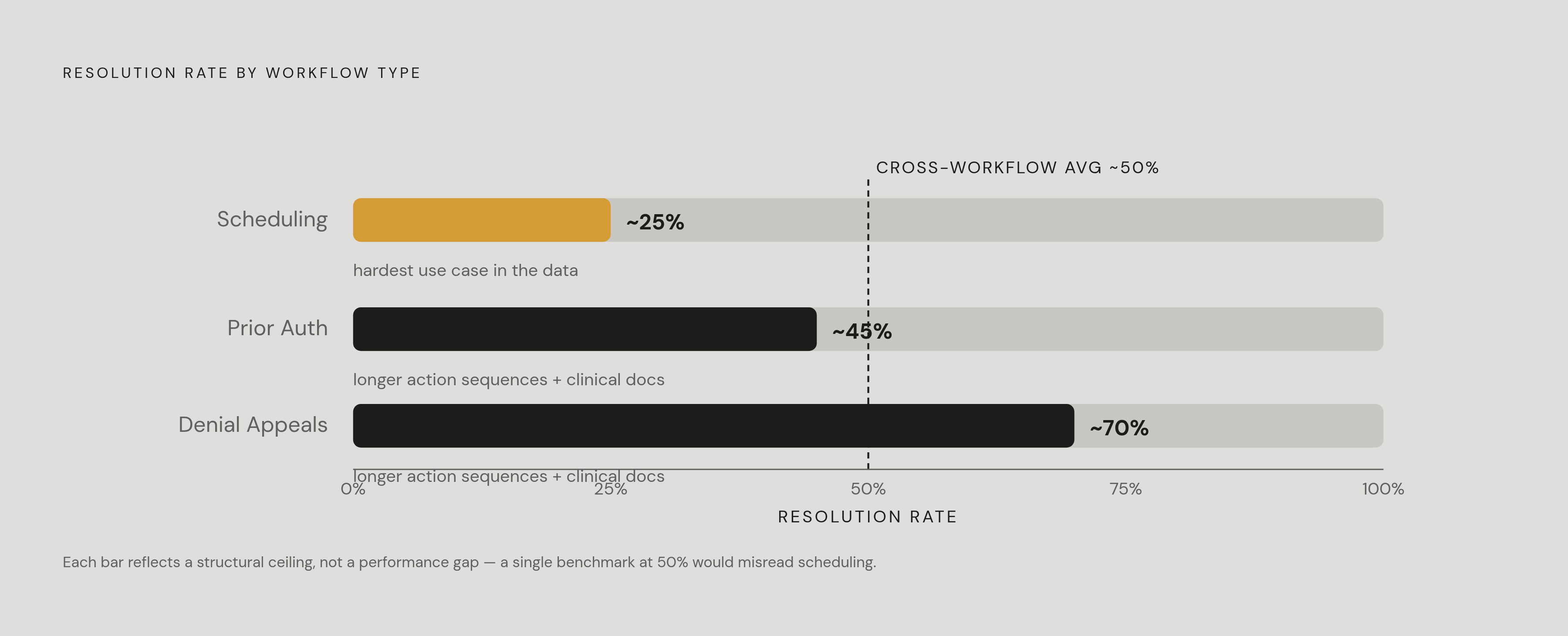
The variance makes the point better than any single average could. Hyro's benchmark data puts the average resolution rate for patient administrative interactions at roughly half, across the full range of deployed use cases. But that average hides enormous differences within it. New appointment scheduling, the hardest use case in the data, averages only around one in four interactions resolved across health systems running agentic AI. Prior authorization and denial appeals sit on different structural ceilings entirely: a resolved PA request involves a longer sequence of actions, a longer time horizon, and clinical documentation requirements that a scheduling agent never has to touch.
Treating resolution rate as a portable, workflow-agnostic benchmark produces two distinct failure modes. An organization can wrongly label a scheduling agent as underperforming when its ceiling is simply lower by structural necessity, and it can just as easily label a denial appeals agent as a success when that agent is clearing the easy cases while quietly abandoning the complex ones. A denial appeals agent that reads the denial letter, assembles corrected documentation, and routes the case for nurse approval has to be judged against the full appeals lifecycle, not against a first-touch submission number that looks impressive in isolation. Resolution rate remains the right starting question. It only becomes a reliable answer once it is asked separately, inside each workflow, against a ceiling and a failure mode specific to that workflow. That reframing is what the next three sections put into practice.
The KPI framework for prior authorization agents
Prior authorization is the right place to apply this framework first, because it is simultaneously the most documented, the most burdensome, and the most consequential administrative workflow in the outline. The scale of the burden is well established: the AMA estimates physicians spend many hours per week on PA tasks, and a single request has historically consumed multiple business days of manual follow-up. A framework that measures only how fast an agent submits a PA request misses the point entirely, because speed at submission does not reveal whether the agent is actually reducing burden or simply moving the burden somewhere else in the lifecycle.
Four KPIs, tracked together, cover that full lifecycle. Submission accuracy rate measures what share of submissions go out complete and payer-compliant on the first pass, since an incomplete submission restarts the clock and erases whatever speed gain the agent produced. Approval cycle time tracks the interval from submission to payer decision, measured against the organization's own pre-deployment baseline for the same payer and procedure mix, rather than against an industry average built on a different case mix entirely. Manual-touchpoint rate captures how often a human has to step back into the workflow mid-process; an agent that still requires staff to re-enter data or chase a fax is not resolving the administrative burden, it is redistributing it. Denial-reversal rate on AI-assisted appeals tracks, for submissions that are initially denied, what share the agent successfully carries through to a reversed decision on appeal, which is the single metric that reveals whether the agent actually handles exceptions or simply breaks on them.
MUSC Health offers a concrete illustration of what strong performance on these KPIs looks like in practice. After expanding its agentic AI deployment, the health system now completes a meaningful share of prior authorizations with zero manual involvement, and processing time per case dropped from a process that previously took tens of minutes to about one minute. That zero-manual-touchpoint figure, not the raw speed number alone, is the evidence that the agent is performing real work rather than shifting it. The regulatory environment is also raising the baseline these KPIs get measured against. The CMS WISeR Model launched in January 2026 across six states, using AI and machine learning alongside human clinical review to screen prior authorization requests for Medicare services, signaling that PA automation paired with human-in-the-loop oversight is becoming a structural expectation rather than a vendor differentiator. The CMS 2026 Prior Authorization Rule, CMS-0057-F, took effect in January 2026 and mandates electronic prior authorization and public reporting, with FHIR-based APIs and full payer API go-live required by January 1, 2027. As that regulatory floor rises, the baseline against which PA agent performance gets measured rises with it.
The strongest objection to this framework comes from the track record of electronic prior authorization itself. Research cited in Health Affairs Scholar, surfaced by DevelopHealth, finds that ePA on its own, without AI-native handling of the full lifecycle, has not reduced provider burden or form-completion costs. That finding does not undercut the case for a lifecycle-based KPI framework; it proves it.
The KPI framework for scheduling and cancellation recovery agents
Scheduling is the most widely deployed agentic AI use case in healthcare administration and the one with the lowest resolution ceiling, the clearest possible illustration of why resolution rate alone misleads. A scheduling agent posting a resolution rate well below the cross-workflow average can still be a genuinely high performer, provided the organization is measuring it against the right KPIs rather than the wrong benchmark.
Provider utilization rate belongs at the top of that list: the share of available provider slots actually filled is the downstream outcome a scheduling agent exists to move, and an agent that books confirmations well but fails to recover cancellations can show a decent resolution rate while leaving real utilization on the table. Cancellation recovery rate is the sharpest metric in the entire framework. Of appointments that cancel, the share the agent successfully reschedules before that slot goes unfilled is a direct revenue-recovery number, and it is what separates a true scheduling and recovery agent from a system that merely confirms bookings. A missed cancellation is lost revenue the moment the slot goes unfilled.
No-show rate sits inside the same framework, since automated reminders and pre-visit outreach fall squarely within a scheduling agent's scope, and a meaningful reduction in no-shows is a direct, measurable sign the agent is doing its job. Staff hours displaced matters too: industry benchmark data shows healthcare organizations saving an average of more than 260 staff hours per month when AI agents take over routine scheduling and confirmation volume. New patient scheduling conversion rate, the share of inbound referrals that convert into a booked and kept appointment, is a distinct number from general scheduling resolution rate and deserves its own line in the framework rather than being folded into an aggregate figure.
Ochsner Health's deployment of Epic Emmie shows this in production: patients rescheduled more than 14,900 appointments through the system, saving the organization nearly 750 staff hours. The meaningful number there is appointments recovered and hours freed, which a raw resolution rate figure would obscure. OmniMD has reported improved appointment adherence through its AI Front Desk product, and appointment adherence rate is exactly the kind of scheduling-specific KPI a universal resolution rate benchmark would never surface on its own. Droidal's voice RCM agent has documented a meaningful reduction in no-shows alongside reductions in eligibility-related denials, which shows how scheduling KPIs and revenue cycle KPIs intersect once an agent handles pre-visit eligibility checks alongside the scheduling task itself.
The KPI framework for denial appeals agents
The denial landscape is structurally different from scheduling or prior authorization: a denial has already occurred, the documentation has already been rejected, and the agent must read an adverse decision, determine what is missing, and construct a corrective response. That is a multi-step exception-handling task, not a submission task, and it needs to be measured as one. An agent judged only on how many appeals it submits will look productive on paper while material revenue quietly erodes in the aging queue behind it.
Appeal success rate is the outcome metric that matters most: of the appeals an agent submits, the share that actually result in payment is the only number confirming the agent is resolving denials rather than simply generating appeal volume. Cycle time from denial to reversal, the number of days between a denial being received and a payment finally being posted, should be tracked against the organization's own pre-deployment baseline, since industry averages reflect a payer and denial-type mix that will differ from any one organization's actual book of business. Aging claims recovered, the dollar value of claims beyond a defined aging threshold that the agent successfully brings back to payment, reveals whether the agent is reaching the hard, long-neglected cases or cherry-picking the recent, easy ones. For agents that also touch billing coding, coding-related denial rate serves as a leading indicator: a drop in coding-related denials shows upstream accuracy improving, not merely that appeals are moving through the pipeline faster. Human escalation rate, the share of denials the agent cannot resolve and has to route to a specialist, tracks precisely where the agent's exception-handling breaks down and tells an organization where its workflow configuration needs attention.
Epic Penny, which automates billing coding, denial appeal letters, and claims follow-up, is now used across a large number of organizations, and its reported results include a reduction in coding-related denials alongside faster generation of appeal letters. The KPIs that matter in that deployment are denial rate reduction and cycle time, rather than the raw count of appeals filed. One health system's experience makes the cycle-time argument concretely: its claims appeals process, which previously ran 15 to 16 days under manual nurse review, now runs one to two days with an AI agent handling the work.
Sources
- Best AI Agents for Medical Practices in 2026 (US Healthcare)
- Healthcare AI Agents: How to Benchmark and Evaluate Performance — and the 5 KPIs That Matter
- AI Agent Examples: 10 Real-World Use Cases in 2026
- AI with agency: a vision for adaptive, efficient, and ethical healthcare
- Top 5 Voice AI Agents for Healthcare Revenue Cycle Management in 2026