End-of-Day Reconciliation Workflows in Drchrono
Daily reconciliation catches errors before they compound into month-end chaos.

Monthly reconciliation is not a lighter version of daily reconciliation. It's a different job entirely, and it's the wrong job, because it happens too late to catch anything before the damage sets in. The real subject here is the specific sequence of tasks that make up end-of-day reconciliation in DrChrono, and why doing them daily, in order, keeps a practice's financial records honest instead of guessed at.
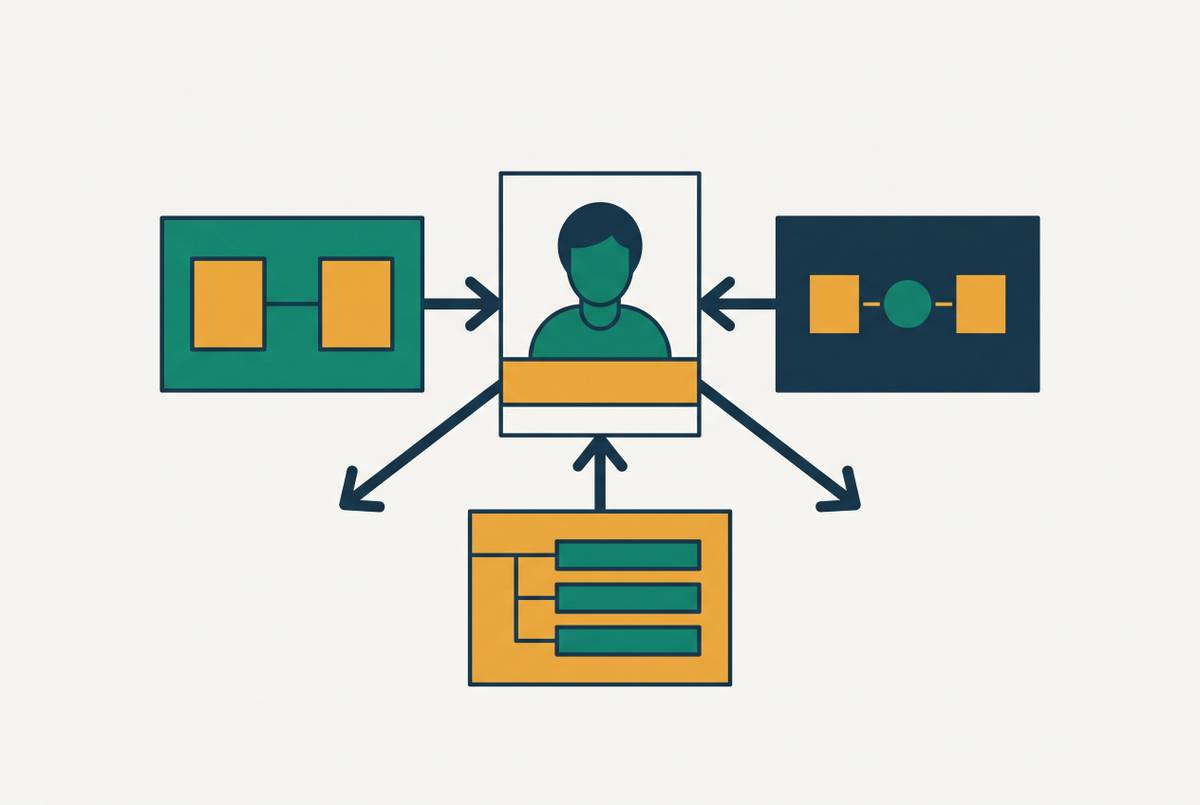
Picture the fragmented version first, because plenty of practices still run this way. A front-desk copay gets collected on one card terminal. A patient pays through an online portal that logs the transaction somewhere else entirely. A check comes in and gets deposited at the bank with no automatic link back to the patient balance it was meant to cover. Staff end up logging into three or four separate systems, hunting down each transaction, and matching it to the right account by hand, one at a time. Payments land on the wrong account. Some don't get posted at all. Outstanding balance reports show money still owed when it's already been paid, so staff call patients to collect on debts that don't exist anymore. Multiply that across a month, and reconciliation turns into a hunt across statements, deposits, and remittance files that never quite line up. Billing staff lose hours to work that produces no revenue and fixes nothing.
None of that is a staffing problem or a competence problem. It's structural, and blaming the staff for it is the wrong diagnosis, though it's the one most practices reach for first. When the systems don't talk to each other, a human has to be the translator, and translators make mistakes because the job asks them to hold too many moving pieces in their head at once.
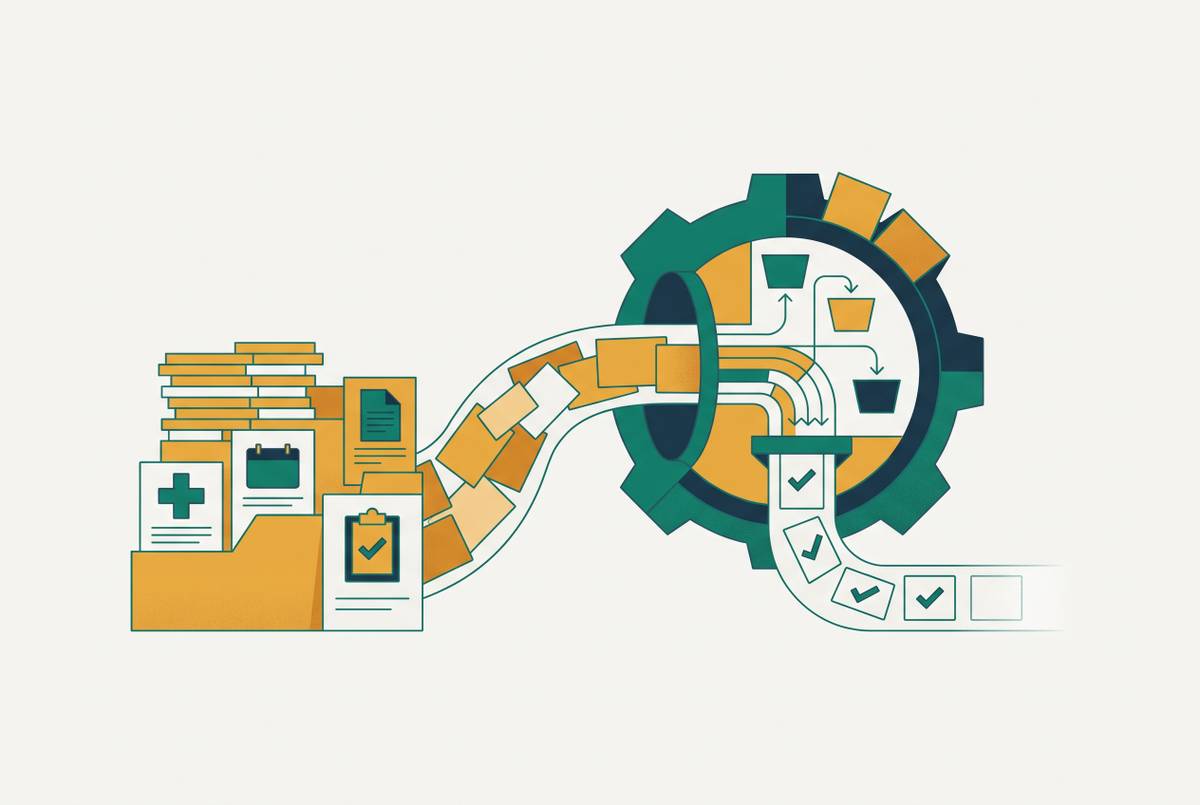
Reconciliation is a bundle of four distinct checks that close out a clinical day's financial activity, each one depending on the one before it. Charge capture verification confirms that every service rendered that day has a charge attached, coded correctly. Payment posting records what actually came in, copays, portal payments, payer remittances, against the right patient account. Deposit matching checks that the bank deposit total for the day matches what the system says was collected. Claim status review looks at what happened to every claim submitted that day, accepted, flagged, or denied, so someone can act before the claim ages into a harder problem.
These stages aren't independent. An uncaptured charge means a claim never gets filed. A misposted payment throws off the deposit match. An unreviewed denial sits and ages when it could have been fixed the same day. ERA and EOB remittance data feed directly into payment posting, and both have to be reconciled against what the payer actually paid, not what the practice expected to be paid. Those two numbers are frequently different.
Reconciliation sits alongside scheduling, eligibility checks, charge capture, claim submission, remittance, denial management, and collections as one stage in the larger revenue cycle. But it's the daily checkpoint. Skip it, and every other stage in that cycle runs on bad information without anyone knowing it yet.
Step one, verifying charge capture before the day closes
Charge capture, in practice, means confirming that every appointment completed that day generated a billable charge with the right procedure and diagnosis codes attached. It sounds simple. It's the step most likely to quietly fail, and it fails silently, which is worse than failing loudly.
In DrChrono, charge capture sits inside the visit workflow itself, not bolted on as a separate billing step after the encounter closes. AI-assisted coding support reviews the clinical note and suggests codes, narrowing the gap between what the provider documented and what actually gets submitted to the payer. Structured data entry during the visit also cuts down on the missed details that would otherwise surface later as a missing charge nobody noticed. Customizable billing profiles store the codes and diagnoses a practice uses often, which speeds up accurate entry for the recurring visit types that make up most of a day's schedule.
At end of day, the review comes down to a few specific checks. Are there appointments marked complete with no charge attached, which happens often when a provider finishes the clinical note but billing never gets triggered? Are there charges sitting with placeholder or missing codes that will fail claim scrubbing later? Does the number of completed appointments match the number of charges actually sitting in the billing queue?
This matters because a charge that never gets captured doesn't show up as a denial. It just disappears. No claim was ever filed, so there's no denial report to catch it, no aging bucket to flag it. It's revenue that vanishes without a trace, and the only way to catch it is to look before the day closes, not after.
Step two, posting payments from ERAs, EOBs, and patient collections
Payment posting is the daily task of recording every dollar that came in, whether from a payer or a patient, against the correct account balance. Two remittance formats drive most of this work. Electronic Remittance Advice (ERA) comes from payers electronically after a claim is adjudicated, and DrChrono posts ERAs directly within the platform without requiring separate software. Explanation of Benefits (EOB) is the paper or PDF version, used when a payer hasn't set up ERA with the provider, and it's also what gets sent to patients regardless of how the provider is paid. DrChrono handles EOB entry in the same workflow.
The gap between an integrated posting process and a fragmented one shows up fast. When a copay gets collected at checkout in an integrated system, it posts to the patient account instantly, updates the open balance, and shows up in reporting without anyone re-entering it. In a fragmented setup, that same copay sits in a separate payment processor until someone manually matches it to the account later, which opens a window for posting errors and balances that look open when they aren't.
As payments post, claim and account statuses update automatically, so staff see an accurate picture without refreshing anything by hand. One-click reporting on payment trends becomes available once posting is current, and that's useful daily, not just at month-end.
What needs checking at this step: every ERA received that day has been applied, any paper EOBs have been entered, front-desk and portal payments both show up in the same account record, and contractual adjustments (the gap between what was billed and what the payer actually allows) post correctly so the remaining patient balance reflects reality.
Step three, matching the day's deposits to posted payments
Deposit matching confirms that the total collected and posted in DrChrono equals the total that actually landed in the practice's bank account for that day. It's a separate check from payment posting, and the distinction matters: posting records the transaction in the patient's chart, but deposit matching confirms the money actually moved and is accounted for at the practice level, not just the account level.
In a fragmented system, this is the step that turns into a spreadsheet-and-bank-statement exercise, line by line, slow and error-prone, usually rediscovered every month-end as a fire drill nobody signed up for. When payment tools are integrated, deposits and remittances line up with patient balances as the transactions happen, so staff aren't cross-checking anything by hand. The system does the matching. The result is fewer manual steps, fewer posting errors from rekeying data twice, and better real-time visibility into what the practice's balances actually are.
At this step, staff confirm that total patient payments (front desk plus portal) match the deposit batch for the day, trace any discrepancy between posted and deposited amounts before the day closes, and make sure refunds or voids show up in the deposit reconciliation, not just quietly adjusted in the patient's account.
For practices running several payment channels at once, in person, text-to-pay, portal, this step carries the most weight, because each channel's transactions have to consolidate into one deposit figure at the end of the day.
Step four, reviewing claim status through the Live Claims Feed
Claim status review means checking, at day's end, what happened to every claim submitted or sitting in queue: accepted, pending, rejected, or denied, so nothing ages without someone knowing where it stands.
DrChrono's Live Claims Feed gives real-time status on every claim without staff needing to log into a payer portal or wait on a batch report to refresh. Underneath that, DrChrono's integrated eProvider Solutions (ePS) clearinghouse connects the practice to thousands of payers electronically, routing claims out and bringing status information back within the same system. That shortens the time between submission and the first signal on whether a claim will go through clean.
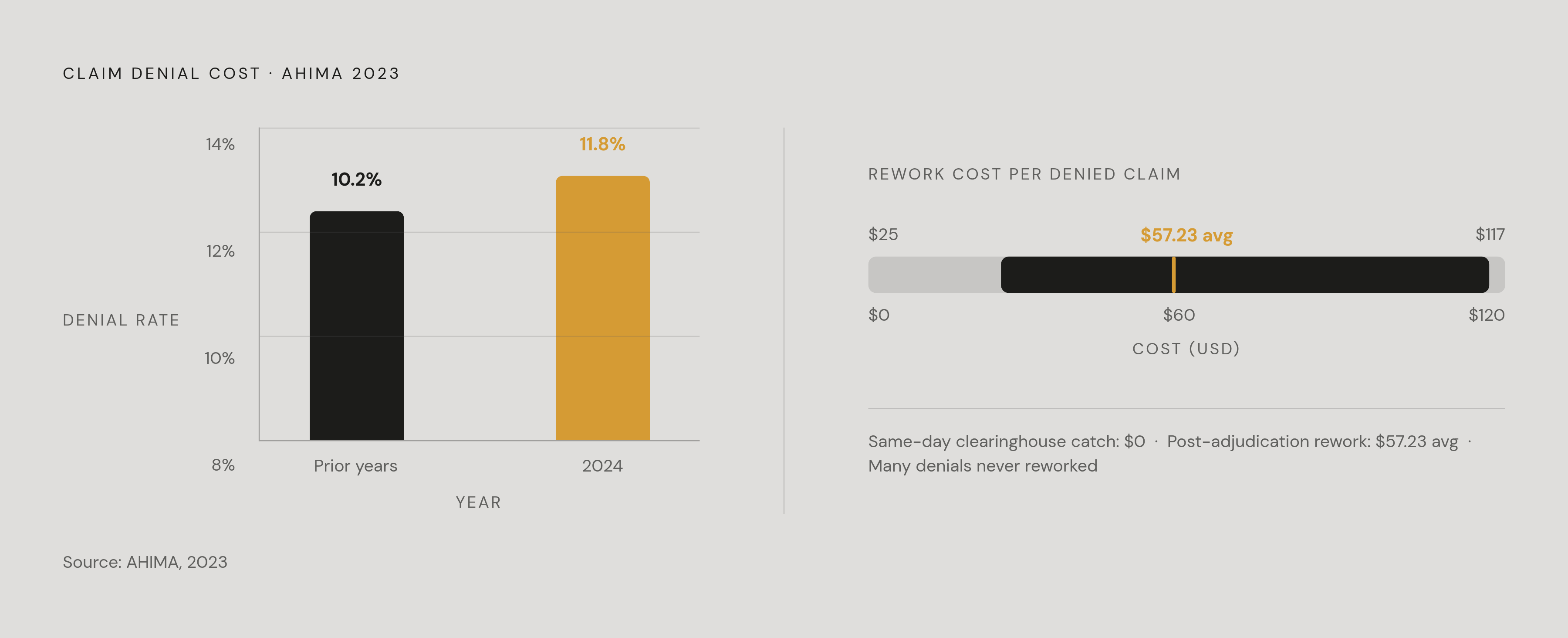
Claims also get validated before submission, with flags raised for errors a payer would reject outright. Catching those errors here costs nothing. Catching them after a denial comes back costs money in direct rework labor, a figure AHIMA puts at $57.23 per claim on average in 2023, with industry research noting direct rework labor ranging from $25 to $117 depending on payer and complexity.
The end-of-day review should surface claims rejected at the clearinghouse level (fixable same-day, before they ever become a formal denial), claims carrying payer denial codes that need action, with the reason documented and someone assigned to own it, and claims sitting in pending status longer than the typical adjudication window, flagged for follow-up. Clean claims moving through adjudication should also get a quick count check against the charges captured in step one, to confirm nothing dropped out of the queue.
The stakes here are real. Initial claim denial rates reached 11.8% in 2024, up from 10.2% just a few years before, according to industry tracking data. And a large share of denied claims never get reworked at all, mostly because staff don't have the time to track and chase every one down. A daily status review habit goes straight at that number, catching actionable denials while the claim is still fresh instead of letting it age past the point anyone will bother.
For practices using DrChrono's managed billing service, certified billers handle denial follow-up directly, with a target clean claim rate of up to 96%. Whether follow-up runs in-house or through DrChrono's RCM team, the daily feed stays visible to practice leadership either way.
How the four steps work as a connected daily habit, not a month-end fire drill
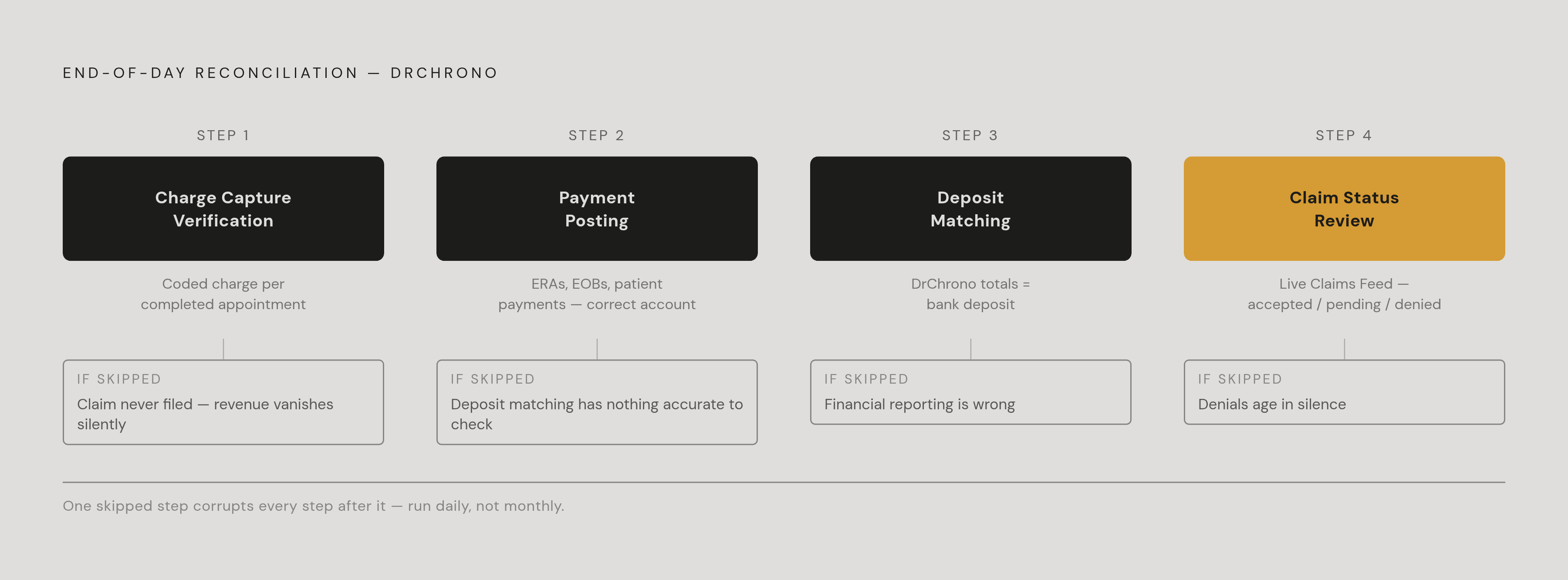
The four steps form a chain, and skipping a link breaks everything downstream of it. Skip charge capture, and claims never get filed in the first place. Skip payment posting, and deposit matching has nothing accurate to check against. Skip deposit matching, and financial reporting is simply wrong. Skip claim review, and denials age in silence until they're much harder to fix.
"End of day" doesn't have to mean 5 p.m. sharp. It means before the next clinical day starts, so nothing from today carries forward unresolved into tomorrow's workload.
That's the real argument for doing this daily instead of monthly, and it isn't a close call. An unresolved claim from Monday gets harder to fix by Friday, once the reason code is stale and the denial window has narrowed. An uncaptured charge from last week won't show up on this week's aging report until it's too late to avoid writing it off entirely. Reconciliation delayed is reconciliation made more expensive, every single time, not just occasionally.
Integrated platforms cut down the daily time cost in a few concrete ways. Automated posting removes the manual re-entry between payment posting and deposit matching. Real-time claim status removes the need to log into separate payer portals for step four. Reporting tools surface exceptions on their own, instead of leaving staff to hunt for the one discrepancy buried in a hundred transactions.
The goal is a billing team that closes out each day already knowing what was charged, what was collected, what was deposited, and which claims need attention, rather than discovering all of it cold at month-end when the trail has gone stale. This holds regardless of staffing model: practices running in-house billers, DrChrono's managed RCM team, or some mix of both follow the same daily workflow, because the visibility is shared across whoever's doing the work.
Where manual reconciliation steps still remain and what automation can address
Integrated billing inside DrChrono handles a lot of this on its own: payment posting, ERA auto-posting, claim submission, status tracking, reporting. That part of the architecture works and cuts a real amount of manual labor out of the daily routine. Nobody should mistake that for the whole problem being solved, though. It isn't, and the gaps that remain aren't scattered randomly. They cluster in the same places, over and over.
Payer portals that don't return ERA data electronically still require someone to log in, click around, and pull remittance data by hand. Denial follow-up often means navigating a payer-specific portal, entering appeal documentation, and tracking resolution separately for each payer, none of it standardized across the industry. Claims that stall in pending status without a clear code attached require someone to chase down what's actually happening. And even with a strong EHR integration, the payer portal itself stays a separate destination: the integration improves the data flow around it, but the portal doesn't disappear.
The scale of that gap shows up in survey data. Only 56% of healthcare organizations said their claims technology was sufficient to meet revenue cycle demands in the 2025 State of Claims survey from Experian Health, which polled 250 revenue cycle leaders, down sharply from 77% in 2022. That's a meaningful drop, and it means even practices running on modern platforms are finding real workflow gaps, not imagined ones.
Computer-use AI agents answer that specific gap, the part native integrations can't reach because there's no API to build against. Platforms such as Novoflow, a Y Combinator-backed healthcare operations company that deploys AI agents navigating EHRs, payer portals, and third-party systems the way a staff member would, are built precisely for this layer. These agents log into payer portals through the same browser interface a staff member would use, no API required, and click through the same screens a human would to retrieve claim status or pull remittance data, without someone needing to sit down and start each session by hand. The same approach applies to denial follow-up: locating the denied claim, entering appeal documentation, and submitting it, across whichever portals aren't connected to the EHR at all. And because no staff member is involved, these tasks can run after hours, once the clinical day has ended and everyone's gone home.
Healthcare workflows touch the EHR, the clearinghouse, and dozens of payer portals that were never built to talk to one another. Agents that operate those portals the way a person would close that gap without waiting on API partnerships between vendors that may never materialize. Robotic process automation deployments already handle payer portal navigation at real scale: one dental service organization has scaled this approach past 100 locations, which shows the model holds up well past a single practice's billing office and into much larger, multi-site operations.
Sources
- How Integrated Payment Solutions Simplify Medical Billing | DrChrono
- RCM and Medical Billing Software for Faster Payments | DrChrono
- How Can I Reconcile the ERA and EOB payments? | DrChrono by EverHealth
- DrChrono EHR features that work with in-house payments and payment partners | DrChrono by EverHealth
- Medical Charge Reconciliation: Ultimate Guide for Finance
- drchrono.com
- support.drchrono.com
- support.drchrono.com