Patient Demographics Management Across Multiple EHR Instances
Healthcare organizations lose control of patient identity when they run multiple EHR systems.
Patient demographics management across multiple EHR instances is a scaling problem, and it scales the wrong way: the bigger a healthcare organization gets, the less anyone actually controls the patient record sitting at the center of it. Once an organization runs more than one EHR, whether from an acquisition, a specialty expansion, or a referral partnership, patient identity stops being a fixed fact and turns into something that has to be maintained, actively and continuously, across systems that were never built to talk to each other. Most operators treat this as an IT integration problem, but the failure actually sits in identity management, and that misdiagnosis is why so many fixes don't actually fix anything.
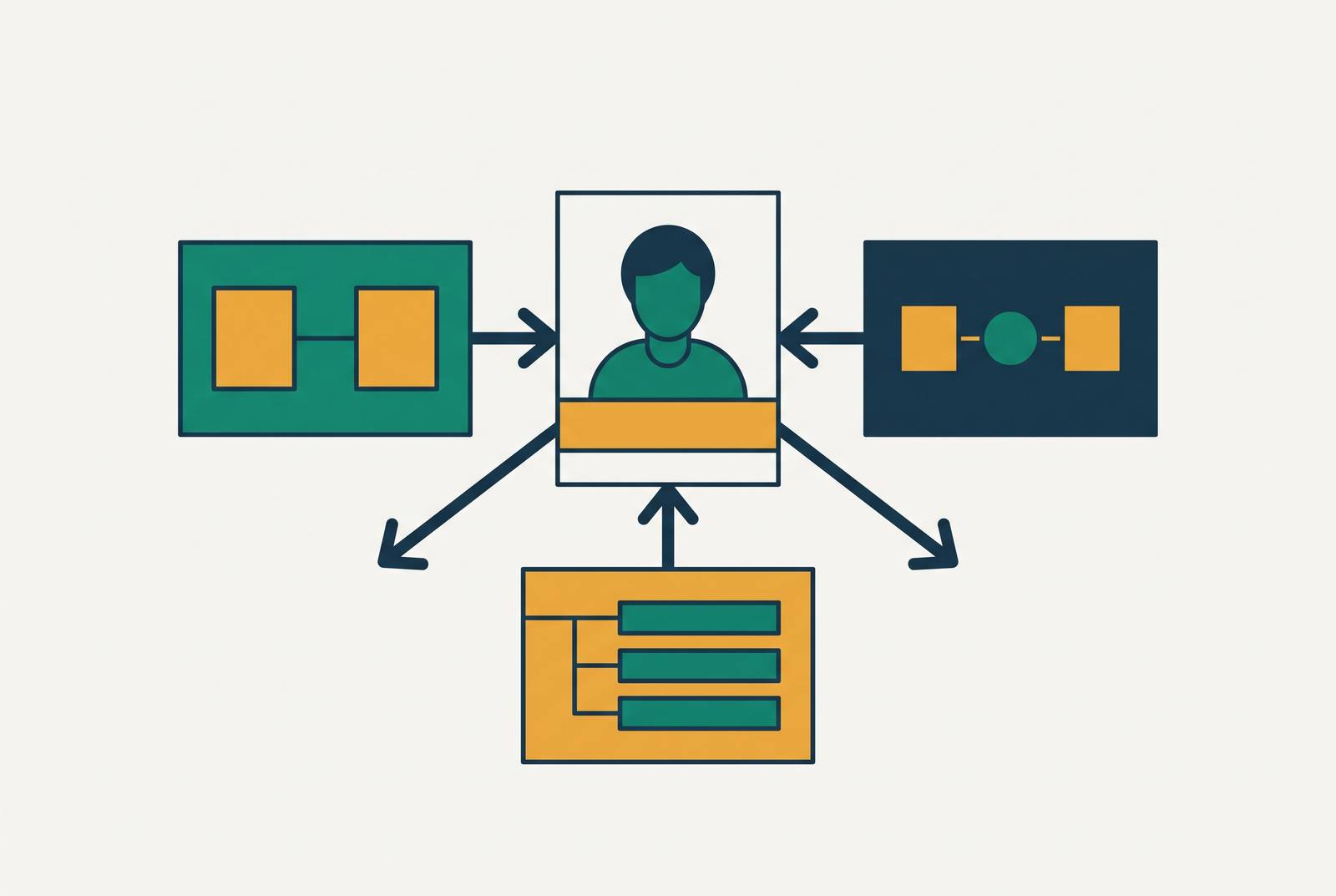
The pattern repeats at every organization operating at scale. Acquisitions bring incompatible EHR platforms under one roof. Affiliations add specialty groups running their own instance. Payer portals, lab systems, and referral networks each keep their own version of the patient record, and none of them update when another one changes. Every system speaks its own dialect: different field structures, different naming conventions, different rules for how a date of birth or a middle initial gets typed in. A patient who moves, switches insurance, or gets referred from a hospital system generates a new version of their own record, one that has to be reconciled, not just filed away.
That reconciliation almost never happens cleanly. Identity matching, confirming that Record A in System 1 and Record B in System 3 belong to the same person, is where fragmentation actually starts. Without ongoing reconciliation that combines probabilistic matching with deterministic rules, small errors compound quietly, and data moves fast between systems while still landing on the wrong patient.
What breaks downstream when demographics are wrong or out of sync
The clinical cost shows up first. When a clinician can't pull a complete history because records across instances don't match, the fallback is to order a duplicate test or move forward blind to a prior diagnosis. The 2025 athenahealth Physician Sentiment Survey of 1,001 physicians found that 95% said getting the right clinical information at the right time matters a great deal; only 28% said sending and receiving patient data across a different EHR was actually easy. That gap between what physicians need and what the infrastructure gives them is where demographic mismatch lives.
Revenue cycle damage starts at intake, and it starts small. The 2025 State of Claims survey found that 32% of providers pointed to inaccurate or incomplete patient data at intake as a driver of claim denials, which makes a demographic error an upstream cause of lost revenue. A denied claim isn't just delayed money. Manual rework costs accumulate across a multi-location portfolio month after month, quietly, without ever showing up as a line item anyone flags.
Staff absorb the rest of the gap. Front-desk and billing teams end up running manual verification loops that shouldn't exist: confirming insurance twice, untangling duplicate patient IDs, re-entering data that already lives somewhere else in the same organization. The system offloads reconciliation onto whoever's sitting at the front desk, and that's the wrong place for it to land.
Referrals break the same way, for the same reason underneath. Scheduling stalls and the chart doesn't transfer cleanly when a referring practice and a receiving practice each hold a different version of the same patient's demographic record. A significant share of referrals never complete successfully, and mismatched patient identity is an underappreciated reason why. Nobody traces a dropped referral back to a middle-initial mismatch, but that's often exactly what happened.
Why interoperability standards alone have not solved demographic synchronization
Standards define the pipe, but they say nothing about the accuracy of what flows through it. Equating "we're FHIR-compliant" with "our patient identity is accurate" is a common mistake operators make when evaluating interoperability tools, and it costs real money to unlearn.
Across the industry, provider-to-provider record sharing, third-party application data sharing, and payer-to-provider record sharing are consistently cited as the use cases organizations struggle with most, and all three depend on accurate patient identity underneath them. Interoperability requires shared terminology, shared expectations, and shared accountability across every party involved. A standard can only define the format data travels in; it cannot enforce accuracy on its own.
Vendor lock-in hasn't gone away either. Plenty of EHR vendors still run proprietary ecosystems that make outside integration expensive and slow, even where a standard technically applies on paper. Traditional EHR integration projects call for real consulting spend and extended implementation timelines, a barrier smaller and mid-market practices often can't clear no matter what the standard promises.
FHIR APIs move data faster between systems, but they don't settle who the data belongs to. A FHIR-compliant exchange between two EHR instances still assumes both sides are pointing at the same patient, and confirming that is exactly the job probabilistic matching and reconciliation logic have to do. Moving records faster without identity confidence at the point of exchange just means the records land on the wrong chart more quickly than before.
Someone has to fill the gap, so people fill it. Staff become the identity resolution layer by default: calling to confirm demographics by hand, re-entering data across instances, catching mismatches through manual review. That's a structural dependency, and it doesn't scale with a multi-location operation no matter how good the staff running it are.
How demographic errors propagate through prior authorization and claims workflows
Prior authorization runs on patient identity from step one, and that's exactly where it tends to fail first. Physicians and their staff spend an average of 13 hours a week completing roughly 39 prior authorizations per physician; any demographic mismatch that stalls or invalidates a submission adds straight to that number. Ninety-three percent of physicians say PA delays affect patient care, and 29% report seeing a serious adverse event tied to treatment held up waiting on approval. Some of that traces straight back to incomplete or mismatched data entered upstream, long before anyone in the PA queue opens the file.
Payer portals don't give mismatches the benefit of the doubt. They cross-check submitted demographics against their own enrollment file, and a difference in name spelling, date of birth, or insurance ID between EHR instances triggers an immediate rejection or a manual review hold. Every rejection sends the task back to staff, stacking rework on top of the original intake error instead of fixing it at the source.
Claims hit the same wall further down the line. In the 2025 State of Claims survey, 54% of providers said claim errors are increasing, with inaccurate patient data at intake named as a root cause. When two EHR instances carry conflicting demographic records, the claim submitted may not match what the payer's eligibility file shows, and that mismatch triggers denial even when the coding and clinical documentation are correct.
The cost runs through the whole cycle, not just the point of failure. Rising denials cost hospitals billions of dollars a year industry-wide, and manual rework costs compound across every rejected claim. OhioHealth cut denials by 42% using AI-based patient access tools aimed at fixing errors at the source. That number says something concrete: the money comes back when the fix happens at intake, not after the claim already bounced.
What automated demographic management actually looks like in a multi-instance environment
Real demographic management runs as ongoing reconciliation: probabilistic matching, which scores the likelihood that two records describe the same person, combined with deterministic rules that match on exact identifiers when they exist. The goal is a confidence score maintained for each patient's identity across every instance in use, refreshed continuously as new data arrives, calculated on an ongoing basis rather than once at intake.
API-based automation runs into a hard limit here. It only works where an API exists, is documented, and is permissioned by the vendor. Across proprietary EHR platforms and older payer portals, that condition fails constantly. Custom API integrations also take real development time up front and need ongoing maintenance every time a connected system updates, a cost multi-location groups running several EHR instances end up paying over and over, on every platform, every update cycle.
Computer-use agents take a different path, suited to this exact constraint. These are agents that operate a screen the way a staff member would: reading fields, entering data, checking a record against another system, all without back-end API access. That approach works across whatever system is already in the workflow, regardless of vendor or whether an API exists at all, which is the condition most multi-location, multi-EHR operations actually live in. Agents go to work on existing systems without an EHR replacement, a custom integration build, or a staff retraining program.
Automating only the demographic entry step still leaves mismatches sitting unresolved further downstream, which defeats the purpose. Full-workflow automation, covering intake, eligibility verification, prior auth submission, and claims together, catches discrepancies at every handoff instead of just one. That's the standard worth holding vendors to, and any pitch that stops short of it deserves scrutiny, not benefit of the doubt.
Deployment realities for multi-location groups and portfolio-level operations
Scale changes the shape of the problem. A two-location group migrating off a single legacy EHR carries a different exposure than a private-equity-backed portfolio running acquired practices across three separate platforms, and the automation approach has to match that scope rather than assume one size fits both. Portfolio operators need configuration that copies a workflow across locations without rebuilding it from zero at every new site.
Speed to deployment decides the actual return, more than any feature comparison does. Traditional EHR integration work runs on extended timelines, and every month spent with demographic mismatches compounding across instances is revenue leakage and staff time that doesn't come back. Automation that works through existing system interfaces, rather than requiring a back-end integration built first, can go live in weeks instead of months, without asking staff to abandon how they already work.
Staff adoption is the variable most often underestimated in these rollouts, and it's usually the one that kills a deployment nobody saw coming. Automation that asks staff to learn a new interface or change their routine creates resistance, and usage gets inconsistent fast; the demographic problem doesn't get solved if staff quietly route around the tool. The deployment model that holds up is the one where agents work in the background, inside the systems staff already use, handling reconciliation and synchronization without a second, parallel workflow bolted on top.
Security and compliance need attention from the start of any evaluation, not as a final checkbox. Patient demographics are PHI, so any automation touching them needs to run under HIPAA-compliant controls; SOC 2 Type II certification and HIPAA compliance are baseline requirements for vendor selection, not differentiators. Multi-location operations spanning multiple states or ownership structures carry compounding compliance obligations on top of that, and the automation layer needs to be auditable and demonstrably secure on demand, not scrambled together after an incident.
Outcomes should get measured against workflow-specific numbers, not vendor dashboards. Denial rate reduction, eligibility verification accuracy, and intake-to-authorization cycle time are the metrics that actually show whether demographic automation is working. Every practice's bottleneck and cost structure differs, so the right baseline gets set at the start of deployment, against the specific workflows being automated, not an industry average with nothing to say about the actual portfolio.
What the current gap between agent capability and production readiness means for operators evaluating tools today
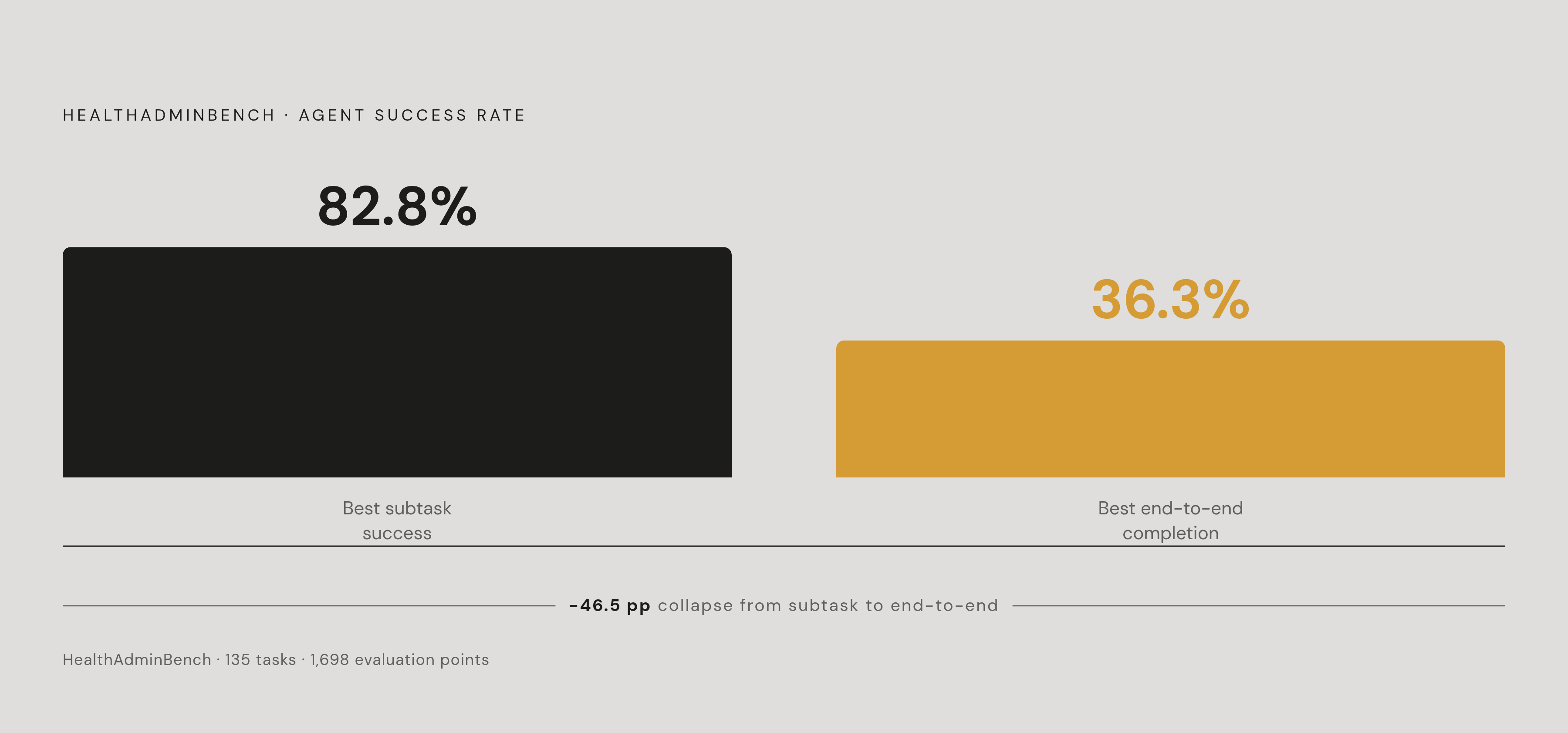
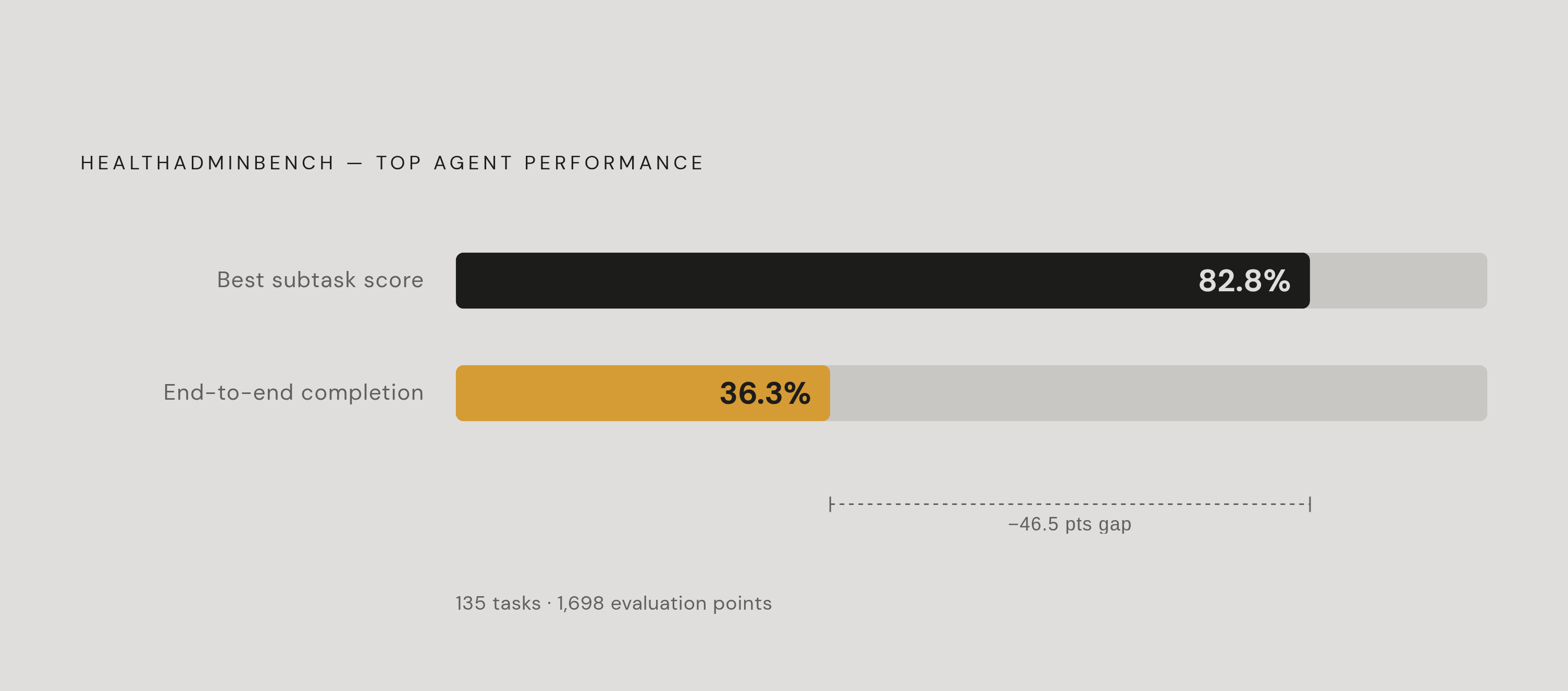
Benchmark data shows a real gap between doing one step well and finishing the whole job, and this is the fact that should set every operator's timeline expectations. HealthAdminBench, a benchmark built from 135 expert-defined healthcare administration tasks and scored across 1,698 fine-grained evaluation points, found the best-performing agent on end-to-end tasks completed only 36.3% successfully, while the top agent on individual subtasks reached 82.8% success. Agents that look strong step by step still fail to carry a full administrative workflow to completion, and completing the full workflow is exactly what demographic synchronization across systems requires. That gap between subtask success and end-to-end completion is the single number operators should hold onto.
Most of the research behind those numbers ran on public websites and general enterprise software, not the gated, sparsely documented, PHI-governed systems that define healthcare administration. Demographic reconciliation across EHR instances means coordinating payer portals, external systems, and document exchange all at once, the kind of multi-system complexity general-purpose benchmarks simply don't test for.
Plenty of health systems already use AI somewhere in operations, but most of that use is narrow, and the distinction matters more than any adoption headline suggests. Providers lean on it mainly for lower-risk tasks like data analysis and basic automation, held back by lingering concerns about accuracy and security. The space between using AI somewhere and automating a full demographic management workflow end to end is where most organizations currently sit, and closing it takes real implementation work, not vendor messaging.
Given that gap, operators evaluating a tool today should ask for evidence of production performance in an actual multi-EHR environment, not benchmark results alone. A clear audit trail on every demographic change an agent makes should be non-negotiable: both a HIPAA requirement and a practical necessity for any multi-location operation managing compliance across separate entities. A realistic deployment timeline should be grounded in the systems already in place, not contingent on integration work that hasn't started yet. And the KPIs, denial rate, intake accuracy, eligibility verification success, should get agreed on before deployment begins, set against the specific workflow being automated rather than whatever the vendor happens to measure well.