After-Visit Summary Completion Rates and Regulatory Requirements
Mandates don't guarantee patients will read or understand the summaries they receive.

The after-visit summary occupies a strange place in medicine: a document mandated by federal policy, defined to the letter by regulation, and ignored by most of the patients it's handed to. The regulatory floor for what an AVS must contain is well established. Whether meeting that floor produces a document anyone actually uses is a separate question, and it's the one this piece takes seriously.
What an after-visit summary must contain
CMS requires the AVS to include a specific set of elements: the patient's name, provider contact information, the date and location of the visit, an updated medication list, updated vitals, the reason or reasons for the visit, procedures performed and other instructions, updates to the problem list, test and laboratory results, and information about the next appointment. None of these elements exists by accident. Each one traces back to a documented point of patient confusion, a specific place where, historically, people left an appointment unsure of what had happened to them or what to do next.
The checklist nature of the requirement can obscure a harder standard: the AVS is also required to be written in plain language, and that requirement is not cosmetic. Roughly a third of patients who receive an AVS report that excessive medical jargon gets in the way of understanding it. A document can satisfy every structural element CMS requires, list the right medications, the right vitals, the right next appointment, and still fail the purpose the policy was written to serve.
Even production itself falls short of universal. The AVS is currently provided in roughly half of all outpatient visits, based on a sourced estimate of approximately 50% delivery, so non-delivery itself remains a compliance gap before engagement is even considered. That means before anyone asks whether patients read the document, read it with comprehension, or acted on what it told them, there's already a compliance gap at the point of handing it over. The floor CMS set is clear. Whether practices clear it, and whether clearing it accomplishes anything, are two different measurements.
Origins of a mandatory clinical output patients rarely read
The AVS exists because of a clinical phenomenon that predates any regulation: patients leave appointments having absorbed symptoms, a diagnosis, medication changes, referrals, and emotional stress all at once, and their recall of the specifics degrades fast under that load. That pattern is consistent with the finding that 29% of AVS recipients say jargon gets in the way of understanding what they were given. The summary was designed as a corrective, something a patient could return to once the adrenaline of the visit wore off and the details started slipping.
But a survey of primary care patients found that most recalled receiving an AVS, while about a third never consulted it once. The document wasn't lost in the shuffle of discharge paperwork. It was handed over, kept, and left unread.
Picture the patient who remembers the word "monitor" but not what she was supposed to monitor, who remembers being told to watch for "side effects" but not which medication they'd come from. That's the exact failure the AVS was built to prevent, and it occurs even in cases where the AVS was produced correctly and placed in the patient's hands. The tension here is structural. Meaningful Use measured AVS compliance at the point of production, tracking whether a clinical summary was provided to patients within a set number of business days, never whether the patient opened it, understood it, or used it. The regulation built a delivery requirement and called it an engagement intervention, and those are not the same thing.
Engagement data on AVS use after visits
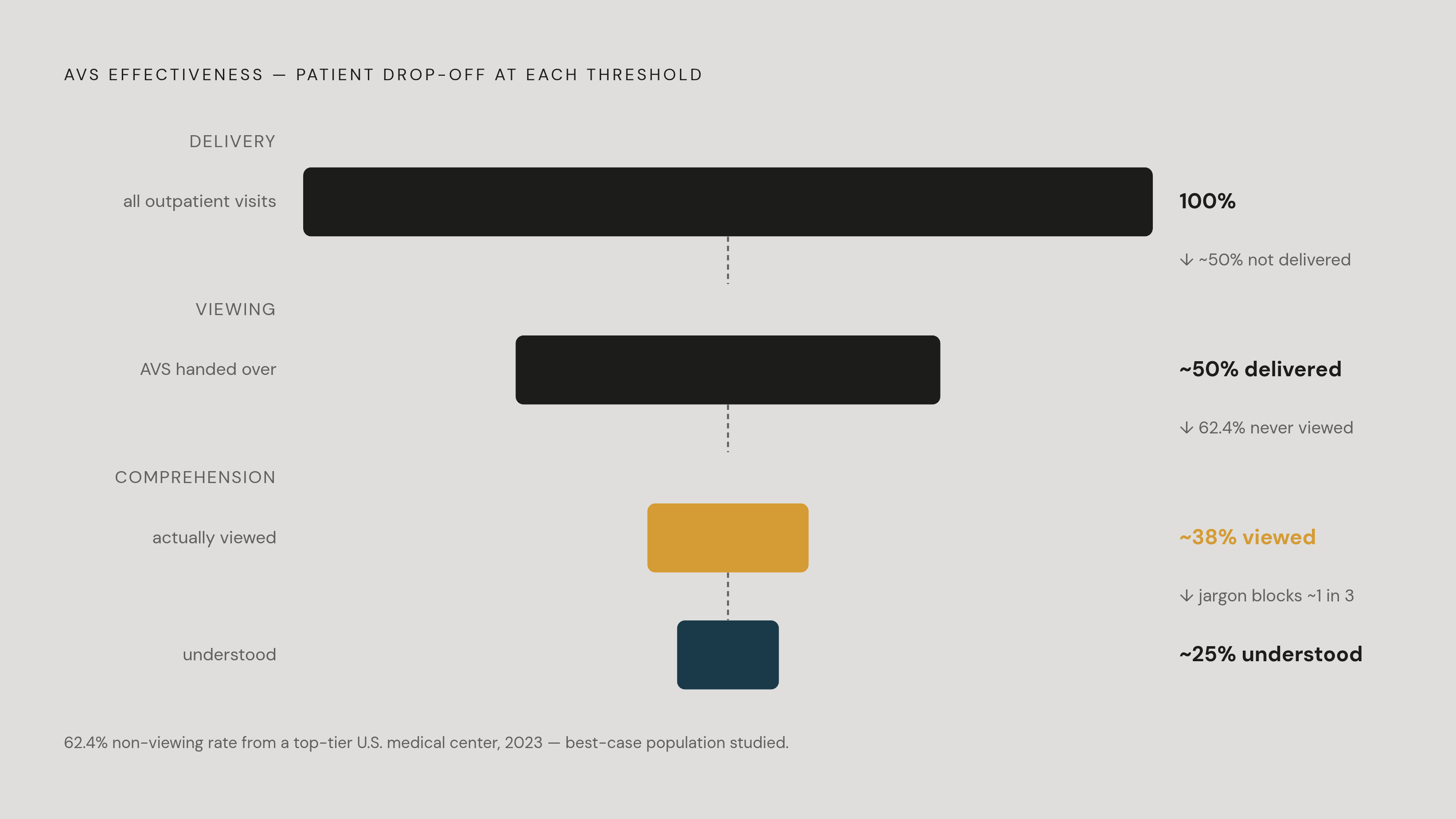
The clearest evidence that this gap is not a product of poverty or poor health literacy comes from one of the best-resourced patient populations studied. At a U.S. medical center serving a patient population among the most diverse, highly educated, and affluent in the nation, 62.4% of patients did not view their AVS in 2023. That number cannot be explained away by limited access to care or by low educational attainment, because the population in question had neither of those deficits.
That finding deserves to be read as a ceiling rather than an outlier. Practices serving populations with fewer resources and less consistent access to digital tools should expect to see engagement rates at or below that level, not above it.
One variable does move the number in the right direction without any additional intervention. Patients who completed a video visit were measurably more likely to engage with their AVS afterward than patients seen in person. That suggests digital-first care delivery shifts the baseline of engagement on its own, without new mandates, new incentives, or new documents.
The obvious rebuttal is that non-viewing might simply reflect a document that wasn't needed: patients who don't need it don't open it, and the ones who do find their way to it eventually. The fog scenario answers that directly. Patients who needed the document most often didn't realize they needed it until they were already confused, standing in a kitchen holding a prescription bottle with no memory of what it was for. By that point, the AVS doesn't reach them because they'd already moved past the moment when they would have thought to look for it.
Why the AVS is often rushed, templated, or impersonal by delivery
The AVS is the last link in a documentation chain that is long before the AVS is even reached. Every hour spent with patients generates roughly twice as many hours of work inside the EHR, and the AVS, arriving last in that queue, gets whatever time happens to be left.
What's left is often very little. Sourced timing data put physicians' median time writing patient instructions per visit at 1.38 minutes. Multiplied across a clinic day with 30 or more patients, that adds up to meaningful time on an annual basis, but it also means any single summary receives only a sliver of attention before it's finalized, a measure of how little room the schedule leaves for the last item in a long documentation sequence, and that distinction matters because the fix for a time constraint and the fix for an attitude problem are not the same fix.
Under that kind of pressure, templates become the rational choice. Templates are also the mechanism most consistently associated with summaries that read as generic, jargon-heavy, and disconnected from what actually happened in the visit. The regulatory requirement drives production of the AVS, time pressure drives reliance on templates, templates drive jargon and genericness, and jargon drives non-engagement, forming a closed loop. None of that non-engagement registers in the compliance measurement system, because compliance was defined at the point of production, not at the point where a patient actually opens the document and tries to use it.
How ambient AI scribes change the upstream documentation burden
Ambient AI scribes represent the first plausible intervention in this chain, though they target the upstream cause rather than the symptom. If the time spent writing clinical notes goes down, the time and mental space available for producing a genuinely useful patient-facing summary goes up. That's the mechanism these tools offer.
The evidence for the upstream effect comes from named health systems with reported results, not from pilot projects or vendor claims alone. Intermountain Health reported a meaningful reduction in time spent on notes per appointment using Microsoft's Dragon Copilot. Cooper University Healthcare reported saving clinicians more than an hour of documentation time daily. A quasi-experimental study spanning dozens of primary care clinics found a measurable reduction in note-writing time that grew larger over the first several months of use, suggesting the benefit compounds as clinicians adapt their workflow around the tool rather than appearing all at once.
Tools built specifically for the AVS compress the task further. Structured, plain-language summary tools can bring per-patient documentation time down to roughly five minutes, a fraction of what the task previously required. Plain-language output paired with clear next steps has been linked to improved medication adherence and meaningfully better comprehension among patients with lower health literacy.
None of that guarantees a better AVS arrives at the end of the process. Ambient scribes free up time upstream and can raise the quality of the clinical note, but they don't automatically improve the patient-facing summary unless the tool generating it has been built and configured specifically for that output. Time saved on the note is not the same as comprehension gained by the patient, and that distinction is where the next objection starts.
The objection: optimizing for completion rate is not the same as optimizing for comprehension
The strongest challenge to the case for AI intervention is straightforward: tools trained to raise completion rates and satisfy structural compliance checks are not the same as tools trained to make sure a specific patient understands and acts on what they're given. Those are two different objectives, and it's easy to mistake progress on one for progress on the other.
Personalization is the variable most closely tied to whether a patient actually engages with a summary. A document that speaks directly to a patient's specific blood pressure medication change is far more likely to get opened and used than a document that is structurally correct but generic in every detail that matters to that patient. An AI tool built to generate templates at scale can raise the average quality of summaries across a patient population while doing nothing for the specific cases where personalization would have made the difference. Average improvement and improvement where it counts are different outcomes, and a practice measuring only the average can miss that its hardest cases haven't moved.
None of this means the tools themselves are the wrong approach. It means their value depends entirely on how they're configured. A tool built to generate structured, plain-language output drawn from the actual content of a specific visit, rather than a population-level template applied uniformly, can close the comprehension gap rather than just the time gap. That configuration choice, made once at deployment, shapes whether the practice ends up with faster paperwork or with summaries patients actually use.
Expansion of the compliance perimeter when AI touches the AVS workflow
Bringing AI into AVS production doesn't just raise a quality question. It raises a risk question, and the risk surface is larger than most practices have mapped before deployment.
HIPAA applies at every point in the workflow where an AI system processes protected health information, which includes the model used to draft notes, any third-party tool that processes the visit transcript, and every vendor integration involved in producing or transmitting the final AVS. Business Associate Agreements are required at each of those points, including the ones beyond the one closest to the patient record.
The minimum necessary rule does not loosen because a system is automated. Workflows should still access only the protected health information required to perform their specific function, and ambient scribes that record full visit audio create a considerably broader data footprint than the documentation methods they replace. That broader footprint is not a reason to avoid these tools. Adopting AI in this workflow is appropriate and can meaningfully improve both documentation quality and patient comprehension, but the compliance perimeter around the workflow has expanded, and practices need to map that perimeter before deployment rather than discover it afterward. Counsel here is practical: know every touchpoint where PHI moves through the system, have the agreements in place at each one, and treat that mapping as part of the rollout plan rather than an afterthought.
Closing the engagement gap as an operational workflow
The compliance floor tells a practice what it must produce. It says nothing about when that document gets delivered, through what channel, whether any follow-up occurs, or whether the patient actually received what they needed in order to act. Closing the engagement gap means treating AVS delivery as a workflow step with its own measurable outcomes.
A workflow built for engagement rather than compliance has a few concrete components. Plain-language output should be generated from the actual content of the visit rather than pulled from a population-level template. Delivery should happen through the channel a given patient actually uses, rather than defaulting to whatever channel is easiest for the practice. Follow-up actions, referral orders, lab orders, and prescription confirmations, should be triggered automatically by the content of the AVS itself. And a feedback loop should track whether those follow-up steps were actually completed.
That coordination layer is where computer-use agents fit naturally. An agent can schedule the referral an AVS recommends, confirm that a prescription was processed at the pharmacy, and flag when a follow-up appointment hasn't been booked within the window the AVS specified. That kind of follow-through extends the same effect already visible in the video-visit data, where patients completing a video visit were 9.0% more likely to engage with their AVS afterward than patients seen in person. Digital-first delivery moved the needle on its own; agents operating across the EHR, pharmacy systems, and scheduling platforms can extend that effect through the entire follow-through process rather than leaving it to chance at the moment of delivery.
Practices that treat the AVS as an administrative output managed by documentation tools alone will continue to produce compliant documents that patients don't use. Practices that treat it as the first step in a follow-through workflow, supported by agents that operate across the EHR, pharmacy systems, and scheduling platforms, will close the gap between what was documented and what actually happened.
The right way to measure that distance is whether the patient booked the follow-up, filled the prescription, or got the lab work done. Those are workflow-specific outcomes that can be tracked from the moment a tool is deployed, and they give a practice a genuine way to judge whether the operational investment in AI, agents, and redesigned delivery is actually working, rather than simply producing more compliant paperwork faster.