Reducing After-Hours EHR Data Entry Burden on Medical Assistants
Five structural gaps, not work ethic, keep medical assistants logging in after hours.

After-hours EHR data entry among medical assistants comes from five identifiable gaps in how ambulatory practices structure the workday, not from any shortfall in individual effort. Fix the gaps, and the work moves back inside business hours. Leave them in place, and the work keeps landing on the same people at 9 p.m., regardless of how the schedule looks on paper.
The MA role in most ambulatory practices sits at the intersection of clinical and administrative work: rooming patients, taking vitals, entering orders, supporting documentation, and cleaning up records after the visit ends. Physician "pajama time" gets the headlines, and for good reason. The 2024 AMA Organizational Biopsy found that 22.5% of physicians spend more than eight hours a week on the EHR outside normal hours. But the same scheduling pressure that pushes physicians to log back in at night pushes MAs to do the same, and their version of the problem barely shows up in the research. Physician after-hours burden gets measured, tracked, and cited in policy discussions. MA after-hours burden mostly does not. That asymmetry is part of why the problem has been allowed to persist so long.
The specific workflow gaps that generate after-hours EHR tasks for MAs
Five gaps do most of the damage, and they show up in nearly every ambulatory setting regardless of specialty.
The first is encounter documentation that never closes at the point of care. MAs typically capture vitals and chief complaint before the physician walks in, then get handed structured data work, problem-list updates, medication reconciliation, order entry, after the physician has already moved to the next room. Research funded by the AMA (Melnick, 2021) found that ambulatory physicians log more than 5 hours in the EHR for every 8 hours of scheduled patient time. That pressure does not stay contained to the physician's own workflow; it pushes downstream to whoever is finishing the chart. Separate AMA-funded research (Simon, 2025) describes problem-list attestation as a "check-the-box" task with high cognitive load. When those lists are duplicative or wrong, which happens often, the MA is the one who inherits the cleanup.
The second gap is intake screening volume that outgrows the appointment slot built to hold it. Primary care visits are loaded with standardized screening questionnaires tied to quality metrics, and AMA-funded research (Simon, 2023) found this prioritization can actually shrink the clinical capacity available for higher-value work. Every extra screening is another set of results someone has to key in, often data that could have been captured once, earlier, instead of re-entered at the visit.
Third, inbox and messaging work has no fixed home in the schedule. Patient messages, refill requests, and prior-authorization prep arrive all day long, on their own schedule, with no designated window to handle them. So they queue for whoever happens to be free at the end of the shift, which is rarely anyone. AMA-funded research (Lew, 2025) tied secure messaging use directly to increased workload and cognitive burden for clinicians, and MAs who pre-process or triage those same messages absorb the identical overhang.
Fourth, poor EHR usability makes every one of these tasks take longer than it should. AMA-funded research (Melnick, 2022) found a strong link between usability and overall workload: a slow, non-intuitive interface stretches out routine data entry, and the longer a task takes, the more likely it gets pushed to the end of the day. Deferred tasks are exactly what builds the after-hours queue.
Fifth, prior authorization prep and payer portal work fall to MAs with no dedicated time carved out for them. PA requests require pulling data from the EHR and re-entering it into a separate payer portal, a two-system task that eats time and breaks up clinical flow. When it can't be finished between appointments, which is common, it gets finished after hours instead.
How the MA workday is structured in ways that make deferral almost inevitable
Back-to-back appointment blocks leave no buffer between patients for documentation or data entry to happen in real time. MAs are also pulled two directions at once: clinical support, like rooming patients and assisting with procedures, and administrative support, like order entry and PA prep. Neither task pauses cleanly for the other. Physicians in primary care spend roughly 3 hours a day on documentation alone, and MAs supporting those same physicians take on parallel entry work without any comparable scheduling allowance built in for them.
There's a gender dimension worth naming directly. AMA-funded research (Rotenstein, 2022) found that female physicians spend more time on EHR documentation than male colleagues do. MA workforces are heavily female-majority in most ambulatory settings, and they face the identical structural pressure, minus the institutional attention that at least gets extended to physicians.
Put together, after-hours EHR entry stops being an occasional overflow event and becomes a load-bearing part of how many practices actually get through the day, an undocumented structural dependency that nobody put in the org chart but that the schedule quietly assumes will happen anyway.
What protected scheduling time can and cannot fix
A December 2025 study in JAMA Network Open looked at a large ambulatory network that reserved one appointment slot per half day for asynchronous EHR tasks, patient messaging, prescription refills, and prior authorizations. The results were real: after-hours EHR use dropped by nearly 25 minutes per week, nonworkday EHR use dropped by nearly 29 minutes per week, and both reductions held through the study period. There was an immediate cost, about 13 RVUs per week in lost productivity, though RVUs trended back upward over time. At the intervention site, burnout fell sharply in a pre/post survey, though that particular measure wasn't tracked across both networks.
The finding here is straightforward: protected scheduling time works. It shifts inbox and PA work back into normal hours because it treats the problem as a scheduling and staffing issue, not just a software issue.
But protected time is only as good as what can actually get done inside it. If PA prep and multi-system data entry still require someone to manually click through a payer portal, the time saved is partial at best, because the underlying task hasn't gotten any faster or simpler. And the study measured physicians, not MAs, whose version of the burden, dual-system entry, order cleanup, message triage, needs its own structural fix rather than a slot borrowed from someone else's calendar. Worth noting too: the study covered general internal medicine across two networks, one intervention and one control, so how well this generalizes to higher-volume specialty practices or multi-location groups isn't yet confirmed.
Where staffing and team-based workflow redesign reduce the pressure on individual MAs
Team-based coverage models point toward one answer. Baptist Health Medical Group piloted a setup where a physician and a nurse practitioner or nonphysician provider jointly cover EHR inboxes while a colleague is on paid time off. The same logic scales down to daily workflows, not just vacation coverage: spread the inbox load across a team instead of parking it with one person.
A Northwell Health neurology practice took a different approach, embedding a clinical pharmacist to manage patient volume and absorb tasks that would otherwise eat into neurologist availability. It's a useful proof point that adding the right role, even one role, reduces the data-entry burden that trickles down to everyone else.
The redistribution logic underneath both examples is simple: MAs should spend their time on work that needs clinical judgment and human presence at the point of care. Pure data transfer, portal navigation, the mechanical stuff, is a strong candidate for reassignment or automation rather than another line item on an already full plate.
Hiring and role redesign, though, are slow and expensive, and multi-location groups and independent practices are already dealing with staffing shortages that make expanding the team difficult in practice. This path works best as a complement to process and technology changes, not a replacement for them. AAMC projects a large physician shortage by 2036, even after revising the estimate downward from earlier projections, and the same pipeline pressure is hitting MA staffing too. Unless workflows change structurally, the after-hours burden is set to get worse, not better, as the workforce shrinks relative to demand.
How AI agents can take over the multi-system data entry that causes after-hours overflow
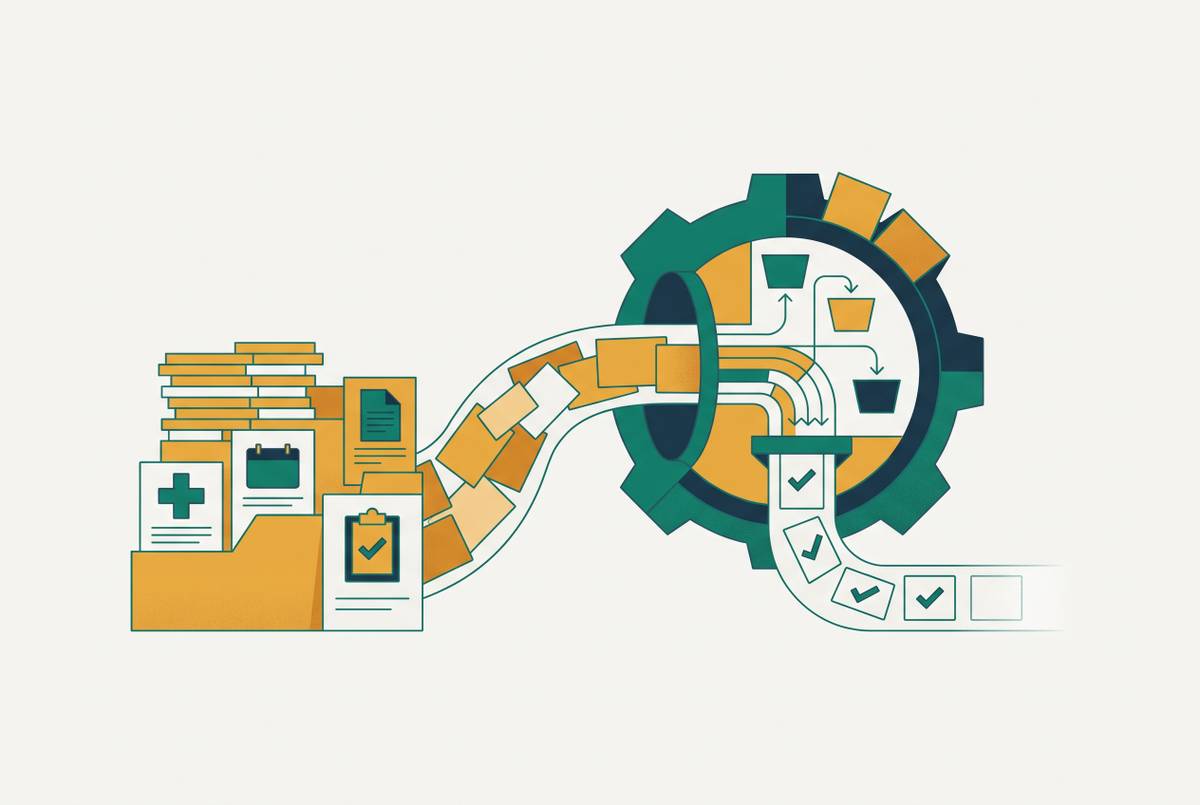
Look closely at what actually fills the after-hours MA queue and a pattern emerges fast: order entry cleanup, prior auth portal navigation, patient message routing, claim prep. All of it is high-volume, repeatable, rule-bound, and verifiable. That profile is exactly what computer-use AI agents are built to handle.
These agents work by reading the screen, clicking, typing, and moving across the EHR and payer portals the same way a staff member does, no API integration and no EHR replacement required. That matters specifically for the after-hours problem: an agent that can navigate a payer portal and finish a prior auth request removes the need for an MA to log back in at 9 p.m. to do it. The task either finishes inside business hours or runs overnight on its own and surfaces a result for review the next morning.
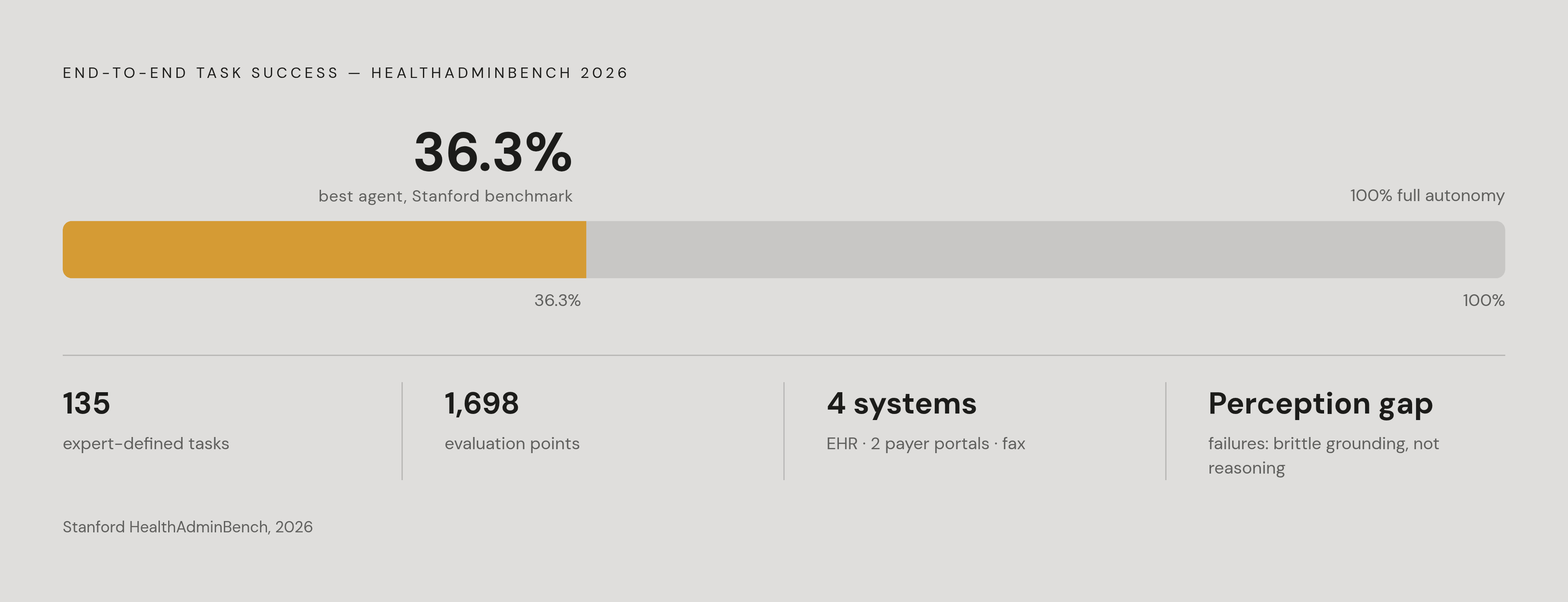
Stanford's HealthAdminBench, released in 2026, gives the first rigorous measurement of where these agents actually stand. It's a benchmark of 135 expert-defined tasks spanning an EHR, two payer portals, and a fax system, producing 1,698 evaluation points across prior authorization, appeals and denials management, and DME order processing. The best-performing agent hit 36.3% end-to-end task success, strong on individual subtasks but still unreliable across a full workflow without a human checking in along the way. Most of the failures traced back to brittle perception-action grounding and incomplete operational knowledge, not reasoning errors, which is an important distinction: it's a solvable engineering problem, not a hard ceiling on what the technology can do.
Practically, that gap means today's agents do best on well-defined, templated sub-workflows with human review built in at set checkpoints, which lines up neatly with the discrete, verifiable tasks that already make up the MA after-hours queue. The deployment detail that matters most: agents that go live without forcing staff to relearn their EHR setup, login structure, or daily routine add no new burden. MAs review outputs. They don't enter data twice.
Worth separating this from voice AI and scheduling chatbots, which handle one narrow slice of the problem, mostly call answering. Computer-use agents cover the fuller range of multi-system administrative work, order entry, portal navigation, PA prep, message routing, that actually generates the after-hours overflow in the first place. Microsoft's Healthcare Agent Orchestrator, unveiled at Microsoft Build 2025 and available through the Azure AI Foundry Agent Catalog, points to where enterprise deployment is headed: modular, specialized agents dividing up tasks that would otherwise eat hours of staff time.
What a realistic implementation path looks like for a practice ready to act
Start with an audit, not a purchase. Break the after-hours MA queue down by task type, documentation cleanup, PA portal work, message triage, order entry, before deciding which lever to pull. Different tasks call for different fixes, and skipping this step is how practices end up buying a tool that solves the wrong problem.
Second, protect time in the schedule for the work that genuinely needs human judgment. The JAMA Network Open model is a reasonable template: one protected slot per half day is the model the JAMA Network Open study used, not a guess.
Third, separate out the repeatable, multi-system data-transfer tasks that don't need clinical judgment at all. PA prep, portal navigation, order entry cleanup, claim data transfer: these are the agent candidates, the tasks where a computer-use agent can take over without anyone losing sleep over judgment calls.
Fourth, deploy agents against those tasks first, with MA review at defined checkpoints rather than full autonomy from day one. Start with templated workflows for the highest-volume task types, and measure against a specific number, after-hours login frequency, time-to-PA-completion, MA overtime hours, instead of chasing a vague promise of improvement.
Compliance is not optional and not a selling point either; it's the baseline. Any agent touching PHI needs to run on HIPAA-compliant, SOC 2 Type II-certified infrastructure, full stop, before anything else about the deployment gets evaluated. And practices shouldn't have to rip out their EHR to get any of this: agents that work across the systems already in place, EHR, payer portals, whatever third-party tools are already in the mix, deliver value without a disruptive system overhaul. Novoflow, for instance, deploys agents that operate across EHRs and payer portals without requiring any API integrations or changes to existing workflows.
Timeline matters more than it gets credit for. Practices that move from workflow audit to a live agent deployment in weeks, not months, can address the after-hours burden before the next hiring cycle even starts, and speed of deployment is itself a factor in how much overflow work MAs absorb while everyone waits for the "better" long-term fix. Success looks concrete and countable: after-hours MA logins drop, overtime hours shrink, PA turnaround gets shorter, and staff attention shifts away from data transfer and back toward the clinical presence that actually needed a human being in the first place.