Clinical Documentation Workflows in Epic Ambulatory
Practices thrive in Epic Ambulatory by respecting its structure, not fighting it.
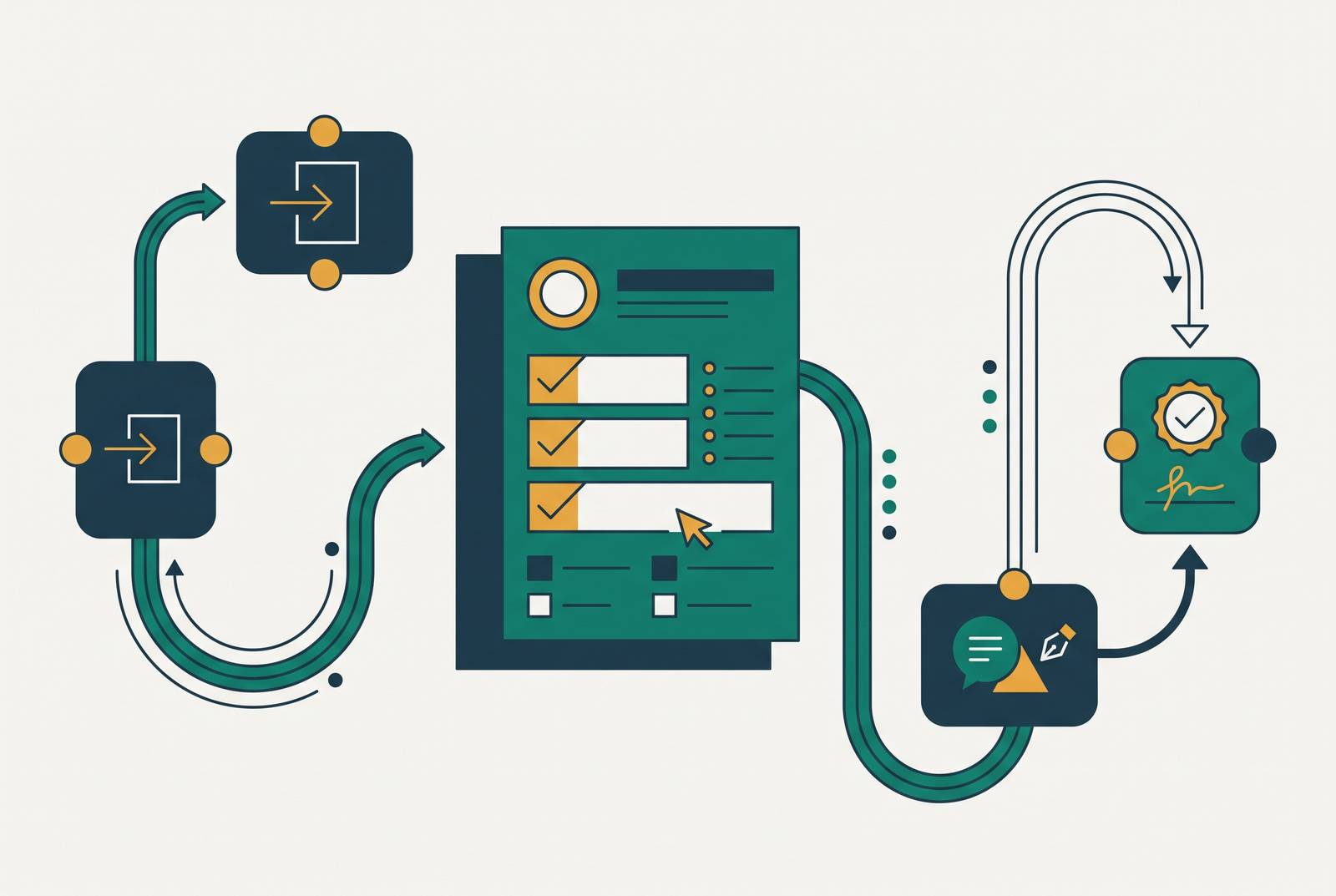
Epic Ambulatory runs on a rigid premise: nothing counts as documentation until it lives inside an encounter. Every workflow this piece covers, from rooming to charge capture, exists because Epic ties clinical work to that structure, and the practices that thrive inside Epic are the ones that respect the structure rather than fight it. Understanding the sequence, and where it stalls, is the difference between a practice that catches its own bottlenecks and one that discovers them three weeks later in a billing report.
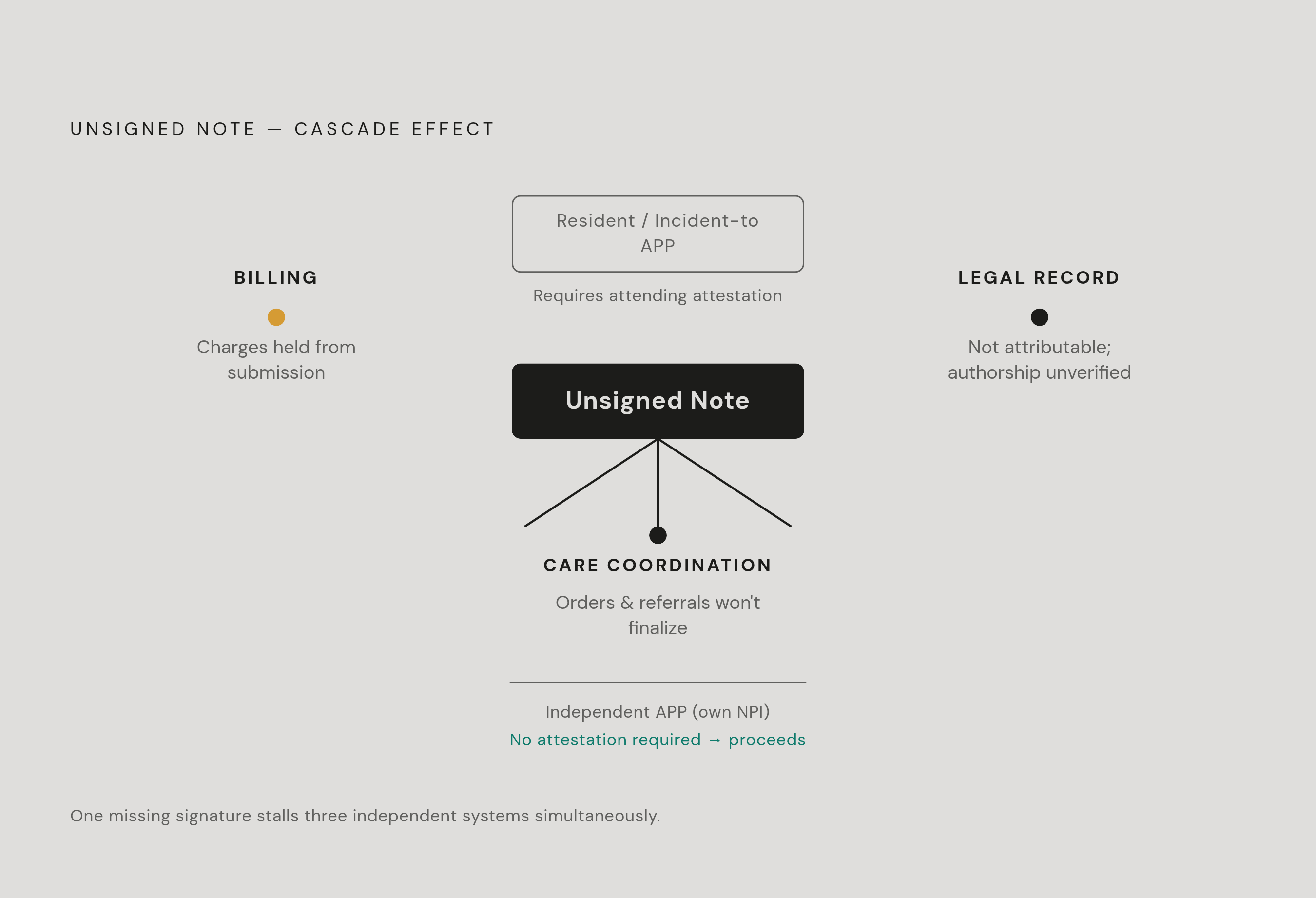
When a physician delays signing an encounter note in Epic Ambulatory, billing systems queue the charges but hold them from submission until the note is finalized, so every day the note sits unsigned is a day that claim sits unlaunched. Certain orders and referrals tied to that note also will not finalize or release downstream until the signature closes the encounter. From a medical-legal standpoint, the unsigned note may not constitute a finished, attributable record at all, meaning three separate systems, billing, the legal record, and care coordination, stall on the same missing signature. Practices that batch signing to the end of the week or let co-signature queues idle without a turnaround expectation are the ones who discover the compounded lag in a billing report weeks later rather than catching it in real time.
Epic Ambulatory is the outpatient-facing side of Epic's electronic health record, distinct from the inpatient environment most people picture when they hear "Epic." Documentation here means the structured capture of a visit: history, assessment, plan, and orders, all built around the scheduled or walk-in appointment that generated them. The encounter is the organizing unit, and the provider note is the artifact everything downstream depends on, billing, referrals, follow-up. Access is role-based on purpose; a medical assistant, a nurse, and a physician see and can act on different pieces of the same encounter, by design. A documentation delay almost never stays a physician's problem alone: it moves, showing up as billing lag, a stalled referral, or a patient message nobody answered.
How a patient encounter moves through documentation stages from rooming to note completion
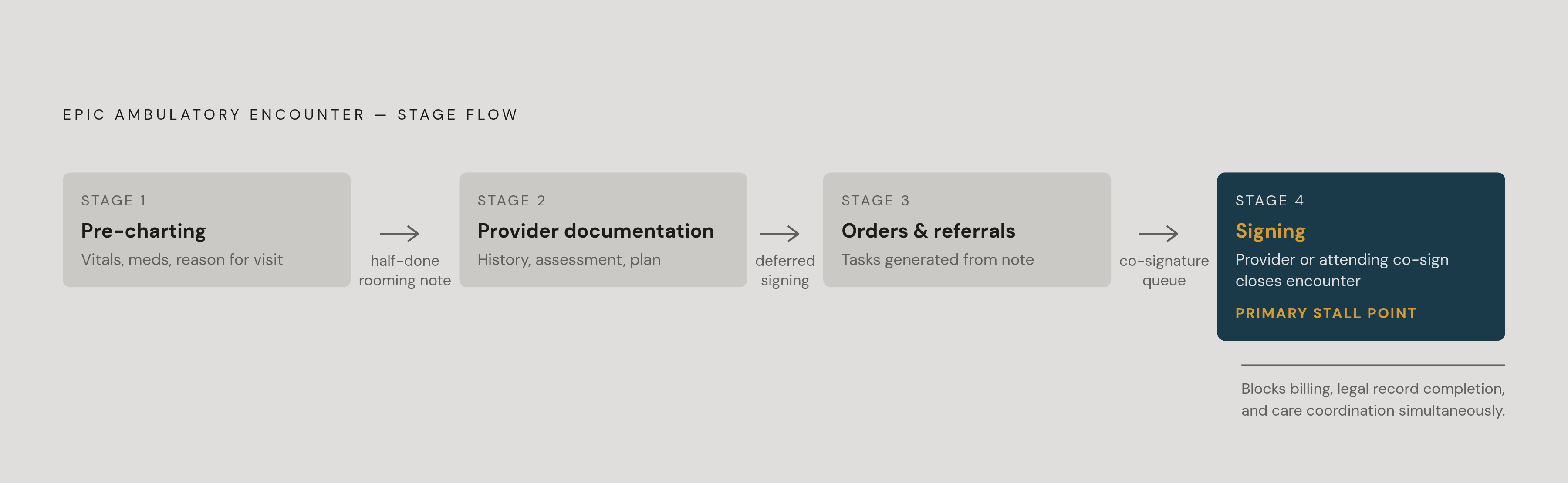
The first stage happens before the provider ever walks in. A medical assistant or nurse opens the encounter, records vitals, reconciles the medication list, and updates the reason for the visit. Call it pre-charting if it helps, but the label undersells what's happening: this step populates the sections the provider's note will build on, and if it's skipped or rushed, the provider inherits the gap, usually without knowing it's there until they're already mid-visit.
Stage two is provider documentation, during or right after the visit. The provider opens the note from the encounter, which already carries what staff filled in upstream. History of present illness, review of systems, assessment and plan: these sections are typically the provider's own work, though ambient documentation tools that turn spoken conversation into draft text are increasingly doing the first pass here. The tool changes; the underlying structure, encounter first, note second, stays the same.
From there, stage three generates the orders, referrals, and follow-up tasks that live inside the note. Stage four is signing, and it's the one that most often stalls. A note isn't complete for billing or legal purposes until the responsible provider signs it, and when residents, advanced practice providers, or scribes have authored part of it, a co-signature has to close the loop.
The handoff between each of these stages is where documentation burden actually piles up. A rooming note that sits half-done, a provider who defers signing until the end of the week, a co-signature waiting on an attending's schedule: these are the seams where delay lives, and they're visible to anyone who knows to look at the handoff rather than the task.
SmartText and SmartPhrases: how templated documentation works and where it breaks down
SmartPhrases are short text shortcuts, triggered by a dot command like ".hpi", that expand into pre-written blocks of text. Providers can build their own or use the defaults Epic ships with, and the payoff is real: high-frequency note elements, normal exam findings, standard counseling language, common diagnoses, get typed once and reused indefinitely.
SmartText is the longer-form version, a structured template with variable fields, called SmartLists, and free-text spots built in, so one template flexes across several versions of the same visit type. Specialty practices with highly repeatable visits, annual physicals, post-op checks, chronic disease follow-ups, lean on these heavily. SmartLists are the pick-list piece: instead of typing "normal cardiac exam," a provider selects it from a dropdown embedded in the template, which speeds the note along and keeps language consistent across providers.
The trouble starts with accumulation, and this is the part practices underestimate. Practices build SmartPhrases for years without pruning them, and the library ends up with three overlapping versions of the same normal-exam text, none of them retired, each slightly different from the last edit somebody made in 2019. Copy-forward is the more serious issue: a provider carries prior note content into a new encounter without actually re-reading it, and the result is a note that's technically complete and clinically stale. That's a compliance problem before it's an accuracy one, because a stale note that gets billed is a note that misrepresents what happened at the visit. System-default templates frequently don't fit a given specialty's documentation needs, which pushes customization work onto either the provider, who has no time for it, or IT, which has a queue.
None of this is exotic. It's the predictable output of a templating system used at scale without upkeep. A SmartText library needs the same periodic audit a chargemaster gets, and administrators who skip that audit are the ones who find the degradation in a chart review instead of before one.
In-Basket routing and how message-driven documentation creates its own workload
In-Basket is Epic's internal messaging and task hub, and it's where everything that isn't a scheduled encounter ends up: patient portal messages, lab and imaging results, refill requests, staff notes, referral responses, prior authorization tasks. Nearly every one of these requires some documentation response, not just a click. A lab result needs a review notation and often a message back to the patient. A refill request needs a clinical decision, and if it's denied, a documented reason. A portal message might require opening a telephone encounter just to have somewhere to record the response.
In-Basket volume is one of the most frequently cited sources of provider fatigue in outpatient practices, and the reason is structural: message-driven work has no visit slot, so it stacks up around the edges of the schedule instead of inside it.
Routing configuration is the lever that determines how badly this lands on providers, and most practices get the default setting wrong. Practices decide which message types go straight to a physician and which route to the care team first. A team-based model, where medical assistants or nurses triage and answer what's within their scope, cuts provider load meaningfully, but only if the protocols are actually written down and staff are trained against them. Skip that step and every message routes to the provider by default, regardless of whether it needed a physician's judgment at all. That default is inefficient on its own terms, and over time it's a real driver of burnout. The revenue cycle connection is direct, too: a prior authorization sitting in an In-Basket queue for four extra days is a claim that submits four days later.
What happens to billing and referrals when a physician delays closing an encounter note in Epic Ambulatory?
Epic tracks a note through a small set of states: in progress, pended, signed, and, where relevant, co-signed. "Pended" specifically means the provider has finished writing but hasn't finalized the note, sometimes because a pending lab result needs to close the encounter first, sometimes because the provider simply batches signing for later. Either way, the note sits open, and an open note is a note the rest of the system can't act on yet.
Billing systems typically queue charges but hold them from submission until the encounter is signed, so an unsigned note is billing lag waiting to compound across a busy week. From a medical-legal standpoint, an unsigned note may not count as a finished, attributable record at all. Some downstream Epic functions, certain orders and referrals among them, won't finalize or release until the note carrying them is signed. Three separate systems, billing, legal record, care coordination, all stall on the same missing signature.
Co-signature adds another layer. Resident notes under teaching physician rules, and some advanced practice provider notes billed incident-to, need an attending's co-signature or attestation before they're complete for billing purposes; independently credentialed advanced practice providers billing under their own NPI don't need that extra step. Practices that never set a clear turnaround expectation for co-signatures tend to find notes sitting unsigned for days, with nobody quite owning the delay.
The fix is rarely done despite being simple: track unsigned note age by provider. It's a measurable number, and practices that watch it and set expectations against it see a direct, traceable improvement in how fast charges actually go out. Epic's own Work List and reporting tools can surface these backlogs before they become a monthly surprise. The discipline is in checking them on a schedule.
How documentation connects to charge capture and why the link is fragile
Charge capture in Epic Ambulatory runs almost entirely off what's written in the encounter. Diagnosis codes come from the assessment section, while procedure codes get generated from orders or from charge entry tied to the visit. The E/M level, the complexity-based code that determines how an office visit gets billed, is increasingly suggested by Epic itself based on documented medical decision making or total time spent.
That chain breaks in a few predictable spots. A provider documents a service but doesn't tie it to the right diagnosis, which is a coding specificity problem more than a clinical one. A service happens but never gets written down anywhere, or gets logged in a telephone encounter that doesn't trigger the correct charge workflow at all. Copy-forward text, the same habit that stales out clinical accuracy, can also inflate documented complexity beyond what the visit actually involved. That's audit exposure, not sloppy writing; the two get treated the same by a payer.
The shift in E/M leveling away from history and exam checkboxes and toward medical decision making or time makes precise documentation of complexity more consequential than it used to be, and providers trained under the old rules can undercode or overcode without realizing the ground moved under them. Epic's charge reconciliation and coding work queues exist to catch the mismatch between what was documented and what was billed before the claim goes out the door. Using them proactively, ahead of any denial rather than as cleanup after one, is what makes documentation the first move in revenue cycle management.
Where administrative and AI-driven automation fits into these workflows without disrupting clinical operations
Look back across every bottleneck this piece has covered and a pattern shows up: In-Basket triage, SmartPhrase upkeep, unsigned note tracking, charge reconciliation. All of it is high-volume, rule-bound, and repetitive. That's precisely the kind of work automation handles well, because the decisions involved are narrow and the inputs are consistent. The scope is bounded: it supports clinical judgment rather than replacing it, and a vendor pitching it as a replacement for that judgment is selling the wrong thing.
Automation fits into In-Basket by sorting and categorizing messages so only the clinically complex ones land in front of a provider. It fits into note-building by pre-filling sections from data already sitting in the chart, vitals, prior diagnoses, current medications, before the provider even opens the encounter. It fits into signing workflows by flagging notes as they age past a set threshold and routing a reminder to the provider or supervisor. And it fits into charge capture by checking that documented diagnoses and procedures actually line up before a claim goes out, rather than after a denial comes back.
The constraint that matters most in an outpatient setting is that none of this can require ripping out or rebuilding how Epic already works. Practices, especially smaller ones without a dedicated IT team, don't have the appetite for a custom integration project, and shouldn't be sold one. Computer-using agents, tools that operate Epic's screens the way a staff member would rather than pulling data through an API, meet that constraint in a way API-dependent tools often can't. The EHR stays exactly as it is; the automation sits on top of it.
Before adopting any of it, an administrator should press on three plain questions rather than take a vendor's word for the answers. Does the tool change how clinical staff already work, or does it slot in underneath them? Does it meet HIPAA and SOC 2 Type II requirements without carving out exceptions to get there? And does it handle the messy cases, the ambiguous refill request, the half-finished rooming note, with the same reliability as a trained staff member, or only the clean ones used in the demo? The point of all of it is to strip the manual overhead out of each stage so providers spend their time on clinical judgment and administrators spend theirs running the practice, not chasing down unsigned notes and miscoded charges one at a time.